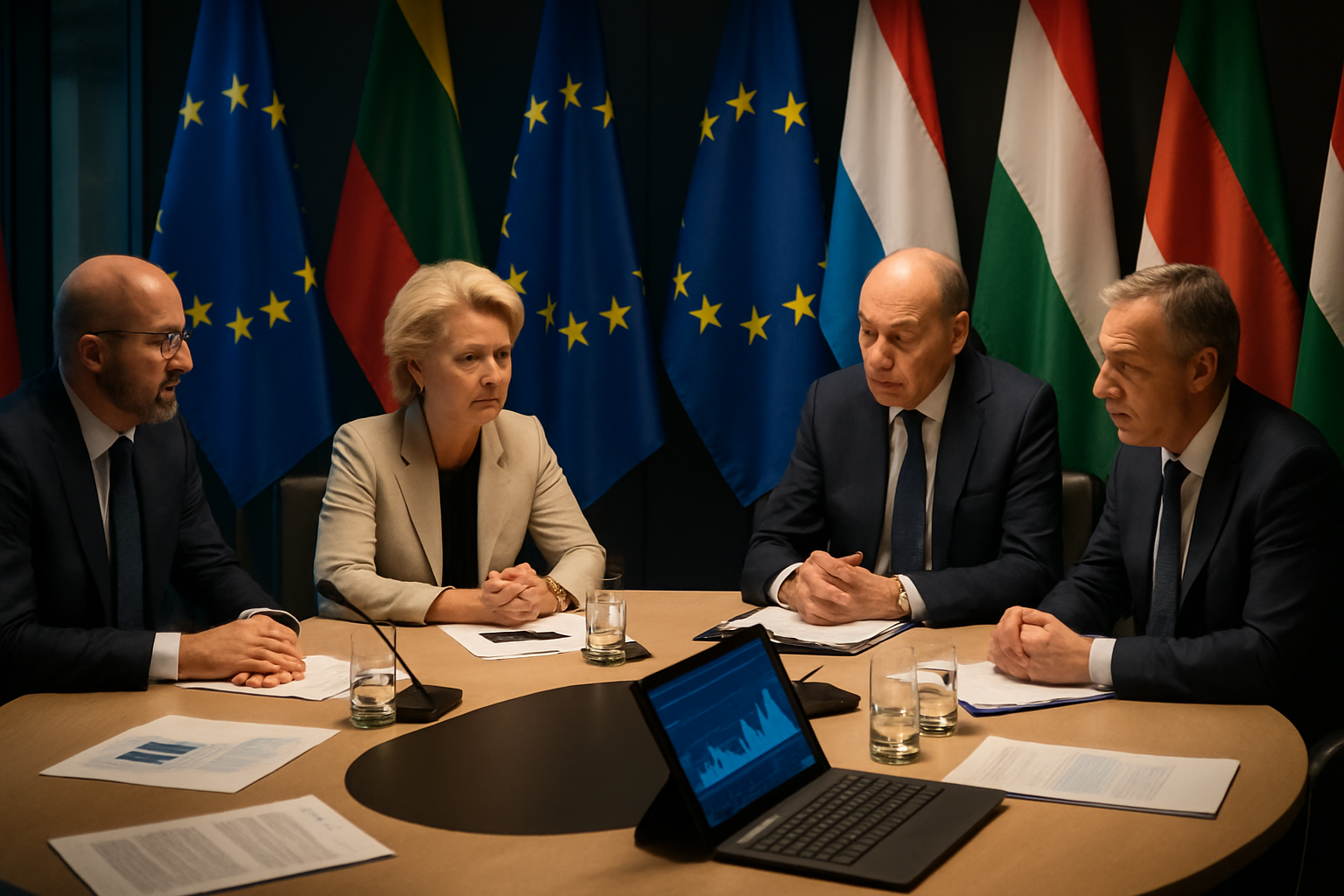
The European Union is implementing sweeping economic reforms under its "Buy European" initiative while simultaneously wrestling with fundamental questions about enlargement and trade policy, as the bloc seeks to strengthen its competitive position against China and reduce strategic dependencies.
Three major developments are reshaping the EU's economic and political landscape this week: the European Commission's controversial "Buy European" legislation designed to boost European competitiveness, heated debates over Ukraine's fast-track EU membership proposal, and the launch of a comprehensive "Made in Europe" strategy targeting Chinese industrial dominance.
Commission Pushes Controversial "Buy European" Policy
European Commission President Ursula von der Leyen is preparing to present legislation requiring EU member states to prioritize European goods and services in strategic sectors, despite significant opposition from several countries including Germany. The initiative represents the most ambitious European industrial policy in decades, aimed at reducing dependence on foreign suppliers and strengthening the bloc's economic sovereignty.
German sources describe the policy as "not uncontroversial," highlighting tensions between free-market principles and strategic autonomy objectives. The legislation would mandate preference for European-produced goods in critical areas including defense, energy infrastructure, and advanced manufacturing.
The timing of the proposal coincides with mounting concerns about China's dominance in critical supply chains. European auditors warn that China controls 60% of global critical materials production and 90% of refining capacity, creating "kill switch" vulnerabilities for European infrastructure. This dependency has been highlighted by the ongoing memory chip crisis, where prices have surged sixfold, affecting European technology competitiveness.
Ukraine Enlargement Debate Intensifies
The European Commission is simultaneously pursuing fundamental reforms to the EU enlargement process, with Ukraine President Volodymyr Zelenskyy expressing hopes for membership by 2027. However, Germany and other member states view these accelerated timelines with considerable skepticism.
The proposed enlargement reforms would allow candidate countries to join the EU before completing all accession negotiations—a dramatic departure from traditional procedures that require comprehensive reforms before membership. This "join first, negotiate later" approach has sparked intense debate about maintaining EU standards while addressing geopolitical pressures.
"Ukraine's ambition for 2027 membership reflects the extraordinary circumstances, but we must balance political urgency with institutional integrity."
— Senior EU Commission Official
Germany's resistance to rushed enlargement procedures reflects broader concerns about maintaining the EU's capacity for effective decision-making as the bloc expands. The country has consistently advocated for thorough preparation before membership, arguing that premature integration could weaken European institutions.
"Made in Europe" Strategy Targets Chinese Competition
The European Commission's "Made in Europe" strategy represents a coordinated response to increasing competition from Chinese manufacturers, particularly in high-technology sectors where European companies traditionally held advantages. The initiative combines the "Buy European" purchasing requirements with broader support for European industrial champions.
Recent Chinese breakthroughs in artificial intelligence and robotics have intensified European concerns about technological sovereignty. Chinese companies like DeepSeek have demonstrated capabilities in training advanced AI systems on restricted hardware, while Unitree Robotics has scaled humanoid robot production from 5,500 to 20,000 units, highlighting China's rapid industrial advancement.
European policymakers are particularly concerned about the automotive sector, where Chinese electric vehicle manufacturers are gaining significant market share. The "Made in Europe" strategy includes provisions for supporting European battery production and charging infrastructure to maintain competitiveness in the transition to electric mobility.
Trade Policy Adaptations
The EU's approach reflects lessons learned from recent trade disruptions and supply chain vulnerabilities exposed during the pandemic and subsequent geopolitical tensions. The bloc is moving away from pure free-market principles toward what officials describe as "strategic trade policy," balancing open markets with security considerations.
This shift comes as the EU navigates complex relationships with major trading partners. Recent Chinese concessions on dairy tariffs—reducing rates from 21.9%-42.7% to 7.4%-11.7%—demonstrate Beijing's willingness to make sector-specific trade arrangements while broader tensions persist.
Meanwhile, the EU continues to manage trade relationships with the United States amid policy uncertainty following recent Supreme Court challenges to American tariff policies. European officials emphasize the importance of multilateral trade frameworks versus bilateral arrangements.
Economic Context and Challenges
The ambitious policy initiatives come during a challenging economic period marked by persistent inflation pressures and energy security concerns. Estonia reported 3.2% consumer price inflation year-over-year in February, while Finland maintained relative stability at 1.8% harmonized inflation, highlighting divergent economic conditions across the eurozone.
Energy costs remain a central concern, with natural gas prices surging 24% across Europe and ongoing vulnerabilities in supply chains. The Druzhba pipeline disruption affecting Slovakia's oil supplies demonstrates the continued risks of energy dependency, particularly for Central European member states.
The European Central Bank has maintained its deposit rate at 2% while monitoring inflation trends across diverse eurozone economies. This monetary policy stance provides some fiscal space for member states to invest in the industrial transformation envisioned under the "Buy European" and "Made in Europe" initiatives.
Political Dynamics and Public Support
Despite policy complexity and internal disagreements, European public opinion shows strong support for greater EU integration. Recent Eurobarometer polling indicates that 89% of Europeans demand greater EU unity, while 86% want a stronger European voice in global affairs, providing democratic legitimacy for ambitious integration initiatives.
However, translating public support into concrete policy implementation faces significant challenges. The enhanced cooperation mechanism allowing groups of member states to proceed with policies without unanimous consent may become increasingly important for advancing controversial initiatives like the "Buy European" requirements.
Political tensions are evident in debates over burden-sharing and strategic priorities. Some Eastern European member states express concerns that new industrial policies could favor Western European manufacturers, while Mediterranean countries seek greater emphasis on digital transformation and innovation support.
Implementation Challenges and Timeline
The success of the EU's economic transformation agenda depends on overcoming substantial implementation challenges. The "Buy European" policy requires complex coordination across 27 member states with different industrial bases and trading relationships. Technical standards, certification processes, and procurement procedures must be harmonized while maintaining competitive markets.
The enlargement reform timeline faces even greater complexity, as constitutional changes in candidate countries must align with EU institutional adaptations. Ukraine's 2027 membership goal would require unprecedented coordination between military conflict resolution, democratic transition, and economic integration.
Financial resources present another major challenge. The "Made in Europe" strategy requires substantial investment in research and development, industrial capacity, and infrastructure modernization. EU officials are exploring innovative financing mechanisms, including green bonds and recovery fund extensions, to support the transformation.
International Implications
The EU's policy evolution reflects broader shifts in global economic governance, as major powers increasingly prioritize strategic autonomy over pure economic efficiency. The success or failure of European initiatives will influence similar approaches in other regions and affect global trade patterns.
China's response to European industrial policy will be crucial for determining whether the initiatives achieve their objectives or simply escalate trade tensions. Recent Chinese flexibility on dairy tariffs suggests Beijing recognizes the importance of maintaining constructive economic relationships with Europe despite strategic competition.
The United States is monitoring European developments closely, particularly regarding defense industrial cooperation and technology sharing arrangements. American policymakers are concerned that European strategic autonomy initiatives could reduce transatlantic economic integration and technological interoperability.
For candidate countries beyond Ukraine, the enlargement reform debate affects long-term European integration prospects. The Western Balkans, Moldova, and Georgia are watching closely to understand how procedural changes might accelerate or complicate their own EU membership aspirations.
The coming months will prove decisive for determining whether the European Union can successfully balance its multiple objectives of economic competitiveness, political enlargement, and strategic autonomy while maintaining internal cohesion and democratic governance principles.