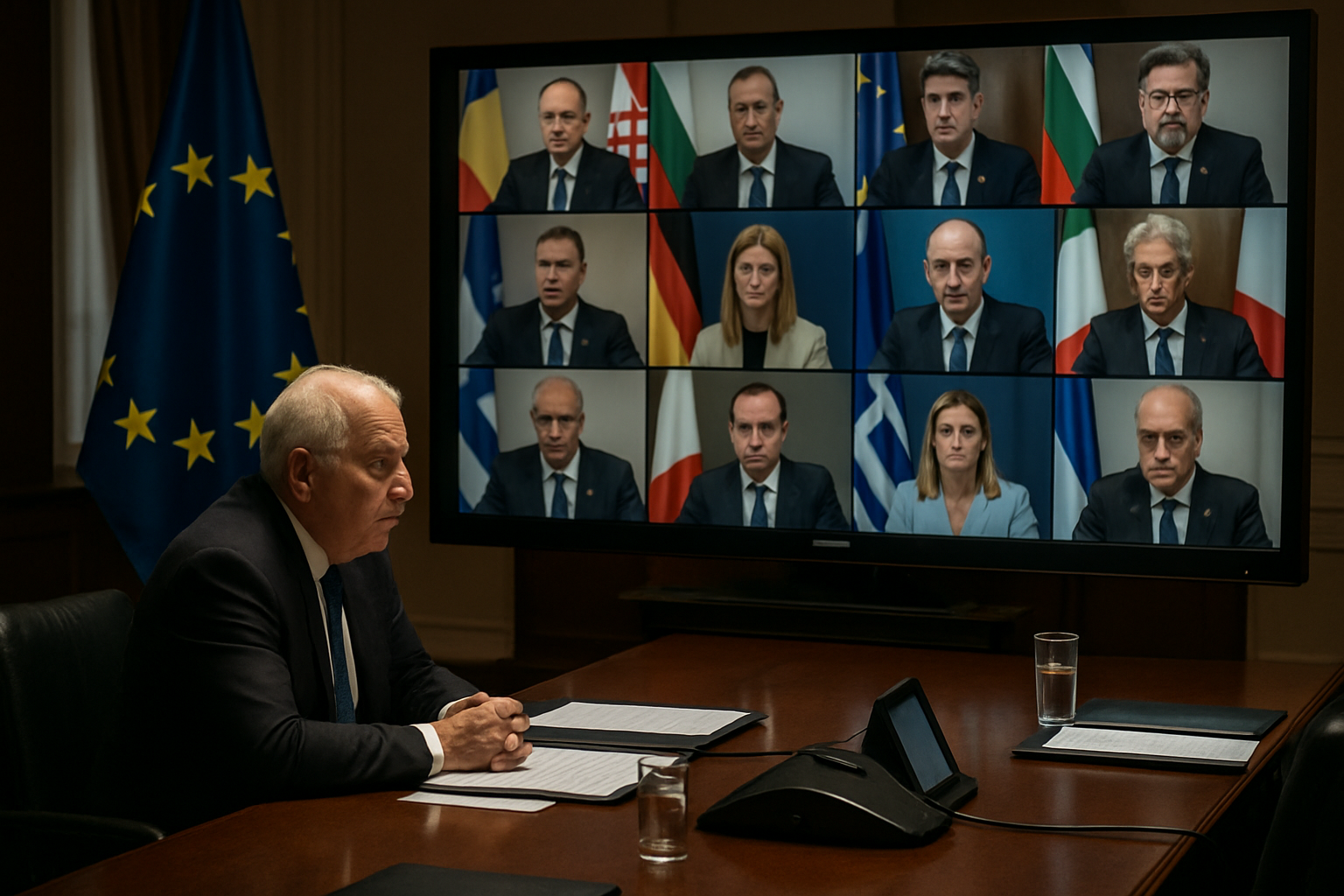
European Union foreign ministers held emergency video conferences on March 2, 2026, to coordinate a unified response to the dramatic escalation in the Middle East following the confirmed death of Iran's Supreme Leader Ali Khamenei and unprecedented regional retaliation strikes.
The emergency sessions, led by EU High Representative for Foreign Affairs Kaja Kallas, brought together the bloc's top diplomats as the crisis reached critical levels. The meetings followed Iran's massive "Operation True Promise 4" retaliation campaign against US facilities and Gulf allies after the largest coordinated US-Israeli military operation since the 2003 Iraq invasion.
Divided European Response to Military Escalation
European foreign ministers found themselves navigating a complex diplomatic landscape as they struggled to present a unified position on the unprecedented Middle Eastern crisis. While the EU issued joint statements calling for "maximum restraint," individual member states offered varying degrees of support for the US-Israeli "Operation Epic Fury" strikes.
According to German sources, EU foreign ministers "do not stand united behind the attacks on Iran, but want to respond together." The division reflects broader European concerns about unilateral military action potentially undermining ongoing diplomatic frameworks, even as they acknowledge Iran's nuclear program poses a legitimate security threat.
"We cannot become hostages to events unfolding at revolutionary pace while Europe reacts at bureaucratic speed."
— EU Diplomatic Source
The emergency response highlighted persistent tensions within the European Union regarding military intervention versus diplomatic engagement. While supporting non-proliferation objectives, several European leaders emphasized that conflict escalation represents an "extremely risky" approach to global stability.
Naval Mission Reinforcement and Security Measures
In response to maritime security threats emerging from the crisis, EU High Representative Kallas announced the reinforcement of the EU naval mission Aspides with additional ships. The decision reflects growing European concerns about commercial shipping protection in international waters and energy supply route security as Iran threatened to close the Strait of Hormuz, through which 40% of global oil transit passes.
The naval response demonstrates European recognition that the Iranian crisis extends far beyond regional boundaries, potentially affecting global energy markets and maritime security. Natural gas prices surged 24% in Europe amid concerns over supply chain disruptions and regional war risks.
Evacuation and Citizen Protection Measures
European governments activated comprehensive evacuation protocols as the crisis expanded across the Middle East. Sweden and Serbia ordered immediate evacuations of their citizens from Iran, citing "extremely uncertain" security conditions. Estonia advised its 3,000 nationals in the Middle East to contact authorities immediately for assistance.
Slovakia prepared emergency repatriation flights from Jordan, while Cyprus activated its national ESTIA evacuation plan for the first time since its establishment. The plan coordinates evacuation efforts for European and third-country nationals during regional emergencies, representing a significant test of European crisis response capabilities.
The activation of multiple national evacuation protocols simultaneously demonstrated both the scale of European civilian presence in the affected region and the coordination challenges facing EU member states during rapidly evolving crises.
Aviation Crisis and Economic Impact
The Middle Eastern airspace closures created unprecedented disruption for European aviation networks. Over 18,000 flights were cancelled worldwide as Iran, Iraq, Israel, UAE, Qatar, Syria, Kuwait, and Bahrain simultaneously closed their airspace - the most extensive aviation disruption since the COVID-19 pandemic.
Major European carriers, including Air France-KLM, Wizz Air, and Bulgaria Air, suspended operations to Middle Eastern destinations until at least March 7. The crisis particularly impacted Dubai International Airport, the world's busiest, which completely shut down after sustaining missile damage.
European passengers found themselves stranded across multiple continents, with hundreds of nationals waiting in airports from Dubai to Hong Kong. The aviation crisis highlighted Europe's dependence on Middle Eastern hub airports for connections to Asia, particularly problematic given existing Russian and Ukrainian airspace restrictions.
Diplomatic Framework Challenges
The crisis emerged despite significant diplomatic progress in Geneva nuclear talks, where Iranian Foreign Minister Abbas Araghchi had announced "broad agreement on guiding principles" - the most substantial diplomatic development since the JCPOA collapse in 2018. European diplomats had invested considerable political capital in supporting these negotiations through Swiss-Omani mediation.
The breakdown of diplomacy despite framework achievements raised fundamental questions about the viability of negotiated solutions in modern nuclear crises. European leaders now face the challenge of preventing further escalation while maintaining credible diplomatic alternatives to military confrontation.
"The collapse of negotiations despite unprecedented regional support demonstrates the fragility of modern crisis management in a multipolar era."
— Swedish Foreign Policy Expert
Nuclear Governance and Strategic Implications
The Iranian crisis occurs against the backdrop of a broader nuclear governance crisis, with the New START treaty having expired on February 5, marking the first time in over 50 years without US-Russia nuclear constraints. UN Secretary-General António Guterres has warned that nuclear risks are at their "highest levels in decades."
European officials view the Iranian situation as a template-setting moment for 21st-century diplomacy versus military confrontation. Success in containing the escalation could provide a framework for future nuclear crisis resolution, while failure may accelerate military solutions and reshape Middle Eastern geopolitics for decades.
The crisis tests European capabilities to contribute meaningfully to global security during a period when traditional alliance relationships face strain and multipolar competition intensifies.
Regional Coalition Under Strain
The unprecedented regional coalition of Saudi Arabia, UAE, Qatar, and Egypt that had backed diplomatic engagement found itself severely strained as Iranian retaliation targeted member territories directly. Egyptian President Abdel Fattah al-Sisi condemned attacks on "sisterly Arab countries," warning of "comprehensive chaos" spreading throughout the region.
European diplomats worked to maintain coordination with these regional partners, recognizing that Middle Eastern stability requires both European engagement and regional consensus. The challenge lies in supporting legitimate security concerns while preventing further military escalation.
Constitutional Crisis in Iran
Iran activated its constitutional succession protocols following confirmation of Supreme Leader Khamenei's death, establishing a three-member transitional council comprising President Masoud Pezeshkian, judiciary head Mohseni Ejei, and Guardian Council jurist Arafi. The Assembly of Experts, consisting of 88 clerics, will select a permanent successor during wartime conditions.
CIA assessments suggest a Revolutionary Guards member will likely be chosen as the next Supreme Leader, indicating continued hardline military influence in Iranian governance. This prospect complicates European hopes for diplomatic engagement with a potentially more moderate Iranian leadership.
Energy Security and Economic Concerns
European governments closely monitor energy market developments as Iran warned that shipping through the Strait of Hormuz would "not be allowed." The strategic waterway carries 40% of global oil transit, making any disruption a matter of international concern affecting global energy security.
Oil prices rose immediately following the Iranian threats, while natural gas increased by 24% in Europe. The crisis demonstrates how regional conflicts can rapidly affect global energy markets and European economic stability, reinforcing arguments for accelerated energy diversification strategies.
Looking Forward: Critical Decisions Ahead
European leaders now face critical decisions in the coming days and weeks that will determine whether the crisis can be contained as a regional confrontation or will escalate into broader Middle Eastern warfare with global implications. The EU's response will test the bloc's capacity for unified foreign policy action during one of the most dangerous international crises since the Cold War's end.
The stakes extend far beyond the immediate crisis, encompassing regional war prevention, global energy security, nuclear governance credibility, and international law enforcement mechanisms that underpin the post-World War II order. European success in contributing to crisis management could demonstrate the continent's relevance as a global security actor, while failure risks marginalizing European influence in future international developments.
As the situation continues to evolve rapidly, European foreign ministers must balance immediate crisis response with longer-term strategic considerations, working to prevent further escalation while maintaining credible diplomatic alternatives to military confrontation.