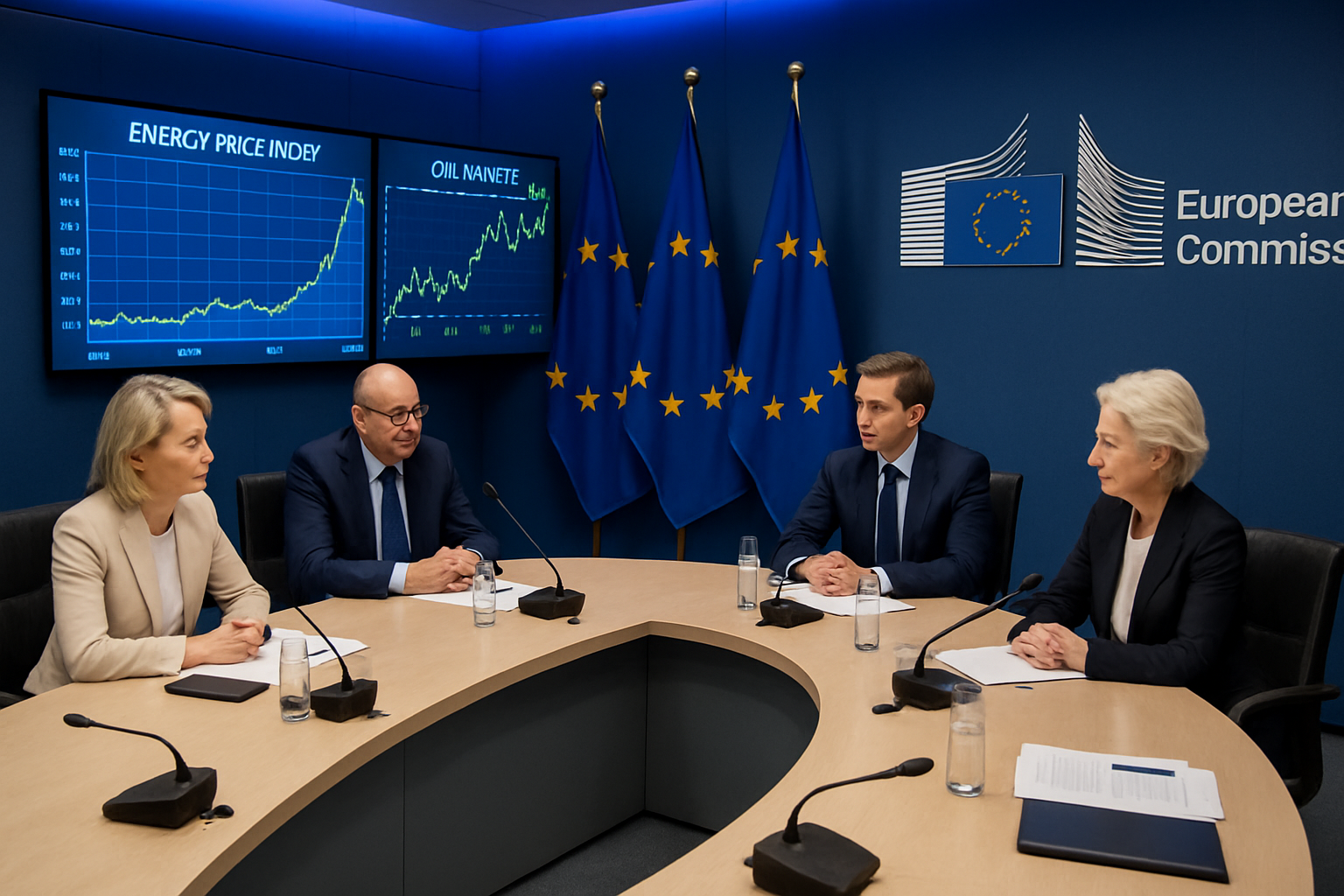
The European Commission is proposing a comprehensive package of consumer vouchers and emergency energy tools to help Europeans cope with soaring energy costs caused by ongoing Middle East conflicts, marking the most significant EU intervention in energy markets since the March 2026 crisis began.
The proposed measures come as member states report mounting pressure on households and businesses from sustained high energy prices following the Iran-led closure of the Strait of Hormuz, which has disrupted 40% of global oil transit since February. Belgium's inner cabinet has already approved an 80 million euro energy support package, with 60 million euros specifically targeted for commuter assistance over a three-month period from May to July.
Member State Emergency Responses
Across Europe, governments are implementing unprecedented emergency measures to shield consumers from energy price volatility. Germany has strengthened antitrust laws to prevent gas station price manipulation—representing the most significant market intervention in modern German energy policy. France has deployed 500 fuel station inspectors to prevent price exploitation, while Romania has outlined five emergency scenarios to prevent diesel from exceeding 10 lei per liter.
Hungary imposed immediate gasoline and diesel price caps to combat "war-driven explosions" in fuel costs, while Slovakia activated its strategic petroleum reserves for the first time under current protocols. These coordinated responses demonstrate a shift away from traditional free-market principles as governments prioritize consumer protection during the crisis.
IEA Historic Intervention
The International Energy Agency has deployed its largest strategic petroleum reserve release in 50 years—400 million barrels from 32 countries, more than double the 182.7 million barrels released during the 2022 Ukraine crisis. Japan has contributed 80 million barrels, marking its first strategic reserves deployment since the 2011 Fukushima disaster, despite the country's 95% dependence on Middle Eastern oil supplies.
"This represents the most severe energy security crisis in decades, exposing single-chokepoint vulnerabilities in our global energy architecture"
— Samuel Ciszuk, Energy Analyst
Consumer Impact Across the Bloc
The energy crisis is creating severe hardship for European consumers. Sweden faces electricity increases of 10-20 öre and gasoline price rises of 1-2 kronor, with the Malmö region most exposed due to continental integration. Ireland reports heating oil approaching €2 per liter in what officials describe as "brazen rip-offs," while Austria has seen fuel costs increase by 20%.
In more severely affected regions, Bosnia-Herzegovina has been reduced to just two days of gas reserves, while Malta would face 45% higher fuel prices without government subsidies. The crisis disproportionately affects lower-income households and essential workers who cannot reduce their energy consumption.
Aviation Industry Crisis
The energy emergency has created parallel disruption in European aviation. Over 18,000 flights have been cancelled worldwide—the worst disruption since COVID-19—with eight Middle Eastern countries maintaining simultaneous airspace closures. Jet fuel costs have surged 122% from $85-90 to $150-200 per barrel, forcing airlines to implement emergency surcharges.
IEA Director Fatih Birol has warned that Europe has "perhaps six weeks of jet fuel" before widespread flight cancellations become inevitable by early June, threatening the summer travel season. Major carriers including Emirates, Air France-KLM, and Wizz Air have suspended operations indefinitely.
Financial Market Disruption
The energy crisis has triggered severe financial market volatility globally. Pakistan's KSE-100 recorded its largest single-day decline in history at -8.97%, while South Korea's KOSPI fell 12% before circuit breakers activated. The Korean won has reached 17-year lows as foreign capital flees emerging markets.
European Central Bank and Bank of Japan coordination has provided emergency liquidity to prevent contagion, but traditional monetary policy tools have proven limited in addressing structural geopolitical disruptions to energy supplies.
Long-term Energy Transformation
The crisis has exposed fundamental vulnerabilities in Europe's energy architecture. Estonia, with 88% renewable electricity generation and Europe's largest battery storage capacity serving 90,000 households, represents a template for energy independence. However, such transitions require years or decades of sustained investment.
Energy experts warn that the 21-mile Strait of Hormuz represents a dangerous single-point failure in modern logistics with no realistic alternatives. Qatar's Energy Minister Saad Al Kaabi has warned that Gulf states may declare force majeure "within weeks" if oil approaches $150 per barrel, threatening to "bring down economies of the world."
Diplomatic Context
The current crisis stems from the complete breakdown of US-Iran nuclear negotiations despite achieving a Geneva "broad agreement on guiding principles"—the most progress since the 2018 JCPOA collapse. Iran maintained its ballistic missiles and regional proxies as "red lines" excluded from nuclear-only discussions, while the US demanded comprehensive coverage including missiles, armed groups, and human rights.
The diplomatic failure led to Operation Epic Fury, the largest US-Israeli coordinated operation since 2003, triggering Iranian retaliation through Operation True Promise 4. The New START treaty's expiration in February 2026 marked the first time in 50+ years without US-Russia nuclear constraints, creating a broader nuclear governance crisis.
European Unity Under Pressure
The crisis represents what UN Secretary-General António Guterres has called the "greatest test of multilateral cooperation and crisis management in the modern era." European coordination of national responses while balancing sovereignty with collective security needs provides a template for future energy governance approaches.
EU High Representative Kaja Kallas has activated unprecedented crisis management protocols, including state aid programs for energy-intensive industries, direct price compensation mechanisms, and accelerated discussions on green transition elements. The coordinated response demonstrates European institutional resilience under extreme pressure.
Recovery Timeline Uncertain
Unlike weather-related disruptions, recovery from this crisis depends on military and diplomatic developments with uncertain timelines. Aviation industries cannot engage in long-term scheduling while multiple airspaces remain closed, and energy markets remain volatile with critical transit routes blocked.
The crisis highlights the urgent need for fundamental energy architecture transformation to reduce dependence on volatile geopolitical regions and strategic chokepoints. While strategic petroleum reserves provide temporary relief, sustained disruptions require supply diversification and renewable transitions that need years to implement.
As European leaders accelerate energy independence infrastructure investments, renewable capacity expansion, and enhanced member state interconnections, the current crisis serves as a watershed moment determining whether diplomatic or military solutions will dominate 21st-century international relations. The implications extend far beyond energy policy, affecting regional conflict prevention, nuclear governance credibility, and international law enforcement mechanisms for decades to come.