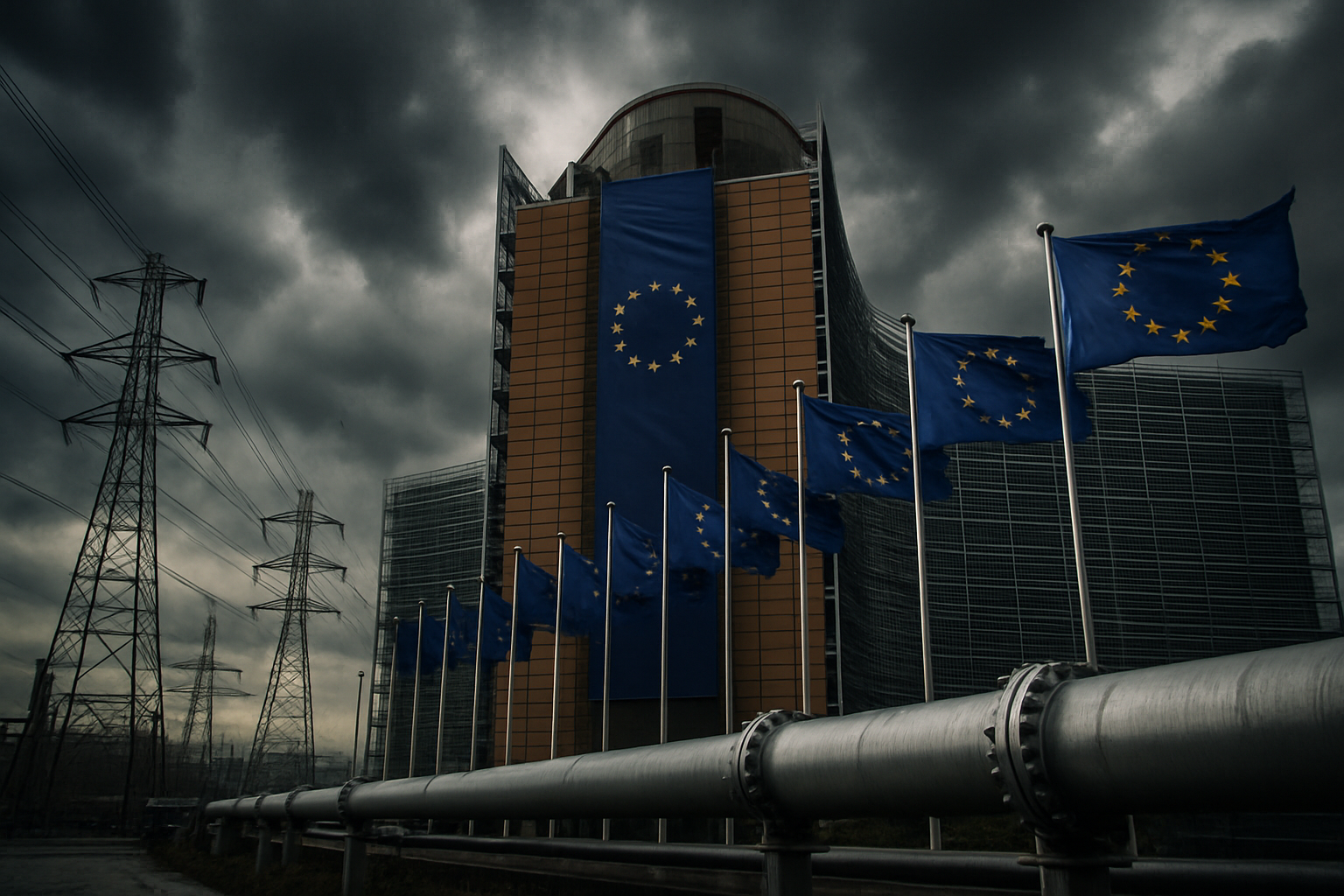
The European Union has issued urgent directives to all 27 member states to immediately maximize natural gas storage levels and prepare emergency energy protocols, as the escalating Middle East conflict threatens to create the most severe European energy crisis since the 1970s oil shocks.
According to multiple European sources, the European Commission has warned that the ongoing Iran-US-Israel war, which has effectively closed the Strait of Hormuz affecting 40% of global oil transit, could lead to catastrophic energy shortages across the continent as winter approaches. The commission's internal assessments suggest that without immediate action, several member states could face critical supply shortfalls within weeks.
Historical Context: March 2026 Energy Crisis
The current crisis stems directly from the March 2026 Middle East conflict that began with Operation Epic Fury, the largest coordinated US-Israeli military operation since 2003. The death of Iran's Supreme Leader Ali Khamenei on March 1, 2026, triggered a succession crisis that escalated into the most dangerous international confrontation since the Cold War.
Iran's Revolutionary Guard declared the Strait of Hormuz "unsafe for shipping" and deployed between 2,000-6,000 naval mines, effectively blocking the world's most critical energy chokepoint. The International Energy Agency (IEA) responded with the largest strategic petroleum reserves release in its 50-year history—400 million barrels from 32 countries—but this has proven insufficient to stabilize markets.
"We are facing the most severe energy security crisis since the 1970s oil shocks. The vulnerability of Europe's energy architecture has never been more exposed."
— Senior EU Energy Official
Immediate Impact on European Energy Markets
Natural gas prices have exploded by 24% across Europe, reaching €47.32/MWh—the highest levels since February 2025. The crisis has been compounded by Qatar's halt of LNG production at its Ras Laffan and Mesaid facilities, which account for approximately 20% of global LNG exports, following Iranian drone attacks on the installations.
The ripple effects are already being felt across member states. Sweden is predicting electricity increases of 10-20 öre per kWh and gasoline price jumps of 1-2 kronor per liter, with the Malmö region being most exposed due to its integration with continental European energy markets. Austria has reported fuel price increases of 20%, while Malta warned that fuel costs would be 45% higher without government subsidies.
Critical Infrastructure Vulnerabilities
The current crisis has exposed dangerous over-dependencies on strategic chokepoints that European policymakers had long warned about but failed to adequately address. The 21-mile Strait of Hormuz has proven to be a single point of failure for modern logistics, with no realistic alternative routes capable of handling the massive volume of energy shipments.
Major shipping companies Maersk and MSC have suspended all Persian Gulf operations, leaving over 150 oil and LNG tankers stranded with billions of dollars worth of cargo. This supply chain collapse affects not just energy, but consumer goods and industrial materials across Europe, demonstrating the interconnected nature of global trade networks.
Member State Emergency Responses
Individual EU countries have begun implementing unprecedented emergency measures reminiscent of wartime protocols:
- Hungary has implemented immediate price caps on gasoline and diesel to combat "war-driven price explosions"
- Slovakia has activated strategic petroleum reserves for the first time under current protocols
- Romania has outlined five scenarios to prevent diesel prices from exceeding 10 lei per liter
- France has deployed 500 fuel station inspectors to prevent price manipulation
- Cyprus has activated its ESTIA evacuation plan for the first time in EU history
The Estonian model has emerged as a potential template for energy independence. With 88% renewable electricity generation and Europe's largest battery storage capacity serving 90,000 households, Estonia represents what energy security could look like. However, experts warn that such transitions require years or decades to implement, leaving Europe vulnerable during this critical interim period.
Commission's Emergency Coordination
EU High Representative Kaja Kallas has activated emergency coordination protocols representing the most comprehensive crisis management response in the bloc's history. The measures include:
- State aid programs for energy-intensive industries
- Direct price compensation mechanisms for consumers
- Accelerated discussions on green transition elements
- Enhanced surveillance of fuel price manipulation
- Coordination with alternative suppliers, particularly Norway and Algeria
The Commission is also exploring alternative supply routes and has fast-tracked discussions on strategic energy reserves expansion. However, officials acknowledge these are temporary measures that cannot address the fundamental structural vulnerabilities exposed by the crisis.
"This crisis highlights the urgent need for fundamental restructuring of our energy architecture to reduce dependence on volatile geopolitical regions."
— Kaja Kallas, EU High Representative
Economic and Political Implications
The energy crisis is occurring against a backdrop of broader economic and political challenges across Europe. Heavy industry sectors are already reporting factory closures due to unviable energy costs, while small and medium enterprises lack the financial resources to weather sustained high energy prices.
The European Central Bank faces a complex balancing act, with traditional monetary policy tools proving limited in effectiveness against structural geopolitical disruptions. Financial markets have reflected these concerns, with major stock exchanges experiencing significant volatility and companies reassessing expansion plans.
Template-Setting Crisis Management
European officials recognize this crisis as a template-setting moment for 21st-century governance in a multipolar world. The rapid transition from diplomatic breakthrough—the February 2026 Geneva framework that achieved "broad agreement on guiding principles" between the US and Iran—to military confrontation demonstrates the fragility of modern crisis management mechanisms.
The stakes extend far beyond immediate energy security. Success in managing this crisis could provide a framework for future nuclear crisis resolution and strengthen diplomatic precedents. Failure, however, may accelerate a shift toward military solutions in international disputes, reshaping Middle Eastern geopolitics for decades while encouraging nuclear proliferation globally.
Long-term Energy Architecture Transformation
Beyond the immediate crisis response, European leaders are acknowledging that fundamental changes to energy policy are inevitable. The current situation has made clear that Europe's energy independence cannot wait for leisurely implementation of renewable transitions.
Key areas requiring immediate attention include:
- Enhanced interconnections between member state energy networks
- Massive expansion of storage facilities
- Diversification of supplier relationships beyond traditional sources
- Acceleration of renewable capacity expansion
- Development of strategic energy reserves at both national and EU levels
The crisis has also highlighted the importance of industrial competitiveness in energy policy. European manufacturers, particularly in automotive, steel, and chemical sectors, require predictable energy costs to maintain global competitiveness. The current volatility threatens not just immediate operations but long-term strategic planning.
Geopolitical Context and Recovery Timeline
Unlike natural disasters or technical disruptions, the current energy crisis depends entirely on military and diplomatic developments in the Middle East. Aviation networks cannot schedule around closed airspace, and energy markets remain volatile while critical transit routes are blocked.
The conflict represents what UN Secretary-General António Guterres has called "the greatest test of multilateral cooperation and crisis management in the modern era." The outcome will have implications extending decades beyond the current events, determining whether diplomatic or military solutions become the precedent for resolving 21st-century territorial and nuclear disputes.
Recovery timelines remain uncertain, with European officials privately acknowledging that even resolution of the Middle East conflict would require months to restore normal energy market function. The strategic petroleum reserves being deployed provide only temporary relief and cannot sustain extended disruptions.
Looking Ahead: European Unity Under Pressure
The energy crisis is testing European unity in ways not seen since the bloc's formation. The coordination required to manage strategic reserves, coordinate supplier relationships, and maintain economic stability while supporting affected industries represents an unprecedented challenge.
Member states with greater energy independence, such as Estonia with its renewable infrastructure, are being called upon to support more vulnerable neighbors. This solidarity will be crucial not just for managing the immediate crisis but for maintaining the social and political cohesion necessary for longer-term energy transformation.
As European leaders prepare for emergency summits in the coming weeks, the decisions made will determine not just Europe's energy security for the next winter, but the fundamental architecture of European integration for decades to come. The crisis has made clear that energy independence is not just an economic necessity but a matter of strategic sovereignty in an increasingly unstable world.
The European Commission's urgent call for member states to build energy reserves represents more than emergency crisis management—it marks a fundamental shift toward recognizing energy security as the cornerstone of European resilience in the 21st century.