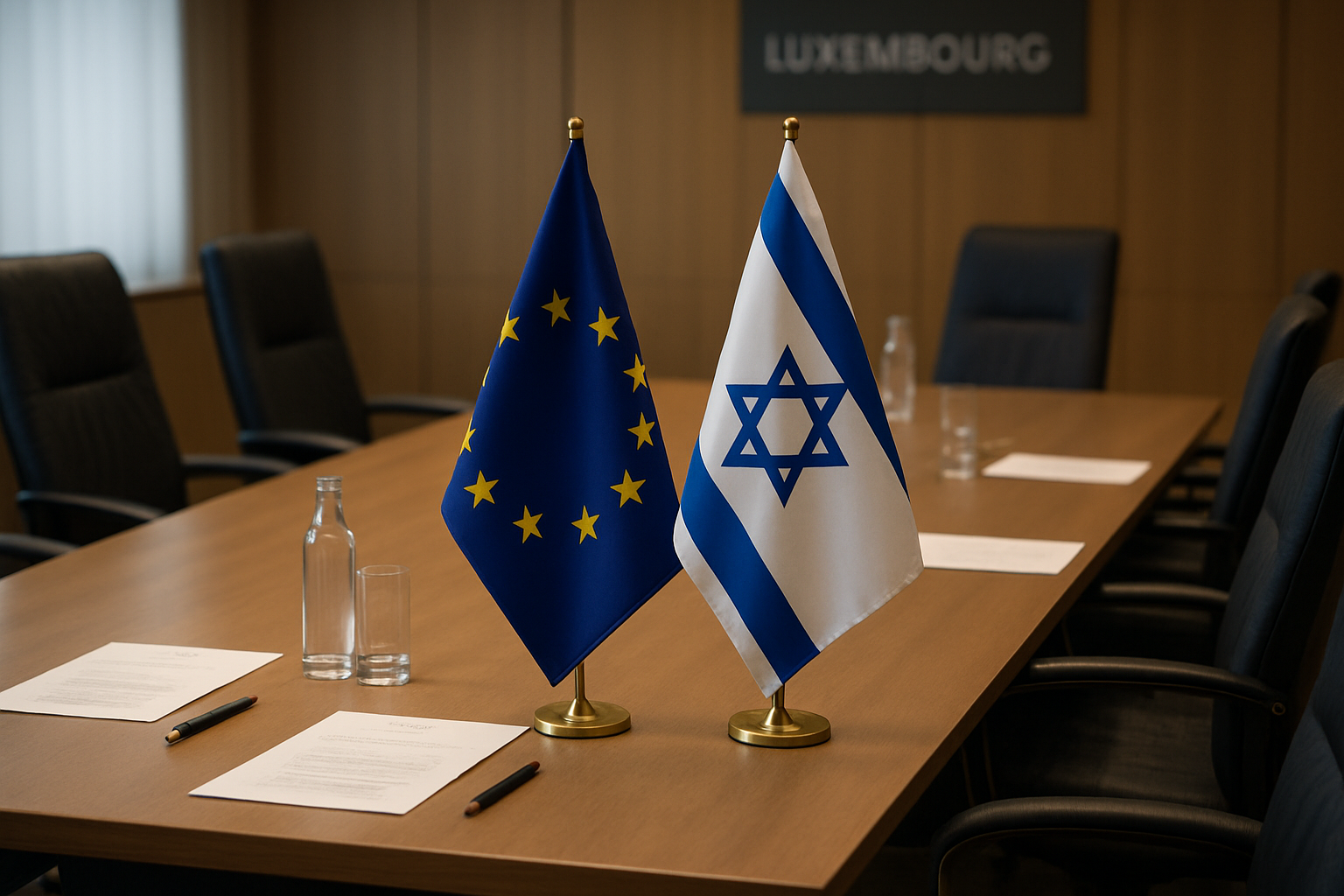
European countries including Spain and Ireland failed to secure sufficient support from EU member states to suspend the bloc's association agreement with Israel during Tuesday's foreign ministers' meeting in Luxembourg, exposing deep divisions within the union over its relationship with Israel.
The diplomatic confrontation highlights escalating tensions between European principles and geopolitical realities, as member states struggle to balance their stated commitment to human rights with strategic considerations in an increasingly volatile Middle East.
Spain's Moral Stand Meets German Resistance
Spanish Foreign Minister Jose Manuel Albares made an impassioned plea to his European colleagues, declaring "Today, Europe's credibility is at stake" as he called for suspension of the EU-Israel association agreement that has governed relations since 2000. The Spanish position, supported by Ireland, centered on concerns about Israeli settlements in the West Bank, the humanitarian situation in Gaza, and new death penalty legislation.
However, the initiative encountered immediate resistance from Germany and Italy, who blocked any formal action to suspend trade relations with Israel. This opposition effectively prevented the unanimous consent required for such a significant policy change, leaving European foreign policy chief Josep Borrell unable to advance the proposal beyond preliminary discussions.
The failure represents a significant setback for Spain's broader diplomatic campaign, which has seen Madrid permanently withdraw its ambassador from Israel in March 2026 and lead international condemnations of Israeli policies. Over 400 EU diplomats have previously demanded increased pressure on Israel, while a European Left Coalition petition has gathered over 400,000 signatures against EU-Israel partnerships.
Historical Context of European-Israeli Relations
The current crisis has deep roots in Spain's long-standing opposition to what it considers violations of international law. Spanish Prime Minister Pedro Sánchez has consistently invoked the 2003 Iraq War precedent, arguing that Europe must learn from past mistakes and avoid complicity in actions that breach international legal standards.
The EU-Israel Association Agreement, which came into force in 2000, contains a human rights clause explicitly linking the agreement to respect for human rights and democratic principles. This legal framework provides the foundation for Spain's suspension request, though implementing such action requires unanimous consent from all 27 member states.
France's diplomatic stance has evolved cautiously, with Foreign Ministry spokesman Pascal Confavre indicating that discussions on suspending the EU-Israel partnership agreement "cannot be excluded" alongside potential national sanctions. This represents a shift in French policy, traditionally more supportive of maintaining European-Israeli cooperation despite policy disagreements.
Italy's Recent Policy Shifts
Italy's position is particularly significant given Prime Minister Giorgia Meloni's recent decision in April 2026 to suspend her country's defense cooperation agreement with Israel, citing the Lebanon crisis and calling for US-Iran negotiations. While Italian officials described the defense memorandum as having "no practical repercussions," the symbolic significance of European nations distancing themselves from Israeli military cooperation cannot be understated.
The Italian move came amid an unprecedented humanitarian crisis affecting 1.2 million displaced Lebanese civilians—representing 25% of the population. The systematic targeting of medical facilities, including attacks that killed 26 paramedics since March, has prompted international condemnation and war crimes investigations.
German Strategic Calculations
Germany's opposition to the suspension reflects complex strategic calculations beyond historical ties to Israel. Berlin's position is informed by broader concerns about European strategic autonomy and the need to maintain stability in transatlantic relations during a period of unprecedented global tensions.
The German stance also reflects practical considerations about the effectiveness of economic sanctions versus diplomatic engagement. German officials have argued privately that suspension of trade agreements may be counterproductive, potentially reducing European influence over Israeli policy without achieving concrete improvements in Palestinian conditions.
The Broader European Dilemma
The failed suspension attempt highlights fundamental tensions within European foreign policy between values-based diplomacy and strategic pragmatism. While 89% of Europeans demand greater EU unity according to recent Eurobarometer polling, the reality shows increasing fragmentation over how to respond to international crises.
This division extends beyond the Israeli question to broader challenges facing European strategic autonomy. The EU has struggled to develop coherent responses to various international crises, from the ongoing Middle East conflicts to the war in Ukraine, often finding itself caught between American pressure and its own declared principles.
"The European Union cannot become a bystander to violations of international law while claiming to champion human rights globally."
— Jose Manuel Albares, Spanish Foreign Minister
Economic and Strategic Implications
The EU-Israel Association Agreement encompasses far more than simple trade relations, covering political dialogue, cooperation in energy, environment, and science. Israel remains an important technology and innovation partner for European industries, particularly in cybersecurity, defense technology, and agricultural innovation.
Disruption of these relationships could affect European competitiveness in critical technology sectors, a consideration that weighs heavily in German and Italian calculations. The timing is particularly challenging given Europe's energy security concerns, supply chain vulnerabilities, and need for technological partnerships in an increasingly competitive global environment.
However, Spanish officials argue that maintaining economic relationships while ignoring systematic violations of international law undermines European credibility and moral authority in global affairs. This tension between economic interests and ethical principles represents one of the defining challenges of 21st-century European diplomacy.
Looking Ahead: Enhanced Cooperation vs. Fragmentation
The failure to achieve consensus on Israel policy raises questions about the future of EU foreign policy coordination. Some member states are exploring enhanced cooperation mechanisms that would allow smaller groups to advance policies without requiring unanimity from all 27 members.
Such arrangements have already been used successfully in other policy areas, including the recent European Parliament approval of deportation to "safe" third countries through center-right and far-right alliances. However, applying enhanced cooperation to fundamental foreign policy questions could further fragment European unity.
The Israel debate also occurs within the broader context of European discussions about strategic autonomy. Recent crises, including the US-Spain diplomatic confrontation over military base access for Iran operations, have accelerated European conversations about developing independent foreign policy capabilities.
International Reactions and Future Prospects
International observers are watching European approaches to the Israel question as a template for how democratic partnerships navigate security dilemmas in the 21st century while maintaining adherence to international law. The outcome will influence how other democratic nations balance security partnerships with human rights considerations.
The European response also has implications for broader Middle East policy, particularly as the region faces unprecedented challenges including the ongoing Iran crisis, Lebanese humanitarian catastrophe, and questions about the future of nuclear diplomacy.
Despite Tuesday's failure, Spanish officials indicated they would continue pressing for action, potentially through alternative mechanisms or renewed efforts to build broader consensus. The debate reflects deeper questions about European identity and values that will continue to shape EU foreign policy for years to come.
As Europe faces an increasingly volatile international environment, the tension between maintaining strategic partnerships and upholding declared principles will only intensify. The Israel debate represents a critical test of whether European institutions can adapt to these challenges while preserving the unity and credibility necessary for effective international leadership.