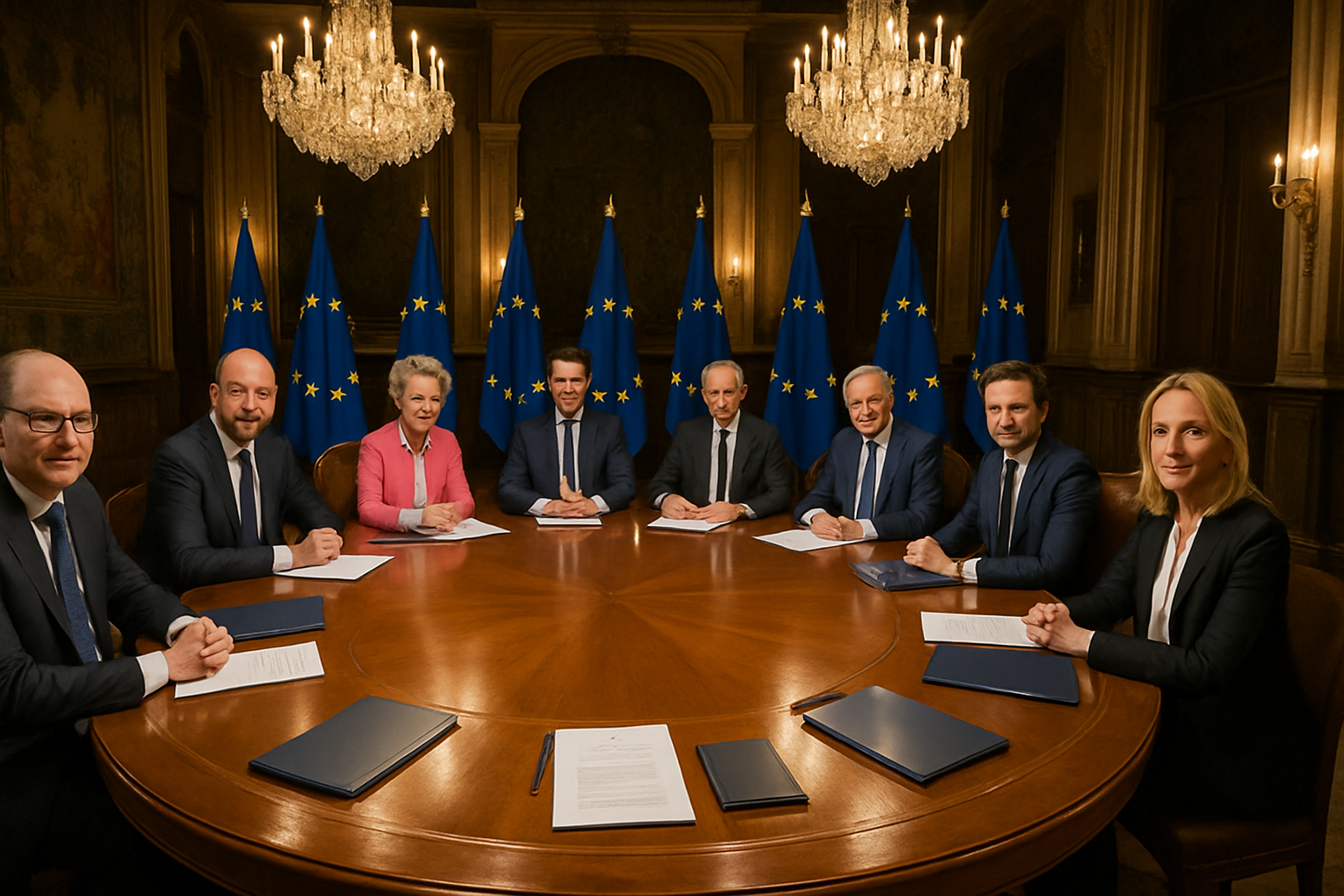
European Union leaders reached unprecedented agreement Thursday on wide-ranging reforms to accelerate the single market and enhance economic competitiveness, responding to mounting pressure from aggressive trade policies by the United States and China at an emergency summit held in Belgium's historic Alden Biesen castle.
The informal European Council summit, described as urgent by multiple leaders, produced commitments to speed completion of the savings and investment union, review merger rules to create European champions, streamline business operations, and eliminate bureaucratic barriers across the 27-member bloc. The gathering represented the most significant EU competitiveness initiative since the bloc's formation.
"One Europe one market… this is our ambition," declared European Commission President Ursula von der Leyen following the summit. She emphasized that the EU executive would crack down on additional legislative layers that member states often add when implementing EU decisions, a practice that has fragmented the single market's effectiveness.
Economic Warfare Backdrop
The summit convened against the backdrop of unprecedented economic challenges. China maintains control over 60% of global critical materials production and 90% of refining capacity, creating what officials described as "kill switch" vulnerabilities for European infrastructure. Memory prices have surged sixfold, affecting European technology competitiveness against Samsung, SK Hynix, and Micron, with shortages expected until 2027.
Simultaneously, the Trump administration has pursued bilateral trade deals that bypass EU frameworks, including agreements with Argentina eliminating 1,600+ tariffs and India reducing duties from 50% to 18%. These bilateral approaches demonstrate American preference for country-by-country negotiations over multilateral EU engagement.
European Parliament President Roberta Metsola warned that "margins are narrowing" and stressed the need for "bold moves for strengthening competitiveness." Recent Eurobarometer polling identified housing costs as the top EU concern, while 89% of Europeans demand greater EU unity and 86% want a stronger global voice.
Comprehensive Reform Package
The leaders agreed to several key measures designed to eliminate internal barriers while protecting European interests. A preference for purchasing European goods will be allowed in strategic sectors, von der Leyen announced. The package includes enhanced European enforcement powers and authorization for state settlement land purchases in critical areas.
Finnish sources confirmed that EU leaders promised to dismantle home market barriers, while Swedish officials emphasized the strategy should be implemented by 2027. Council President António Costa described the castle discussions as "excellent," stating they fundamentally concern strengthening the union "in a threatening and unpredictable world."
Romania reported that the 27 member states committed to applying reforms "to restore economic competitiveness that can better withstand pressures from China and the United States." The leaders expressed sharing "the same sense of urgency" and emphasized the need to "act immediately and accelerate."
Internal Tensions and Diplomatic Friction
Despite the unified final outcome, the summit faced significant internal challenges. Spain criticized a pre-meeting organized by Germany, Italy, and Belgium, arguing it undermined basic EU principles by attempting to predetermine political directions before the full summit. This friction highlighted ongoing tensions over economic leadership within the European Union.
Italian media reported that French President Macron and German Chancellor Merz arrived together at the castle but later disagreed over eurobonds, demonstrating the complex negotiations required to reach consensus among diverse national interests.
Greek sources confirmed the informal summit concluded with emphasis on competitiveness and simplification, while Cyprus noted the wide-ranging commitments to improve the bloc's border-free internal market functionality.
Digital Sovereignty Push
The competitiveness discussions intersected with ongoing European digital independence efforts. Spain is implementing the world's first criminal executive liability framework for tech platforms, while France has escalated enforcement through cybercrime raids on social media platforms. The European Commission's TikTok investigation found Digital Services Act violations with potential penalties reaching billions.
Slovakia's €1.3 billion digital euro pilot project advances European monetary independence from US payment systems, while concerns about American cloud service dependency drive Swedish reports highlighting Europe's strategic vulnerabilities.
Strategic Timeline and Implementation
Von der Leyen promised to present the complete agenda for implementation by March 2027, creating a compressed timeline for what she described as dramatic policy transformations. The urgency reflects external pressures, including upcoming geopolitical settlements with June deadlines for major international negotiations.
The summit's success in achieving consensus demonstrates European determination to maintain economic sovereignty amid authoritarian competition. However, implementation challenges remain significant, requiring coordination across 27 democratic systems while preserving democratic governance principles.
The February 12 Alden Biesen summit may determine whether European leaders choose gradual institutional evolution or rapid transformation necessary for 21st-century competitive survival. Stakes include the future of global democratic governance amid unprecedented technological and geopolitical change.
Economic and Strategic Implications
The agreements position Europe to establish itself as a third pole in global economic competition, contrasting with potential subordination to US-China systems. Success requires balancing immediate crisis responses with long-term structural reforms while maintaining democratic accountability.
The summit represents a test of whether democratic societies can maintain economic sovereignty while competing with authoritarian systems. The outcome will influence global economic architecture, potentially establishing templates for democratic coordination in an increasingly multipolar world.
With January 2026 marking the 18th consecutive month exceeding 1.5°C above pre-industrial levels, the competitiveness measures also address climate urgency through green technology development and sustainable economic transformation within the enhanced single market framework.