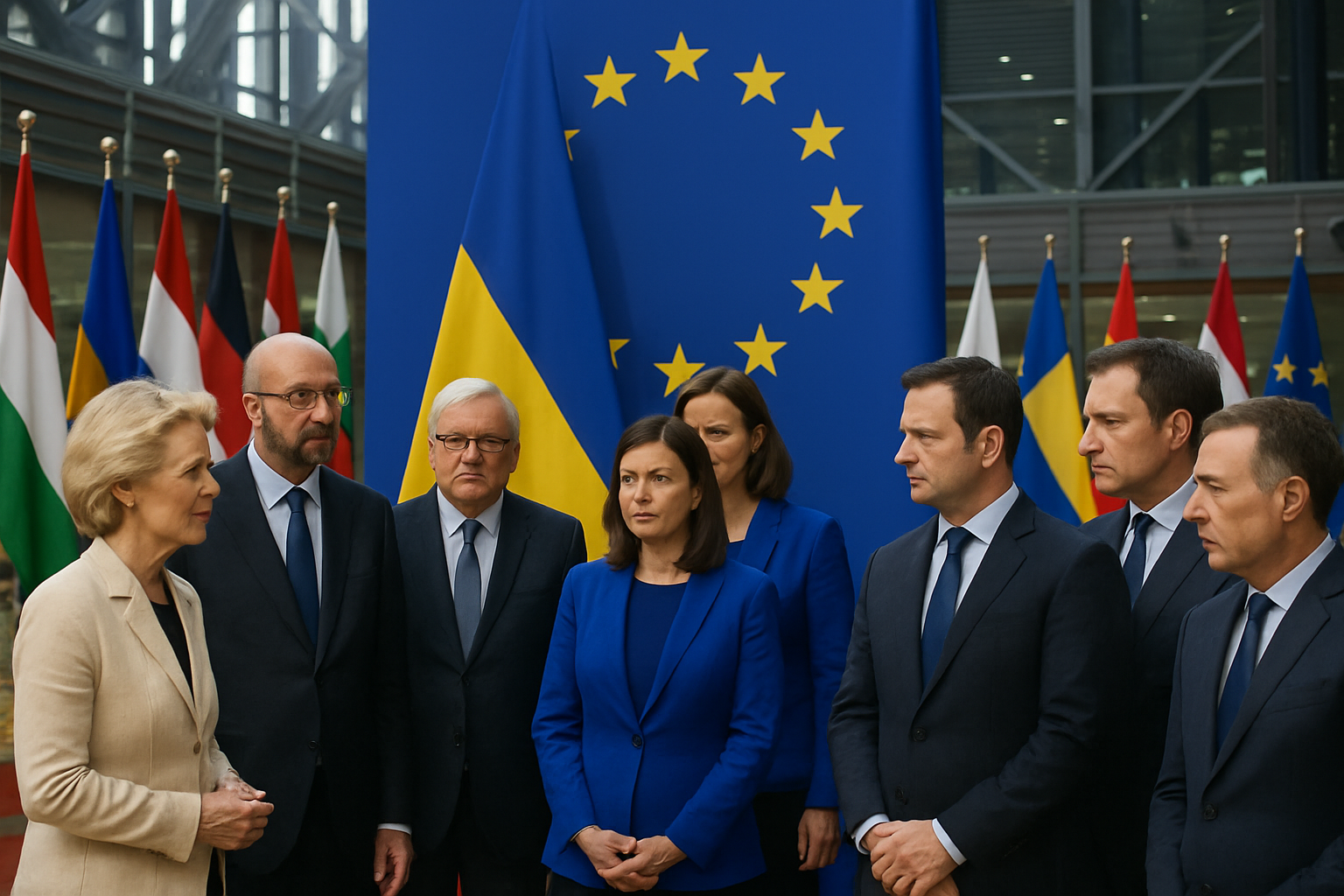
European Union leaders traveled to Kyiv on February 24, 2026, to mark the fourth anniversary of Russia's full-scale invasion with renewed pledges of financial and military support, as Ukraine navigates the most significant diplomatic opportunity since the conflict began alongside continued military escalation.
European Commission President Ursula von der Leyen, European Council President António Costa, and several EU prime ministers made a solidarity visit to the Ukrainian capital, expressing outrage over Hungarian Prime Minister Viktor Orbán's persistent blockade of the historic €90 billion aid package. The visit came as Ukraine faces massive Russian infrastructure attacks and participates in unprecedented diplomatic breakthroughs that have restored hope for a peaceful resolution.
Historic Financial Support Despite Internal Divisions
The EU's €90 billion loan package represents the largest single-nation assistance program in European Union history, covering defense procurement and civilian reconstruction over the 2026-2027 period. The European Parliament approved the package with a decisive 458-140-44 vote, demonstrating broad European commitment despite significant internal resistance.
"This is precisely the signal that must be sent to the aggressor. Russia will ultimately be responsible for reimbursement."
— President Volodymyr Zelensky
However, the package faces critical obstacles from Hungary, Slovakia, and the Czech Republic, which refuse to participate in financing despite broad European support. Hungarian Foreign Minister Péter Szijjártó announced Budapest would block the loan until Ukraine restores Russian oil transit through the Druzhba pipeline, creating the deepest European divisions since the conflict began.
The pipeline crisis has forced Slovakia to declare an oil emergency and release 250,000 tons of strategic reserves, while Croatia negotiates alternative Mediterranean routes. This dispute exposes continued vulnerabilities to Russian energy leverage despite extensive diversification efforts.
Military Assistance Scales Up Across Member States
Individual EU member states have significantly expanded their military support commitments as the conflict enters its fifth year. Estonia announced an €11 million military assistance package specifically for air defense weapons and ammunition, announced by Prime Minister Kristen Michal during his visit to Kyiv on the anniversary.
Latvia's government approved €1.88 million to support Ukraine's energy and military sectors, continuing the pattern of Baltic states leading European military assistance efforts. Sweden and Denmark jointly committed €246 million for advanced Tridon Mk2 air defense systems, while Germany has provided 35 Patriot missiles through the Ramstein coordination framework.
Portugal announced additional military aid and energy support packages, with Commission President von der Leyen promising a priority package of drones and ammunition to be delivered by Easter. This tactical support comes as Ukraine faces accelerating Russian territorial gains, with Moscow capturing 481 square kilometers in January 2026 compared to 260 square kilometers in December 2025.
Diplomatic Breakthrough Creates Peace Momentum
The EU support announcements occur against the backdrop of unprecedented diplomatic progress following successful trilateral negotiations in Abu Dhabi, Geneva, and planned talks in Washington. The February breakthrough achieved a historic 314-prisoner exchange—the first in five months—and restored US-Russia military communications after a four-year suspension.
Ukrainian Defense Minister Rustem Umerov described the Geneva talks on February 17-18 as achieving "significant progress" on ceasefire monitoring mechanisms, though territorial disputes remain unresolved. European "Big 5" observers from Germany, France, Italy, the UK, and Poland participated for the first time, adding institutional weight to the diplomatic process.
The Trump administration has established a June 2026 deadline for comprehensive peace negotiations, with talks potentially moving to Washington for presidential-level engagement. This timeline creates unprecedented pressure for territorial compromise innovation, as eastern Ukrainian territories under Russian control remain the fundamental sticking point.
Nuclear Crisis Adds Urgency
The diplomatic efforts unfold against the alarming backdrop of the New START treaty's expiration on February 5, 2026—the first time in over 50 years that the United States and Russia operate without nuclear constraints. Both nations control 80% of global nuclear weapons, with Russia possessing 4,380 warheads and the US maintaining 3,708.
UN Secretary-General António Guterres has warned of a "grave turning point" with nuclear risks at their "highest in decades." The restoration of US-Russia military communications through the diplomatic process now represents the only remaining formal channel between the nuclear superpowers, including crucial deconfliction protocols for operations in Syria, the Arctic, and Africa.
Systematic Civilian Targeting Continues
Despite diplomatic progress, Russia has intensified its "energy terrorism" strategy, targeting civilian infrastructure during extreme winter conditions. Over 1,170 Kyiv buildings remain without heating during minus-30°C temperatures, while Ukrainian nuclear plants were forced to halt electricity production for the first time in the conflict.
The systematic targeting extends beyond infrastructure to direct civilian casualties. The February 11 Bohodukhiv drone strike killed four civilians, including three children aged one and two years old, plus their father—the second deadly attack on the same town within three days. President Zelensky has disclosed that 55,000 Ukrainian soldiers have been officially confirmed killed, with a "large number" still missing in action.
"The EU will grant Ukraine the promised €90 billion loan one way or another. We have various options at our disposal."
— Ursula von der Leyen, European Commission President
European Unity Under Pressure
The crisis has exposed fundamental tensions within the European Union between national sovereignty and collective action during wartime. While 89% of Europeans demand greater EU unity according to Eurobarometer polling, Hungary's veto threats demonstrate how individual member states can leverage unanimity requirements to pursue independent policies.
Lithuania's Foreign Minister Kestutis Budrys declared that "the EU cannot become Budapest's hostage," reflecting growing frustration with Hungary's blocking tactics. The crisis has accelerated discussions about "enhanced cooperation" mechanisms that would allow willing member states to proceed without unanimity, representing a potential fundamental shift in EU decision-making processes.
Romanian officials have emphasized the necessity of EU internal defense production capabilities, while agricultural commissioners warn of food security implications as hybrid warfare tactics expand. The crisis tests European integration principles against individual member state interests during the continent's most serious security challenge since World War II.
Looking Toward June Negotiations
The combination of renewed EU financial commitments, expanded military assistance, and diplomatic momentum creates a critical moment for the conflict's potential resolution. European Council President Costa emphasized that peace efforts must be based on UN Charter principles, stating that "Russia cannot dictate terms or gain an advantage at the negotiating table while suffering significant losses on the battlefield."
However, the EU has announced it will not participate in Trump's planned Peace Council meeting, preferring to maintain its coordinated approach through existing diplomatic channels. Commission President von der Leyen confirmed the EU's position while announcing a new €920 million plan to help Ukraine prepare for the winter of 2026-2027.
The success or failure of the June negotiations will have profound implications for European security architecture, international law enforcement, and territorial sovereignty principles in the 21st century. As the conflict approaches its fifth year, the diplomatic breakthrough paradox—where humanitarian progress occurs alongside continued military escalation—represents both the greatest opportunity and the greatest challenge for achieving sustainable peace in Europe since World War II.
Strategic Stakes for European Integration
The Ukraine crisis has fundamentally altered European strategic thinking, with discussions of strategic autonomy reaching unprecedented levels. France has begun exploring the expansion of its nuclear deterrent beyond national scope for the first time since the Cold War, while the Munich Security Conference declared that the "post-war order no longer exists."
The EU's response to internal divisions over Ukraine support will likely determine the future trajectory of European integration. Success in maintaining unity while delivering promised aid would strengthen the union's credibility as a global actor, while failure could signal broader fragmentation in the face of external pressure.
As European leaders prepare for the challenging months ahead, the test of democratic solidarity against authoritarian pressure has never been more critical. The stakes extend far beyond Ukraine's borders to the fundamental principles of international law, territorial sovereignty, and the capacity of democratic institutions to respond effectively to 21st-century security challenges.