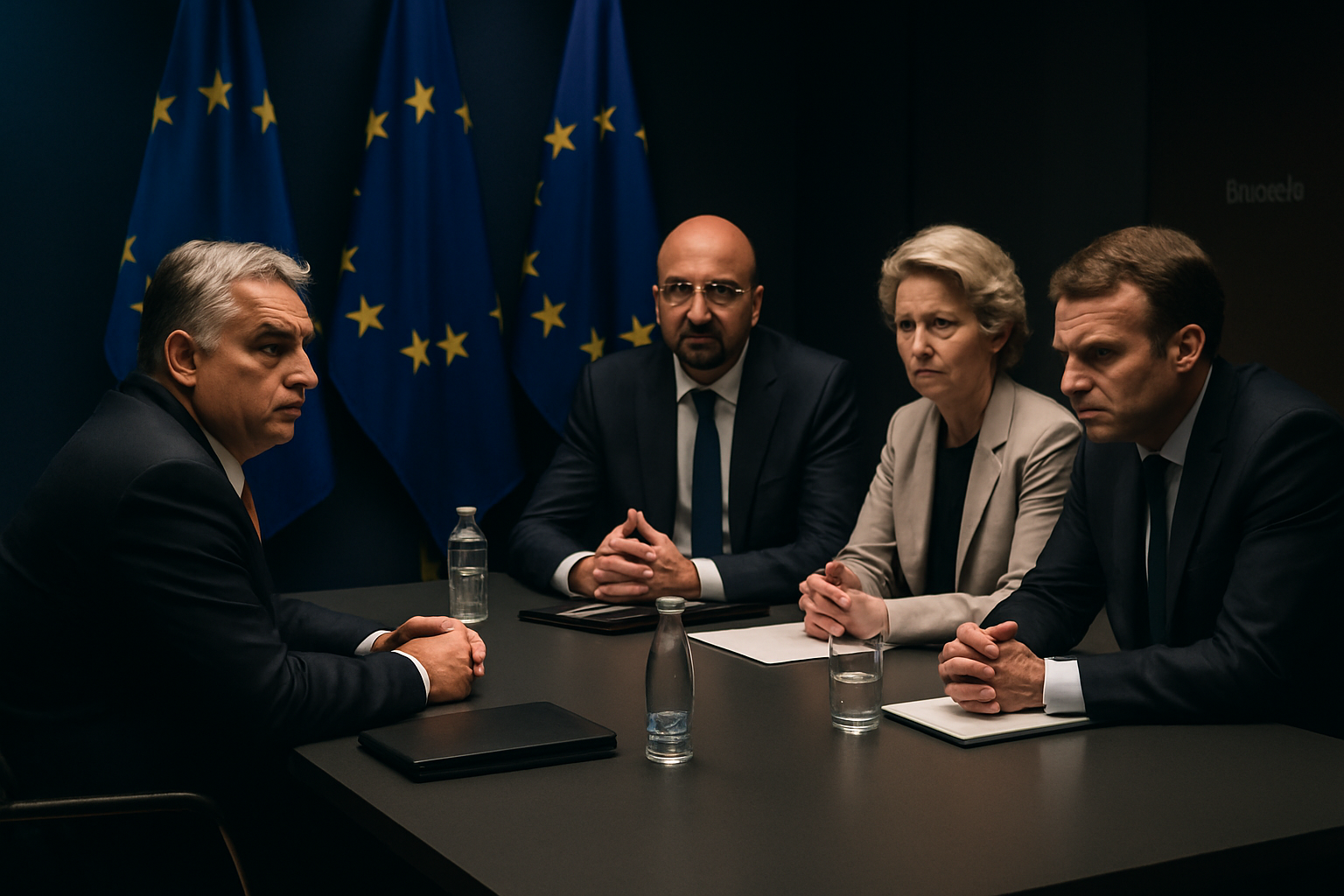
European Union leaders are mounting an unprecedented pressure campaign against Hungarian Prime Minister Viktor Orban as his government continues to block the EU's historic €90 billion aid package for Ukraine, creating the deepest institutional crisis within the bloc since Russia's invasion began.
The standoff has reached critical proportions as EU officials warn that Hungary's obstruction threatens not only Ukraine's defense capabilities but also the fundamental principles of European solidarity during wartime. Lithuanian Foreign Minister Kestutis Budrys delivered one of the most pointed criticisms, declaring that "the EU cannot become Budapest's hostage."
The Pipeline Dispute at the Heart of the Crisis
At the center of Hungary's blockade lies the Druzhba oil pipeline dispute, which has been offline since late January 2026. Hungary claims Ukraine deliberately manipulated oil supplies as "political blackmail," while Ukraine maintains that Russian drone attacks damaged the infrastructure, requiring extensive repairs.
Hungarian Foreign Minister Péter Szijjártó has been uncompromising in his position, stating that Budapest will maintain its veto of both the €90 billion EU aid package and the 20th sanctions package until oil transit through the Druzhba pipeline resumes. This pipeline represents Hungary's last major energy connection to Russia, making it a critical piece of the country's economic infrastructure.
The dispute has already forced Slovakia to declare an oil emergency, releasing 250,000 tons of strategic reserves to maintain domestic supply. Slovakia's Prime Minister Robert Fico has joined Hungary in pressuring Ukraine, previously issuing ultimatums to cut electricity supplies unless oil transit resumed.
Historic Aid Package in Jeopardy
The €90 billion loan package represents the largest EU financial assistance program ever designed for a single nation. Approved by the European Parliament with an overwhelming 458-140-44 vote, the package was designed to cover Ukraine's defense procurement and civilian reconstruction needs through 2026-2027.
However, the EU's unanimity requirements for such major financial commitments have given Hungary effective veto power over the entire program. This has exposed fundamental tensions between national sovereignty and collective action during wartime conditions.
Slovakia, Czech Republic, and Hungary have all refused to participate in the financing of the loan package, demonstrating persistent East-West divisions within the EU despite broad European support for Ukraine. The refusal of these three countries to contribute shows how domestic political pressures can limit European solidarity even during existential security crises.
Enhanced Cooperation Discussions Gain Momentum
The Hungarian blockade has accelerated discussions about enhanced cooperation mechanisms that would allow willing EU member states to proceed without requiring unanimity. Such a move would represent a significant departure from traditional EU decision-making processes but may become necessary to preserve collective action capabilities during wartime.
European Council President António Costa has taken the unprecedented step of issuing a direct letter to Budapest demanding that Hungary honor its previous commitments. This public pressure campaign reflects growing frustration among EU institutions with Hungary's systematic use of veto powers to block collective policies.
The crisis tests whether the EU's institutional mechanisms can adapt to extraordinary circumstances while maintaining democratic legitimacy and member state sovereignty principles.
Electoral Politics and International Pressure
Orban's position is complicated by Hungary's upcoming April 12, 2026 parliamentary elections, where his Fidesz party faces unprecedented electoral vulnerability. For the first time since 2010, polling shows Fidesz trailing opposition coalitions, creating genuine uncertainty about Orban's political future.
The crisis provides Orban with opportunities to demonstrate independence from Brussels while maintaining support from the Trump administration, which has provided explicit backing for the Hungarian leader. US Secretary of State Marco Rubio's recent visit to Budapest included strong endorsements of Orban's leadership, giving Hungary alternative sources of international legitimacy amid EU tensions.
This dual dynamic—domestic electoral pressure combined with US support—allows Orban to use EU veto powers as both domestic political tools and leverage in international relationships.
Broader Implications for European Unity
The standoff occurs during a critical period for Ukraine, as peace talks have been indefinitely suspended due to the Iran crisis. The diplomatic momentum that had achieved a 314-prisoner exchange and the restoration of US-Russia military communications after a four-year suspension has stalled, making continued European support even more crucial.
Meanwhile, Russian forces have accelerated territorial gains, capturing 481 square kilometers in January 2026 compared to 260 square kilometers in December 2025—an 85% increase that represents the fastest territorial expansion in months. This military pressure makes the blocked aid package particularly urgent for Ukraine's defense capabilities.
The energy warfare tactics continue as well, with over 1,170 Kyiv buildings still lacking adequate heating during extreme winter conditions. This "winter weapon" strategy affects more than 17.8 million Ukrainians who are accessing emergency support programs.
Alternative Pathways and Future Scenarios
EU leaders are exploring multiple pathways to overcome Hungarian obstruction. Enhanced cooperation procedures could allow the majority of member states to proceed with Ukraine support without Hungarian participation. However, such mechanisms would set significant precedents for future EU decision-making and could further fragment the bloc during a critical security period.
Croatia has offered alternative Mediterranean routes for oil supplies, but these would accommodate only non-Russian crude and would require months or years for full implementation. Ukraine has also proposed the Odessa-Brody pipeline as a replacement system, though this too would require substantial time and investment.
The resolution of this crisis will have implications far beyond the immediate Ukraine aid question. It will determine whether European institutions can maintain collective action capabilities when member states prioritize national interests over shared security concerns.
Nuclear Context and Diplomatic Urgency
The dispute unfolds against the backdrop of unprecedented nuclear governance challenges. The New START treaty between the US and Russia expired on February 5, 2026, eliminating nuclear constraints that had existed for over 50 years. Both countries control approximately 80% of global nuclear weapons, creating what UN Secretary-General António Guterres has called a "grave turning point" with nuclear risks at their "highest in decades."
This nuclear governance vacuum adds urgency to resolving the EU aid crisis, as stable European support for Ukraine becomes even more critical for maintaining deterrence and diplomatic leverage in potential future peace negotiations.
The Stakes for European Integration
The outcome of this confrontation will influence the trajectory of European integration for decades. Success in delivering the promised aid while managing internal divisions would demonstrate the EU's capacity to act decisively during wartime conditions. Failure could signal broader fragmentation when facing external pressure, potentially emboldening other challenges to European unity.
Recent polling shows 89% of Europeans demand greater EU unity, with 86% wanting a stronger European global voice. However, the institutional mechanisms for achieving this unity are being tested under extraordinary pressure, with the unanimity requirements proving to be a potential vulnerability in crisis conditions.
As European leaders continue their pressure campaign against Budapest, they face a fundamental question about the future of EU governance: whether the bloc can adapt its decision-making processes to meet 21st-century security challenges while preserving the democratic principles and member state sovereignty that form its foundation.
The coming weeks will be decisive in determining whether diplomatic pressure can overcome Hungary's resistance or whether the EU will need to pursue more dramatic institutional innovations to maintain its collective action capabilities during one of the most serious security crises since World War II.