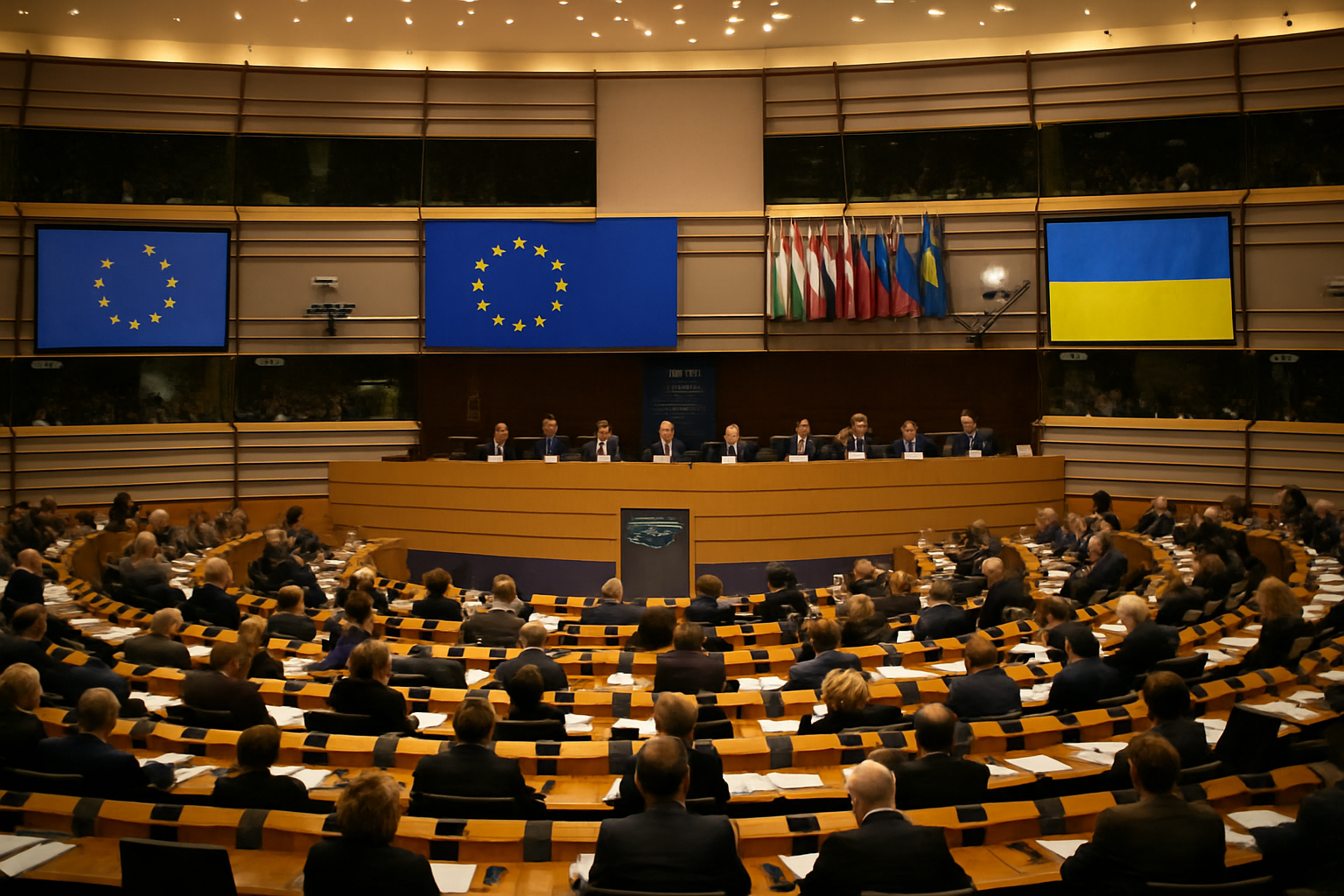
The European Parliament has approved a historic €90 billion loan package for Ukraine, the largest EU financial assistance ever provided to a single nation, as reports emerge of intensifying US pressure on President Volodymyr Zelensky to announce presidential elections by May 2026.
The loan approval, secured with 458 votes in favor, 140 against, and 44 abstentions on Wednesday, provides crucial financial lifeline for Ukraine's defense and reconstruction efforts over 2026-2027. The package includes modifications to the EU's Ukraine mechanism and amendments to the 2021-2027 multiannual financial framework, enabling the EU budget reserve to serve as loan guarantees and debt servicing coverage.
US Election Pressure Intensifies
Concurrent with the EU financial commitment, reports from multiple international sources suggest the Trump administration is pressuring Ukraine to hold presidential elections alongside a peace referendum by May 15, 2026. According to Financial Times reporting cited by French media, Ukrainian and European officials involved in discussions indicate Zelensky may announce the election plans on February 24 – the fourth anniversary of Russia's full-scale invasion.
Ukraine's Presidential Office responded to these reports with measured statements emphasizing security concerns. "The Office of the President is not opposed to elections, but security must be guaranteed," officials stated, addressing what they characterized as premature speculation about electoral timelines.
"Security must be guaranteed before any electoral process can proceed."
— Office of the President of Ukraine
The proposed elections would mark Ukraine's first national vote since Zelensky's 2019 presidential victory, effectively ending the martial law period that has suspended normal democratic processes since February 2022.
Diplomatic Breakthrough Amid Military Escalation
The financial and political developments occur against the backdrop of significant diplomatic progress in the Ukraine conflict. Recent trilateral talks in Abu Dhabi between Ukraine, Russia, and the United States achieved the first prisoner exchange in five months, with 314 personnel swapped – 157 military personnel from each side plus three Russian civilians returned from Ukrainian custody.
Ukrainian Defense Minister Rustem Umerov described the Abu Dhabi negotiations as "substantial and productive," with detailed discussions on ceasefire implementation and monitoring mechanisms. Most significantly, the talks restored US-Russia military communications after a four-year suspension, establishing deconfliction protocols and incident prevention measures.
However, military operations continue to intensify even as diplomatic channels remain open. Russia launched what DTEK energy company described as the "most powerful blow" of 2026 against Ukrainian energy infrastructure, leaving over 1,170 buildings in Kyiv without heating during minus-30°C temperatures. The attack broke an informal Trump-Putin energy truce just before the peace negotiations commenced.
Territory Remains Core Dispute
Despite humanitarian breakthroughs in prisoner exchanges and communications restoration, fundamental territorial disputes remain unchanged. Eastern Ukrainian territories under Russian control continue to represent the primary sticking point for any comprehensive peace agreement.
Russian forces have accelerated territorial gains, capturing 481 square kilometers in January 2026 compared to 260 square kilometers in December 2025. Over 10,000 Russian drones and bombs were launched in January alone, demonstrating continued military pressure alongside diplomatic engagement.
European Unity Despite Divisions
The €90 billion loan approval demonstrates remarkable European solidarity, though not without internal tensions. Slovakia, Czech Republic, and Hungary have indicated they will not participate in the financing mechanism or interest payments, revealing persistent divisions within the EU regarding the extent of support for Ukraine.
The loan mechanism received broad backing across multiple EU member states, with Denmark, Lithuania, and other nations providing unanimous support for the package. Lithuanian sources emphasized the loan represents "financial assistance to a funds-lacking Kyiv" nearly four years after Russia's invasion began.
The package coordinates with existing international support mechanisms, including a Swedish-Danish €246 million air defense initiative featuring advanced Tridon Mk2 systems, and Poland's continued fighter jet deployments for border security enhancement.
Humanitarian Crisis Deepens
The financial assistance comes as Ukraine faces its most severe winter humanitarian crisis since the conflict began. President Zelensky recently disclosed that 55,000 Ukrainian soldiers have been officially confirmed killed since February 2022, with a "large number" still classified as missing in action. International research estimates suggest actual casualties could be 2-3 times higher when including undocumented losses.
Over 17.8 million Ukrainians are currently accessing winter support programs as energy infrastructure attacks continue. The systematic targeting of power generation and distribution facilities during extreme cold represents what Ukrainian officials describe as "energy terrorism" – using winter conditions as a weapon against civilian populations.
Emergency warming centers have been activated across eight affected regions following the recent massive attack, which caused the shutdown of the Darnytska thermal power plant in Kyiv and forced 820 buildings in Kharkiv to drain their heating systems entirely.
Nuclear Escalation Concerns
The crisis has taken an unprecedented turn with Ukrainian nuclear power plants completely halting electricity production for the first time since the conflict began, following Russian attacks on substations and power transmission lines. International Atomic Energy Agency Director General Rafael Grossi confirmed the shutdown, while Ukrainian Foreign Minister warnings emphasized that such attacks put "all of Europe at risk of nuclear incident."
This nuclear dimension coincides with the February 5 expiration of the New START Treaty between the US and Russia – marking the first time in over 50 years that the world's largest nuclear powers operate without bilateral arms control constraints.
International Stakes and Timeline
The convergence of EU financial commitment, US electoral pressure, and ongoing military operations creates unprecedented complexity for conflict resolution. The June 2026 peace deadline previously established by the US administration, with negotiations potentially moving from Abu Dhabi to Washington venues, suggests the highest levels of American engagement.
European divisions persist regarding diplomatic approaches, with Germany opposing direct Putin talks while France and Italy support broader engagement strategies. The UAE's neutral hosting role has proven crucial for concrete humanitarian results, including the prisoner exchanges and communications restoration.
"This represents the most significant diplomatic opportunity since the conflict began."
— International diplomacy observers
The May 2026 election timeline, if implemented, would represent an unprecedented democratic transition during active conflict, requiring extensive security guarantees and international oversight mechanisms.
Looking Ahead
The success of the €90 billion EU loan package and potential Ukrainian elections will largely depend on broader conflict resolution progress. The combination of sustained international financial support, diplomatic engagement through multiple channels, and continued military pressure creates a complex environment where humanitarian breakthroughs coexist with ongoing escalation.
The eastern Ukrainian territories remain the fundamental challenge for any comprehensive peace agreement. Russia's insistence on territorial recognition conflicts with Ukraine's territorial integrity principles, creating the core dispute that neither prisoner exchanges nor financial assistance can directly resolve.
Coming weeks will prove critical in determining whether the diplomatic momentum achieved in Abu Dhabi can translate into broader territorial compromise breakthroughs, or whether continued military operations will overshadow peaceful resolution efforts. The European Parliament's historic financial commitment provides a foundation for long-term reconstruction, while the potential May elections represent a test of democratic resilience under extraordinary circumstances.
This convergence of financial, diplomatic, and political developments marks one of the most significant moments in the nearly four-year conflict, with implications extending far beyond Ukraine to European security architecture and international conflict resolution mechanisms for the 21st century.