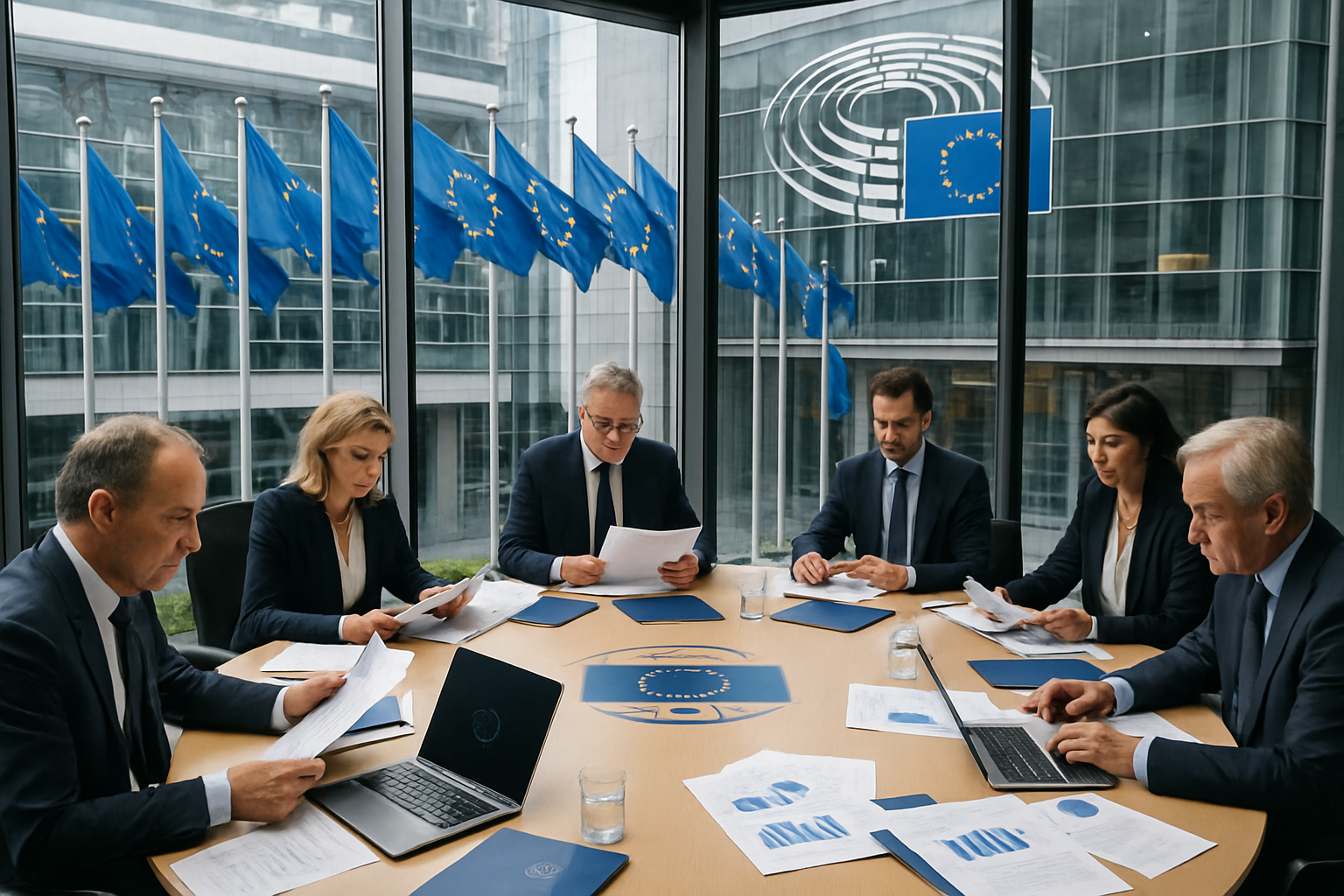
The European Union has unveiled its most ambitious industrial policy overhaul in decades, launching a comprehensive "Made in Europe" initiative that mandates European participation in critical sectors including batteries, nuclear power, and green technologies amid escalating global economic tensions.
The European Commission's announcement on March 4, 2026, marks a decisive shift from the bloc's traditional free-market approach toward strategic trade policy, as EU leaders grapple with China's overwhelming dominance in critical materials and America's bilateral trade pressure under the Trump administration.
Strategic Sectors Under New Requirements
According to sources from Finland's national broadcaster YLE, the new regulations will require European content in public procurement for strategic sectors. The policy specifically targets batteries and nuclear power plants, where European participation will become mandatory for government contracts and subsidies.
French media reports indicate the initiative introduces "European preference" in public procurement and state aid deployment across member states. This represents a fundamental departure from EU competition rules that traditionally prohibited favoring European suppliers over international competitors.
Slovakia's business media describes the measures as an "accelerator" designed to reduce dependence on China, focusing protection on three strategic sectors that have become critical vulnerabilities for European economic security.
Response to Chinese Supply Chain Dominance
The policy directly addresses China's stranglehold on critical materials, with the country controlling 60% of global production and 90% of refining capacity for lithium, cobalt, and rare earth elements essential for renewable energy infrastructure. EU auditors have repeatedly warned that climate goals are at serious risk due to these dependencies.
The timing coincides with a severe memory chip crisis that has seen semiconductor prices increase sixfold, affecting European technological competitiveness against Samsung, SK Hynix, and Micron. This shortage is expected to continue until new fabrication facilities become operational in 2027.
Recent Chinese technological breakthroughs, including DeepSeek's training on restricted Nvidia chips and Unitree Robotics scaling production from 5,500 to 20,000 humanoid robots, demonstrate China's ability to circumvent technological restrictions and advance despite Western barriers.
Economic Context and External Pressures
The "Made in Europe" launch comes as the continent faces multiple economic challenges. Natural gas prices have surged 24% across Europe, while persistent supply chain disruptions continue to hamper industrial production. Estonia reports 3.2% inflation, contrasting with Finland's more stable 1.8% harmonized inflation rate.
European Central Bank analysis reveals that persistently high electricity prices are undermining the EU's central electrification strategy for achieving net-zero emissions, despite the Clean Industrial Deal launched in February 2025. Euro area electricity consumption has actually declined 6.3% between 2015-2023, contrary to Commission targets of increasing electricity's share from 23% to 32% by 2030.
The policy shift also responds to the Trump administration's bilateral trade approach, which has bypassed EU frameworks through direct deals with countries like Argentina (eliminating over 1,600 tariffs) and India (reducing duties from 50% to 18%). This strategy has created pressure on EU multilateral trade principles.
German Opposition and Internal Tensions
Despite broad support for European industrial sovereignty, significant internal opposition exists. German Chancellor Friedrich Merz's recent visit to China, where he secured a 120-aircraft Airbus deal worth billions, illustrates the complex balancing act between economic interests and strategic autonomy.
Germany has acknowledged China's evolution from a "lucrative market to competitive threat" in high-tech manufacturing, as Chinese firms now compete directly with established European manufacturers in sophisticated products. However, German businesses remain concerned about completely severing profitable relationships with China, the country's largest trading partner.
The German approach emphasizes "fair competition" while maintaining economic cooperation, reflecting broader European tensions between immediate commercial interests and long-term strategic independence.
Implementation Challenges and Timeline
The initiative faces substantial implementation challenges across 27 member states with different economic structures and political priorities. The policy requires coordination between enhanced cooperation mechanisms that allow willing member states to advance without unanimous consent, essential for navigating complex economic reforms.
Financial requirements are enormous, with estimates suggesting hundreds of billions of euros needed for alternative supply chains, domestic production capacity, and technological innovation. The European Commission has committed to a March 2027 implementation agenda, providing less than a year for comprehensive structural changes.
Success depends on maintaining democratic accountability while responding to authoritarian competition, a challenge highlighted by recent summit tensions where Spain criticized Germany-Italy-Belgium pre-meetings for undermining EU principles.
Digital Sovereignty Integration
The industrial policy integrates with broader European digital sovereignty efforts, including Slovakia's €1.3 billion digital euro pilot, Spain's world-first criminal executive liability for tech platforms, and France's enforcement raids on social media companies.
These measures address European concerns about dependency on US cloud services and Chinese digital infrastructure, creating potential "kill switch" vulnerabilities where foreign governments could disrupt European operations through technological control.
Public Support and Democratic Mandate
Recent Eurobarometer polling shows 89% of Europeans demand greater EU unity, with 86% wanting a stronger global voice. This provides a democratic mandate for ambitious integration initiatives despite internal political friction over economic leadership approaches.
The overwhelming public support contrasts with traditional skepticism toward EU economic intervention, suggesting that external pressures have shifted European attitudes toward accepting more centralized economic coordination.
Global Implications
The "Made in Europe" initiative represents a test case for whether democratic societies can maintain economic sovereignty while participating in global technological development. Success could establish Europe as a "third pole" in global competition alongside the United States and China, while failure might result in subordination to US-China technological systems.
International observers are monitoring the European approach as a potential template for other regions seeking to balance economic openness with strategic autonomy. The stakes extend beyond immediate trade relations to fundamental questions about democratic governance in an increasingly multipolar world.
The coming months will determine whether European leaders can translate political commitments into practical policies that benefit businesses and consumers while preserving the continent's role as a global technological and economic leader. The window for effective action continues to narrow as geopolitical pressures intensify and technological competition accelerates.