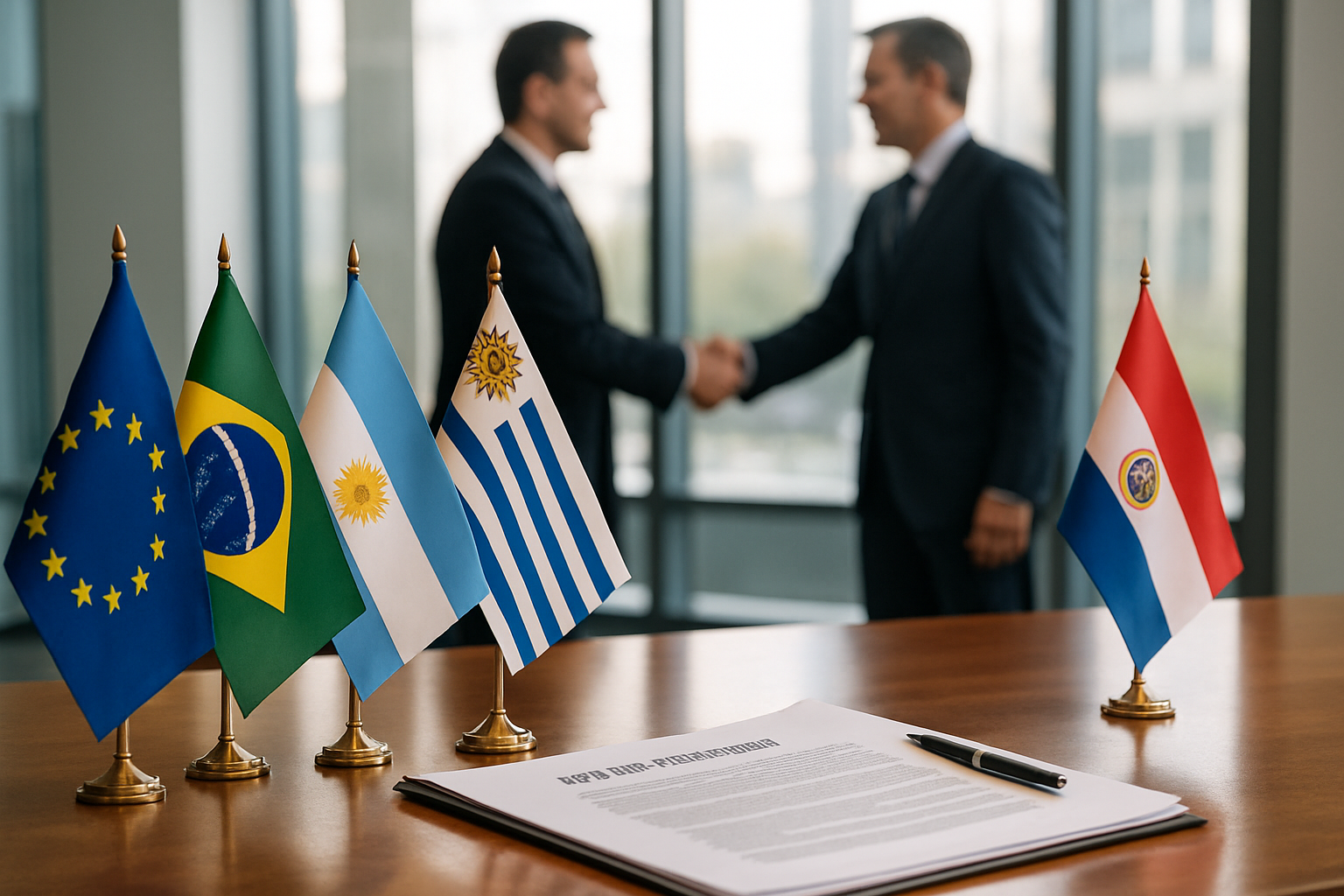
The European Union's trade agreement with Mercosur countries will enter provisional force on May 1, 2026, the European Commission announced Monday, creating one of the world's largest free trade zones covering 780 million people across Europe and South America despite fierce French opposition and unresolved parliamentary challenges.
Brussels officially notified the South American countries of the provisional implementation, marking a significant milestone for a deal that has been over two decades in the making. The agreement encompasses the European Union's 27 member states and the four Mercosur nations: Brazil, Argentina, Uruguay, and Paraguay.
Historic Trade Zone Takes Shape
The provisional implementation represents approximately 25% of global GDP, making it one of the most significant trade agreements in modern history. The deal will eliminate tariffs on billions of euros worth of goods annually, benefiting European exporters of automobiles, machinery, chemicals, and pharmaceuticals while providing South American agricultural products with improved access to European markets.
According to Finnish broadcaster YLE, the agreement covers 700 million consumers, creating unprecedented opportunities for cross-Atlantic trade. Italian news agency ANSA confirmed that Brussels has formally notified the South American countries of the implementation timeline, setting the stage for immediate economic benefits.
"This agreement represents a new chapter in EU-Mercosur relations, creating opportunities for 780 million people across both regions with unprecedented market integration."
— European Commission Statement
French Opposition Remains Fierce
Despite the provisional implementation, French opposition to the agreement continues to pose challenges. President Emmanuel Macron has characterized the deal as a "bad surprise," leading a coalition of European countries including Ireland, Austria, and Poland that maintain reservations about the agreement's agricultural competition implications.
The French government has raised concerns about cheaper agricultural imports from South America, particularly beef, soybeans, sugar, and poultry products, which they argue create unfair competition for European farmers. This opposition has forced the European Commission to pursue provisional implementation while bypassing traditional European Parliament approval procedures.
Strategic Response to Global Trade Realignment
The agreement's implementation comes as part of the EU's broader strategy to establish itself as a "third pole" in global competition, positioned between American and Chinese trade systems. This strategic positioning has become increasingly urgent as the Trump administration pursues bilateral trade deals, including agreements with Argentina that eliminated over 1,600 tariffs and with India that reduced duties from 50% to 18%.
European Commission President Ursula von der Leyen has positioned the agreement as essential for European competitiveness in an era of "America First" policies and increasing Chinese economic influence in Latin America. The deal serves as a template for how the EU can advance strategic economic partnerships even when facing significant internal divisions.
South American Ratification Progress
On the South American side, the agreement has gained strong momentum. Brazil's Congress completed ratification in March 2026, with Vice President Geraldo Alckmin confirming that provisional implementation could begin in May. Argentina ratified the deal earlier, aligning with President Javier Milei's free-trade reform agenda, while Uruguay has also provided its approval.
Paraguay remains the final Mercosur country requiring completion of ratification procedures, though parliamentary approval is expected given the nation's agricultural export interests and unanimous support shown in preliminary votes.
Environmental Concerns and Safeguards
Environmental organizations, led by Greenpeace, have characterized the provisional implementation as a "betrayal of the European Green Deal," raising concerns about potential acceleration of Amazon deforestation and ecosystem damage. Critics argue that enforcement mechanisms are insufficient to protect South American rainforests despite the agreement's inclusion of sustainability chapters.
However, the agreement does require adherence to the Paris Climate Agreement and includes anti-deforestation measures. Supporters argue that the economic opportunities created by the deal provide incentives for sustainable development practices in South America while strengthening environmental cooperation between the regions.
Parliamentary Approval Still Required
Despite provisional implementation, the agreement still requires full European Parliament approval for permanent ratification. The Court of Justice review continues, adding complexity to the implementation timeline and creating uncertainty about the deal's long-term viability.
Several EU member states retain the right to challenge the agreement through legal and political channels. The European Commission has emphasized the provisional nature of the implementation, pending full ratification across all participating countries.
Economic Impact and Implementation Approach
The provisional implementation will follow a phased rollout, prioritizing measures with broad support while addressing compliance mechanisms for more contentious provisions. European Parliament committee hearings are scheduled to examine environmental impact, economic effects, and enforcement mechanisms throughout the implementation period.
The agreement creates opportunities for enhanced market integration, with European companies gaining access to South American consumers while South American exporters benefit from reduced barriers to European markets. The deal is expected to generate significant economic activity across both regions, supporting job creation and industrial development.
Global Implications and Precedent
The successful provisional implementation, despite internal EU divisions, demonstrates institutional flexibility that could serve as a template for future trade agreements where unanimous support proves elusive. This approach allows the EU to advance strategic economic partnerships while preserving democratic accountability through ongoing parliamentary oversight.
The agreement's success or failure will influence European trade policy approaches for the remainder of the decade, affecting how the EU navigates the balance between economic openness and strategic autonomy in an increasingly multipolar world.
As May 1 approaches, businesses across Europe and South America are preparing for the new trade environment, with many expecting significant changes in supply chains, pricing, and market access that could reshape economic relationships between the two regions for generations to come.