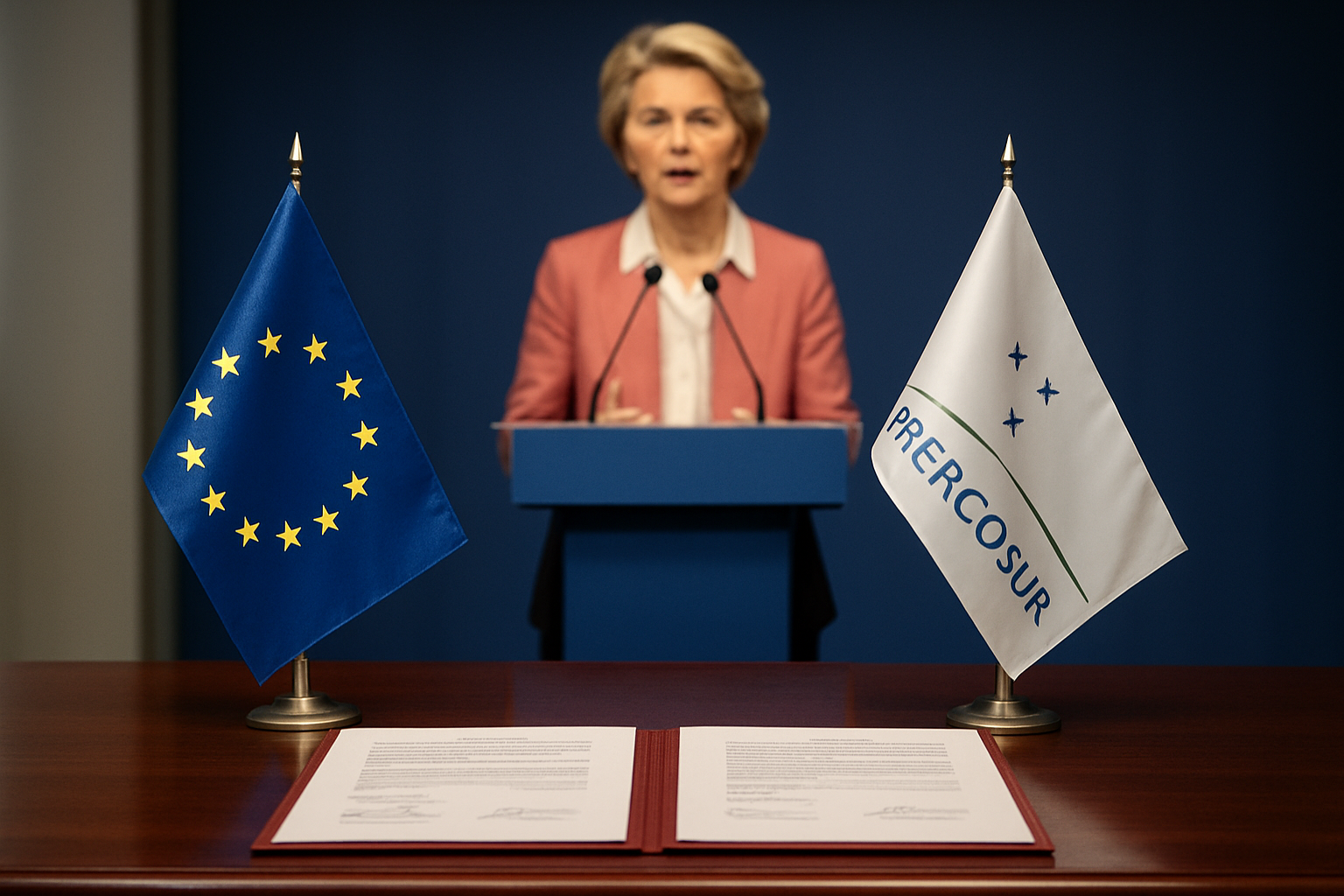
European Commission President Ursula von der Leyen announced Friday that the EU-Mercosur trade agreement will enter provisional force without waiting for European Parliament approval, in a controversial move that bypasses traditional procedures and creates one of the world's largest free trade zones covering 780 million people.
The announcement precipitated immediate backlash from France, with President Emmanuel Macron denouncing it as a "bad surprise" and French Agriculture Minister Marc Fesneau leading fierce opposition. The decision allows trade components of the massive agreement to proceed while the European Court of Justice review continues and full parliamentary ratification remains pending.
Historic Economic Partnership Activated
The provisional implementation creates the world's largest free trade area by population, encompassing the 27 EU member states and the four Mercosur countries: Brazil, Argentina, Uruguay, and Paraguay. The combined economic bloc represents approximately 25% of global GDP and eliminates tariffs on billions of euros worth of goods traded annually between the two regions.
Recent ratifications by Uruguay and Argentina provided the necessary momentum for the Commission's decision, despite significant opposition from several EU member states. The agreement particularly benefits European automobile, machinery, chemical, and pharmaceutical exporters while providing South American agricultural products with improved access to European markets.
"This represents a historic moment for global trade cooperation and demonstrates the EU's commitment to multilateral partnerships."
— Ursula von der Leyen, European Commission President
French Opposition Intensifies
France has emerged as the most vocal opponent of the agreement, citing concerns about unfair competition from cheaper South American agricultural imports. French farmers fear an influx of beef, soybeans, sugar, and poultry that could undercut domestic producers operating under stricter environmental and labor standards.
The French government argues that the agreement undermines European Green Deal objectives and threatens to accelerate Amazon deforestation. Environmental groups, including Greenpeace, have characterized the deal as a "betrayal of the European Green Deal," arguing that enforcement mechanisms for environmental protections are insufficient.
Despite the opposition, the German Federal Government and Green Party leader Franziska Brantner welcomed the provisional implementation, viewing it as essential for European economic competitiveness. This divide highlights the complex political dynamics within the EU regarding trade policy.
Argentina Pushes for Swift Implementation
Argentina has demonstrated strong support for the provisional application, with Buenos Aires expressing "conformity" with Brussels' decision. The timing aligns with President Javier Milei's broader economic reform agenda, including recent labor market modernization and bilateral trade agreements with the United States.
The agreement provides Argentine exporters with significant new opportunities in European markets, particularly for agricultural products and critical minerals. This comes as Argentina seeks to diversify its economy and reduce dependence on traditional trade partners amid ongoing economic transformation.
Portuguese Perspective on Implementation
Portugal has taken a measured approach to the provisional implementation, with officials noting that the partnership will proceed despite ongoing judicial review. Portuguese media emphasized that the agreement moves forward even without full Senate approval in Brazil, highlighting the complex ratification processes across both regions.
The Portuguese position reflects broader Iberian Peninsula support for enhanced trade ties with Latin America, building on historical cultural and economic connections. Portuguese businesses, particularly in sectors like renewable energy and infrastructure, stand to benefit from expanded market access.
Environmental and Sustainability Concerns
The agreement includes comprehensive sustainability chapters requiring adherence to the Paris Climate Agreement and implementing anti-deforestation measures. However, critics argue that these provisions lack sufficient enforcement mechanisms to prevent environmental damage, particularly in the Amazon rainforest.
Proponents counter that the agreement includes unprecedented environmental safeguards for a trade deal of this scale. They argue that economic integration can provide incentives for sustainable development practices while creating markets for green technologies and renewable energy products.
Political Challenges Ahead
Despite provisional implementation, full parliamentary approval remains uncertain. Several EU member states, including France, Ireland, Austria, and Poland, have expressed reservations about various aspects of the agreement. The European Parliament's eventual vote could face significant opposition, potentially taking months or years to achieve approval.
The Court of Justice review adds another layer of complexity to the implementation timeline. While trade components proceed provisionally, any adverse legal ruling could complicate or halt the agreement's continued application.
Strategic Global Context
The EU-Mercosur agreement represents part of a broader European strategy to diversify supply chains and reduce dependence on single-partner relationships. This approach competes with US bilateral trade deals under the Trump administration and China's Belt and Road Initiative, establishing Europe as an independent trade policy actor in an increasingly multipolar world.
The provisional implementation demonstrates the EU's willingness to use institutional flexibility to advance strategic economic partnerships, even in the face of internal opposition. This approach may serve as a template for future trade agreements where unanimous member state support proves elusive.
Implementation and Future Prospects
The Commission has outlined a phased rollout approach, prioritizing trade measures with broad support while addressing concerns through enhanced monitoring and compliance mechanisms. European Parliament committee hearings are scheduled to examine environmental impacts, economic effects, and enforcement mechanisms in detail.
Member states retain rights to challenge specific provisions through legal and political channels. The Commission emphasizes the provisional nature of the current implementation, pending full ratification processes across all participating countries.
The success of this unprecedented approach to trade agreement implementation could influence future EU trade policy, particularly regarding other major partnerships under negotiation. The outcome will serve as a critical test of whether the European Union can maintain trade leadership amid internal divisions and external competitive pressures.