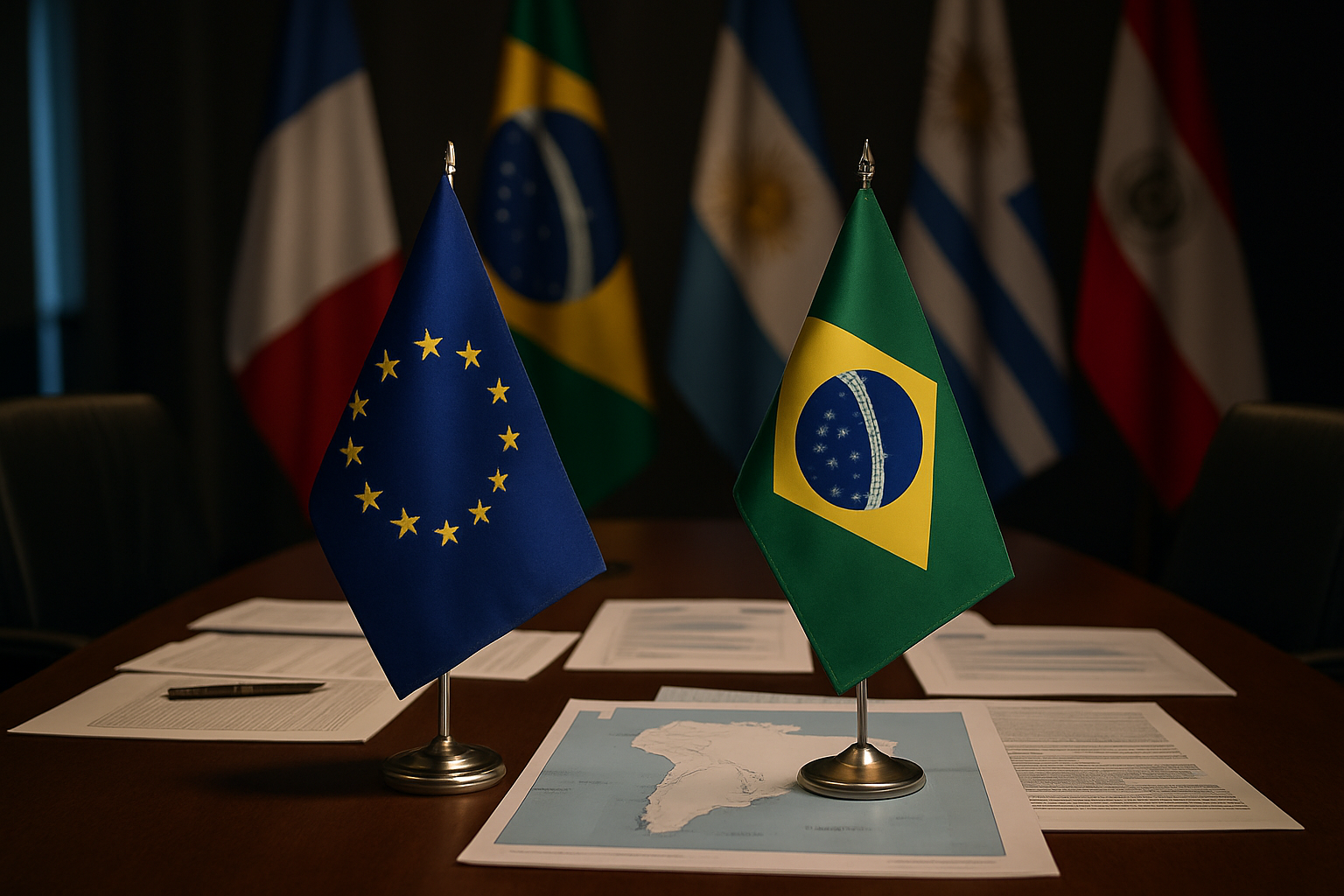
European Commission President Ursula von der Leyen announced Friday the provisional implementation of the controversial EU-Mercosur trade agreement, moving forward with the long-stalled deal despite fierce opposition from France and widespread farmer protests across Europe.
The decision to provisionally apply the trade deal with South American Mercosur countries—Brazil, Argentina, Uruguay, and Paraguay—marks a significant breakthrough for an agreement that has been in negotiation for over 25 years and was politically announced in 2019 but subsequently stalled due to internal EU divisions.
Historic Trade Agreement Takes Shape
The provisional implementation allows key commercial components of the agreement to enter into force before final ratification by the European Parliament and all 27 EU member state parliaments, a process that could extend for years. This mechanism, provided for in EU treaties, enables immediate economic benefits while the lengthy approval process continues.
Von der Leyen emphasized that provisional application is "by definition temporary" and stressed that the agreement will only be fully concluded when the European Parliament and all national parliaments have given their approval. The decision came after Argentina and Uruguay completed their ratifications, providing the momentum needed for the Commission to move forward.
"Over the last few weeks, I have engaged deeply on this issue with member states and taken note of the progress made by our Mercosur partners in their ratification processes."
— Ursula von der Leyen, European Commission President
French Opposition Intensifies
French President Emmanuel Macron immediately condemned the decision as a "bad surprise," highlighting the deep divisions within the EU over the trade deal. France has consistently led opposition to the agreement, with French farmers fearing they will be undercut by cheaper agricultural imports from South America, particularly beef, soybeans, sugar, and poultry.
The timing of the announcement has sparked particular frustration in Paris, coming as French agriculture faces mounting pressures from climate challenges, disease outbreaks, and global market volatility. French agricultural unions have repeatedly warned that the deal would expose European farmers to unfair competition from producers operating under different environmental and labor standards.
Creating a Global Trade Giant
Once fully implemented, the EU-Mercosur agreement will create one of the world's largest free trade zones, covering approximately 780 million people and representing about 25% of global GDP. The deal promises to eliminate tariffs on billions of euros worth of goods annually, opening significant opportunities for both European and South American exporters.
European automobile manufacturers, machinery producers, chemical companies, and pharmaceutical firms stand to benefit significantly from improved access to South American markets. In return, the agreement provides South American agricultural products with enhanced access to European consumers, potentially reshaping global food supply chains.
Environmental Concerns Mount
Environmental groups have strongly criticized the agreement, with Greenpeace characterizing it as a "betrayal of the European Green Deal." Critics argue that increased agricultural trade with South America, particularly Brazil, could accelerate deforestation in the Amazon rainforest and undermine global climate objectives.
The agreement includes sustainability chapters requiring adherence to the Paris Climate Agreement and incorporating anti-deforestation measures. However, environmental activists argue that enforcement mechanisms remain insufficient to prevent ecological damage, particularly given Brazil's track record on Amazon protection.
Political Challenges Ahead
The provisional implementation faces significant political hurdles, with several EU member states expressing reservations. Beyond France, countries including Ireland, Austria, and Poland have raised concerns about various aspects of the agreement, from agricultural competition to environmental standards.
The European Parliament's approval remains uncertain, with committees scheduled to examine the agreement's environmental impact, economic effects, and compliance mechanisms. Member states retain the right to challenge the deal through both legal and political channels, potentially complicating implementation.
Strategic Implications
The move forward with Mercosur comes as part of the EU's broader strategy to diversify supply chains and reduce dependence on single trading partners amid global economic realignment. The agreement represents a test of EU independent trade policy in an increasingly multipolar world, competing with US bilateral agreements under the Trump administration and China's Belt and Road Initiative.
Von der Leyen's decision reflects the EU's determination to maintain global trade leadership while managing internal divisions. The Commission has promised a phased approach to implementation, prioritizing measures with broad member state support while addressing specific concerns through targeted safeguards.
Implementation Timeline
The provisional implementation will proceed despite ongoing legal review by the European Court of Justice and continued political opposition from several member states. European Parliament committee hearings are scheduled to examine various aspects of the agreement, including environmental impact assessments and compliance mechanisms.
The Commission has indicated that implementation will be gradual, with priority given to measures that enjoy broad political support. Member states retain various rights to challenge specific provisions, ensuring that domestic concerns can be addressed during the rollout process.
Looking Forward
The EU-Mercosur agreement's provisional implementation represents a watershed moment in transatlantic trade relations. Success could establish a template for large-scale trade agreements that balance economic opportunities with environmental and social concerns. Failure, however, could undermine confidence in the EU's ability to deliver on complex international agreements.
As the agreement moves into its implementation phase, all stakeholders—from European farmers to South American exporters—will be watching closely to see whether the promised benefits materialize while environmental and social safeguards prove effective in practice.