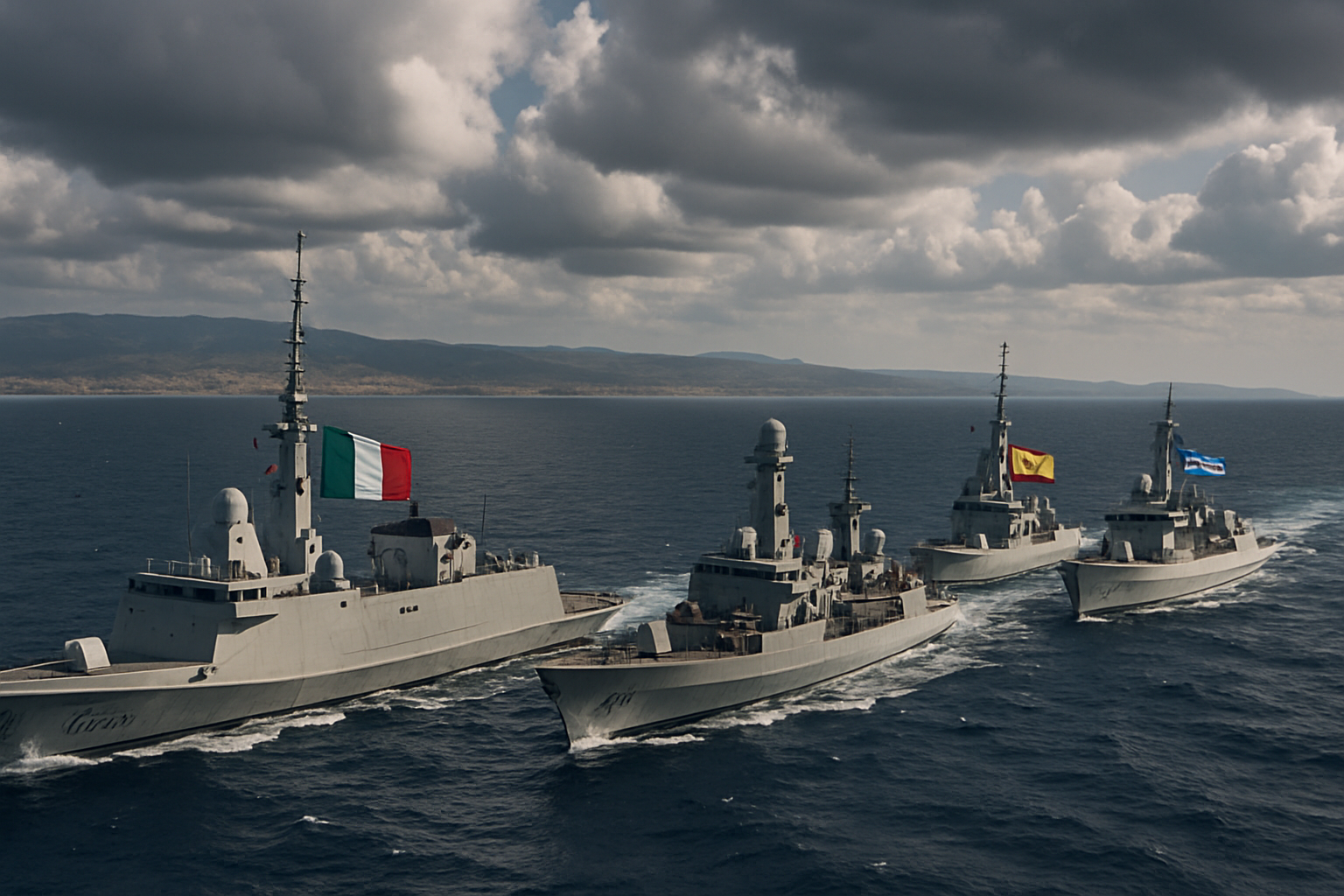
In an unprecedented display of European solidarity, four major EU nations have deployed military assets to Cyprus following Iranian drone attacks on British sovereign bases, marking the most significant Eastern Mediterranean military mobilization since the 1974 Turkish invasion.
The coordinated response from Greece, France, Italy, and Spain represents a watershed moment in European defense cooperation, as the continent faces its first direct targeting by Middle Eastern conflicts since World War II. European Council President António Costa praised the rapid four-nation response as "an example of European autonomy," while simultaneously warning of the dangers of further escalation in the Middle East.
Swift European Military Response
The military deployment began within hours of Iranian drone strikes on RAF Akrotiri, the British sovereign base area that houses approximately 3,000 UK personnel. Greece immediately dispatched four F-16 fighter jets alongside two advanced naval frigates, including the modernized Kimon - representing Athens' most substantial Cyprus support since 1974.
French President Emmanuel Macron personally ordered the deployment of anti-missile systems, advanced anti-drone technology, and the naval frigate Languedoc to Cypriot waters. The French response builds upon a December 2025 strategic partnership established between Macron and Cypriot President Nikos Christodoulides, demonstrating the activation of existing defense agreements.
Italy has positioned the missile frigate Federico Martinengo, equipped with advanced air defense capabilities and carrying over 160 navy personnel. The vessel, which recently gained operational experience in the Red Sea as part of the EU's EUNAVFOR Aspides mission, is expected to reach Cyprus waters within 48 hours.
Spain has deployed the Cristóbal Colón air defense frigate, equipped with sophisticated missile defense systems specifically designed to counter drone and missile threats. Spanish Prime Minister Pedro Sánchez distinguished this European territorial defense mission from broader Middle East interventions, stating Spain supports "no to war in Iran" while maintaining "solidarity with Cyprus, an EU country victim of this war."
Comprehensive Defense Architecture
The multi-national deployment creates a sophisticated, multi-layered defense umbrella over Cyprus. French anti-missile and anti-drone technology provides the technological foundation, while Greek F-16 interceptors offer rapid air response capabilities. British Sea Viper missile systems from HMS Dragon complement Spanish and Italian naval air defense platforms.
This coordinated response demonstrates Europe's capacity for independent defense action when territorial integrity is threatened. The deployment represents the most concrete expression of European strategic autonomy in decades, achieved through rapid coordination independent of NATO or US-led frameworks.
Cyprus Emergency Protocols
Cyprus activated its national ESTIA evacuation plan for the first time in history, evacuating Akrotiri village and closing schools in the Asomatos, Episcopi, and Trachoni areas. Government spokesman Konstantinos Letymbiotis coordinated the European response through emergency EU Foreign Affairs Council sessions, managing both the immediate crisis and broader diplomatic implications.
The crisis exposed significant gaps in Cyprus's civil defense infrastructure, with only 2,200 shelters providing protection for approximately 30% of the population. The government has initiated comprehensive reviews of emergency preparedness, including district-by-district testing of SMS alert systems and shelter capacity assessments.
"Cyprus was not the target - the target was the British bases. However, we stand ready to defend our territory and our European partners."
— Konstantinos Letymbiotis, Cyprus Government Spokesman
Strategic Context and Regional Implications
The Iranian attacks on RAF Akrotiri represent part of "Operation True Promise 4," a massive retaliation campaign following the death of Supreme Leader Ali Khamenei in US-Israeli strikes. The Islamic Revolutionary Guard Corps declared "no red lines remain," marking a dangerous expansion of Middle Eastern conflicts to European territory.
Cyprus's strategic vulnerability stems from its position just 100 miles from Lebanon and 200 miles from Syria, placing it at the intersection of multiple conflict zones while hosting Western military assets. The island's role as both an EU member and host to British sovereign bases creates unique diplomatic and security challenges.
The European response serves dual purposes: immediate military deterrence against further Iranian actions and diplomatic reassurance that European solidarity remains operational when member states face external threats. Success in coordinating defensive measures provides a template for future extra-regional threats requiring European territorial defense responses.
Historical Significance
This marks the first time since World War II that Middle Eastern conflicts have directly targeted European sovereign territory, fundamentally challenging traditional geographic containment assumptions. The coordinated four-nation response within hours demonstrates European capacity for rapid military coordination when continental security is threatened.
The deployment establishes important precedents for European alliance responses to threats originating beyond traditional regional boundaries. Geographic boundaries no longer effectively contain regional conflicts, requiring new approaches to continental security cooperation that transcend traditional alliance frameworks.
European Council President Costa's characterization of the response as "European autonomy" signals a potential template for future security challenges where European interests diverge from broader NATO or US strategic priorities.
Broader Crisis Context
The Cyprus deployment occurs within a broader Middle Eastern crisis that has triggered the largest international evacuation since the Arab Spring, with over 18,000 flights cancelled worldwide and oil prices surging past $80 per barrel. The closure of the Strait of Hormuz affects 40% of global oil transit, demonstrating how regional conflicts now carry immediate global consequences.
Nuclear diplomacy between the US and Iran has collapsed despite achieving the most progress since the 2018 JCPOA breakdown. Iran continues uranium enrichment at 60% purity with over 400kg of weapons-grade material, while the February 5 expiration of the New START treaty has created the first period in over 50 years without US-Russia nuclear constraints.
Regional Coalition Under Strain
The unprecedented diplomatic consensus between Saudi Arabia, UAE, Qatar, and Egypt supporting negotiations has come under severe pressure as Iranian retaliation has targeted member territories. Egyptian President Abdel Fattah el-Sisi condemned attacks on "sisterly countries," warning of "comprehensive chaos" if the situation escalates further.
Looking Forward
The success of this European coordination will influence future defense planning and continental security architecture for decades. The rapid deployment demonstrates that European strategic autonomy discussions can translate into operational reality when territorial integrity is threatened.
Extended operations will require sustained political will across electoral cycles, coordination of command structures among four nations, and careful management of relationships with non-European allies while maintaining European decision-making autonomy.
The template established by this crisis response could define the next phase of European integration in security matters, providing frameworks for future diplomatic engagement with extra-regional threats while maintaining European unity in the face of unprecedented challenges.
March 2026 represents a watershed moment in European security cooperation, offering the most dangerous crisis management test of the modern era. Success could demonstrate European global security relevance and provide frameworks for future diplomatic engagement, while failure risks marginalizing European influence in Middle Eastern developments and encouraging further territorial violations.