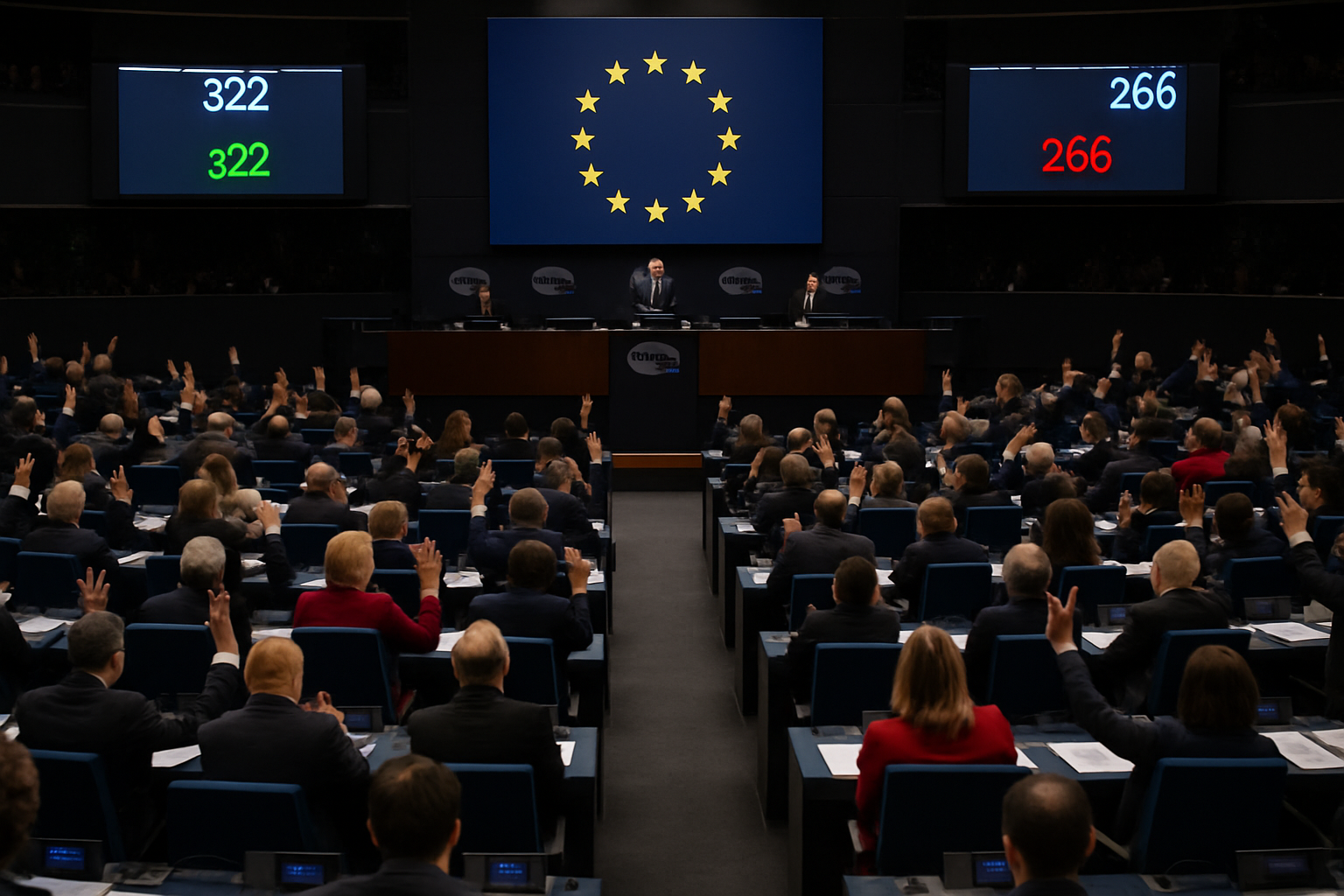
The European Parliament on Thursday approved controversial legislation to establish "return hubs" - offshore detention centers outside EU borders for processing rejected asylum seekers - in a decisive 389-206 vote with 32 abstentions, marking the most significant transformation of EU migration policy since the 2015-2016 refugee crisis.
The historic vote represents a fundamental shift from protection-based to deterrence-focused asylum principles, allowing member states to deport migrants whose asylum applications have been rejected to offshore detention facilities outside EU territory, even when their countries of origin refuse to accept them back.
Coalition of Conservative and Far-Right Forces
The legislation passed through an unprecedented alliance between center-right and far-right parties in the European Parliament, with German sources reporting that CSU politician Manfred Weber's conservative European People's Party aligned with far-right groups, including Germany's Alternative for Deutschland (AfD), to secure passage.
This political realignment has raised concerns about the normalization of far-right positions on migration policy within mainstream European politics, representing what critics describe as the institutionalization of hardline approaches that were considered extreme just a decade ago.
Maltese Nationalist MEP Peter Agius defended the vote, stating that lawmakers "voted strongly" in favor of the return hubs proposal. Speaking after the vote, Agius insisted the reform would give Malta and other frontline states "peace of mind" in managing migration pressures.
Building on External Processing Models
The new framework builds extensively on Italy's Albanian processing model, which has served as a template for broader European external deportation strategies. Under the approved measures, rejected asylum seekers can be transferred to facilities in third countries - likely in Africa - regardless of their personal connections to those nations.
A coalition led by Greece, including Germany, Netherlands, Austria, and Denmark, has already announced plans to establish such centers, utilizing enhanced cooperation mechanisms that allow smaller groups of member states to advance policies without requiring unanimous EU consent.
This enhanced cooperation approach represents a significant institutional innovation, previously used successfully for initiatives like the European Public Prosecutor's Office and PESCO defense cooperation, but now applied for the first time to controversial immigration policies.
Sharp Human Rights Criticism
Human rights organizations have mounted fierce opposition to the legislation, warning of potential violations of the non-refoulement principle - the international legal prohibition against returning people to territories where they face persecution, torture, or other serious harm.
Legal experts argue that the new system enables circumventing traditional asylum protections by relocating claimants to pre-designated "safe" countries with no consideration of individual circumstances or personal connections. Critics contend this fundamentally undermines the post-World War II international refugee protection framework.
Civil rights organizations are preparing constitutional challenges across multiple jurisdictions, focusing on proportionality questions, non-discrimination principles, and compliance with international humanitarian law. The European Court of Justice is expected to face immediate legal challenges once implementation begins.
Implementation Challenges and Timeline
Despite parliamentary approval, the legislation requires formal ratification by all 27 EU governments before implementation can begin. This process could take months or years, with several member states expected to raise concerns about the practical and legal implications.
Complex third-country partnership negotiations remain necessary for facility establishment, with potential host nations likely to demand significant financial compensation and legal protections. Questions persist about which countries would be willing to host such facilities and under what conditions.
The EU's Entry/Exit System has already demonstrated both the potential and limitations of enhanced border technology, detecting over 4,000 overstayers in its first four months of operation while creating processing delays that required partial summer suspensions.
Public Opinion and Political Context
The vote occurs amid significant public pressure for stronger border controls, with Eurobarometer polling showing 89% of Europeans demanding greater EU unity while 72% express border security concerns. These figures reflect the complex political environment in which European leaders are operating.
However, the legislation also faces resistance from within European institutions, with some member states maintaining that humanitarian obligations must remain paramount in migration policy. The speed of institutional opposition to similar controversial statements by European Commission President Ursula von der Leyen earlier this month demonstrated continued commitment to legal frameworks among many EU stakeholders.
Economic and Demographic Contradictions
The restrictive approach comes at a time when many EU countries face severe labor shortages in critical sectors including healthcare, agriculture, and construction. Albania has successfully integrated 27,000 foreign nationals to address workforce gaps, highlighting the economic contradictions in pursuing restrictive migration policies while facing demographic challenges from aging populations.
The UK's recent implementation of emergency visa restrictions for Afghanistan, Cameroon, Myanmar, and Sudan has already disrupted billions in international education revenue and academic partnerships, illustrating the potential economic costs of hardline approaches.
Climate Migration Pressures
The policy transformation occurs as climate displacement pressures intensify, with March 2026 marking the 19th consecutive month of global temperatures exceeding 1.5°C above pre-industrial levels - the longest sustained warming period in recorded history.
Environmental migration experts warn that current asylum categories are inadequate for handling climate-induced displacement, which falls outside traditional refugee definitions but represents a growing source of population movement that existing systems were never designed to manage.
International Template-Setting Implications
The European Parliament's decision is being closely monitored worldwide as a potential template for how developed democracies might manage complex migration flows in the 21st century. The success or failure of the European external processing approach could influence international migration management strategies for decades.
Recent tragedies, including 15 migrants who died in an Aegean Sea collision near Chios island in February, underscore the human costs of the current system and the urgent need for comprehensive approaches that balance security objectives with humanitarian commitments.
Historical Significance
The legislation represents the most significant European migration policy transformation since the Dublin system establishment, moving away from the principle that reaching European soil guarantees access to protection procedures. This departure from post-WWII international refugee protection norms has profound implications for global humanitarian governance.
The enhanced cooperation mechanism's use for controversial policies could reshape EU operations on sensitive issues, potentially enabling smaller groups of like-minded countries to advance initiatives that would otherwise face institutional resistance.
As European leaders prepare for implementation challenges ahead, the return hubs decision stands as a critical test of whether democratic societies can maintain humanitarian values while developing effective responses to complex migration pressures in an era of climate change, regional conflicts, and economic disruption.