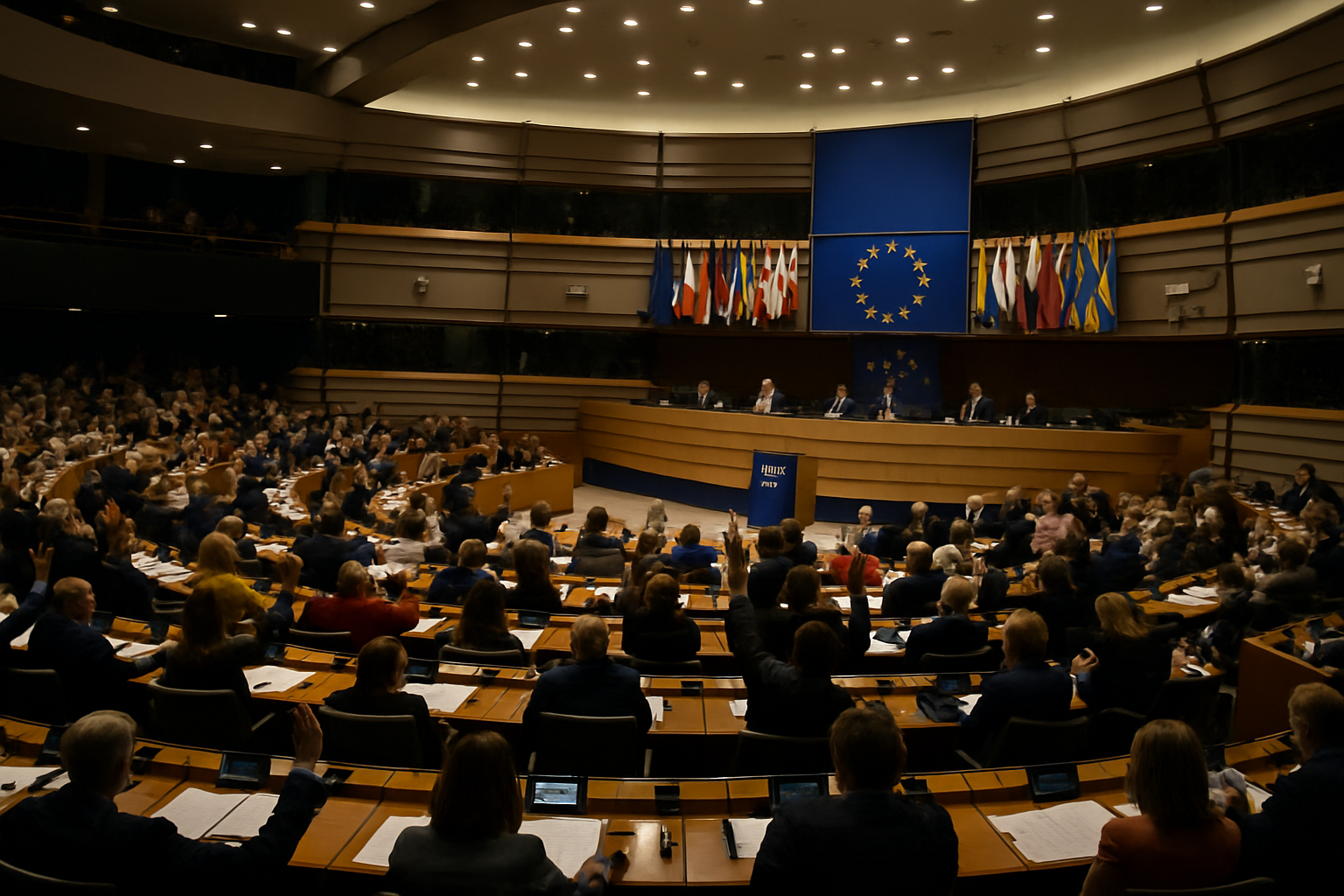
The European Parliament has approved conditional implementation of the landmark EU-US trade agreement, marking a critical juncture in transatlantic relations as the United States grapples with constitutional challenges to its trade authority and growing European concerns about American policy predictability.
The vote, held Thursday March 26, 2026, represents the first time the European Parliament has imposed such stringent conditions on a major US trade agreement, reflecting deep institutional concerns following the Trump administration's constitutional confrontations over tariff policy and judicial authority.
Parliamentary Conditions and Safeguards
According to sources from across European member states, the Parliament has introduced unprecedented oversight mechanisms to protect European economic interests. German media reports indicate the agreement now includes "strict conditions to ensure that the economic interests of the Union are respected," while Italian sources confirm the introduction of "clauses by large majority to guarantee compliance with commitments."
The conditional approval comes amid what Danish parliamentary sources describe as "controversial" negotiations, with lawmakers expressing concern about the stability of US trade policy following the Supreme Court's devastating 6-3 ruling in February that struck down President Trump's global tariff program under the International Emergency Economic Powers Act (IEEPA).
"An agreement is an agreement," European Commission officials declared, emphasizing that the US must honor its 2025 joint declaration trade commitments.
— European Commission Statement
Constitutional Crisis Context
The Parliament's decision occurs against the backdrop of the most serious constitutional crisis in American governance since Watergate. Following the Supreme Court's application of the "major questions doctrine," which requires congressional authorization for presidential actions of "vast economic and political significance," Trump immediately escalated to 15% global tariffs using Section 122 of the Trade Act 1974 while launching unprecedented attacks on the judiciary.
The President called Supreme Court justices "disgrace to our nation" and "disloyal to Constitution," representing the most severe attack on judicial independence by a sitting president in modern American history. This constitutional confrontation has raised fundamental questions about the reliability of US trade policy and institutional governance that directly influence European strategic planning.

European Strategic Response
Bernd Lange, the influential German Social Democrat who chairs the Parliament's Trade Committee, has been leading the institutional response to what European officials characterize as American policy "chaos." Sources indicate that Lange has suggested potentially freezing US trade agreements entirely if institutional reliability cannot be guaranteed.
The Parliament's approach represents a broader European strategic autonomy initiative, building on the February 2026 Alden Biesen competitiveness summit where EU leaders agreed on comprehensive single market reforms and "European champions" creation to reduce dependence on unreliable trading partners.
Enforcement Mechanisms
Romanian parliamentary sources confirm that the new framework includes "strict conditions" with enhanced enforcement mechanisms. The agreement now features:
- Mandatory compliance verification systems
- Suspension clauses for policy violations
- Enhanced dispute resolution mechanisms
- Regular review processes tied to institutional stability
Transatlantic Relations Under Strain
The conditional approval reflects deeper tensions in the transatlantic relationship, with EU Foreign Policy Chief Kaja Kallas having delivered unprecedented criticism in recent months, accusing the Trump administration of actively seeking to "divide Europe" and demonstrating clear hostility toward the European Union as an institution.
This institutional friction extends beyond trade policy to fundamental questions about Western cooperation. The Spain-US diplomatic crisis over military base access for Iran operations, where Trump called Spain a "terrible ally," exemplifies the growing divide in approaches to international law and multilateral cooperation.
"The U.S. has been very clear that they want to divide Europe. They don't like the European Union. Our answer should not be that we handle Trump bilaterally, but that we do it together."
— Kaja Kallas, EU High Representative
Economic Implications and Market Response
The conditional framework addresses European concerns about economic sovereignty while maintaining the potential benefits of expanded transatlantic trade. The agreement, if fully implemented under the new conditions, would eliminate numerous tariffs between the trading blocs, potentially benefiting European automotive, machinery, chemical, and pharmaceutical exporters while providing American agricultural products improved European market access.
However, the uncertainty created by ongoing US constitutional challenges has already impacted market confidence. Slovakia's pioneering €1.3 billion digital euro pilot program and enhanced European "Made in Europe" industrial policies reflect growing continental determination to reduce strategic dependencies on unpredictable partners.
Global Competition Context
The Parliamentary vote occurs within a broader context of global trade realignment, with China announcing zero-tariff arrangements with 53 African countries and the EU successfully implementing the Mercosur agreement despite internal opposition. European Commission President Ursula von der Leyen's "commercial trilogy" strategy aims to establish the EU as a "third pole" in global competition, reducing reliance on both American and Chinese systems.
The conditional approval enables European engagement with the US market while protecting against institutional instability. This approach contrasts sharply with the Trump administration's preference for bilateral negotiations that bypass multilateral frameworks, as demonstrated in recent agreements with Argentina and India.
Implementation Challenges Ahead
The path forward requires careful coordination between European institutions and American trade authorities operating under constitutional constraints. The Supreme Court's 150-day limit on Section 122 tariffs creates urgent pressure for congressional action, while European parliamentarians have made clear that full implementation depends on American institutional stability and policy predictability.
The agreement's success will largely depend on whether American democratic institutions can resolve the ongoing constitutional crisis and establish reliable trade authority that European partners can trust for long-term economic planning.
Historical Significance
This represents the first time the European Parliament has imposed such comprehensive conditions on a major US trade agreement due to concerns about partner institutional stability. The precedent may influence how democratic partners approach trade relationships with nations experiencing constitutional or institutional challenges.
The vote reflects Europe's evolution from reactive crisis management to proactive strategic planning, with 89% of Europeans demanding greater EU unity and 86% wanting a stronger global voice according to recent Eurobarometer polling. This democratic mandate provides legitimacy for the Parliament's assertive approach to protecting European economic interests.
As the United States works to resolve its constitutional crisis over trade authority, the European Union has demonstrated that even close allies must meet institutional reliability standards for full economic partnership. The conditional approval preserves transatlantic economic opportunities while safeguarding European sovereignty and economic security in an increasingly multipolar world.