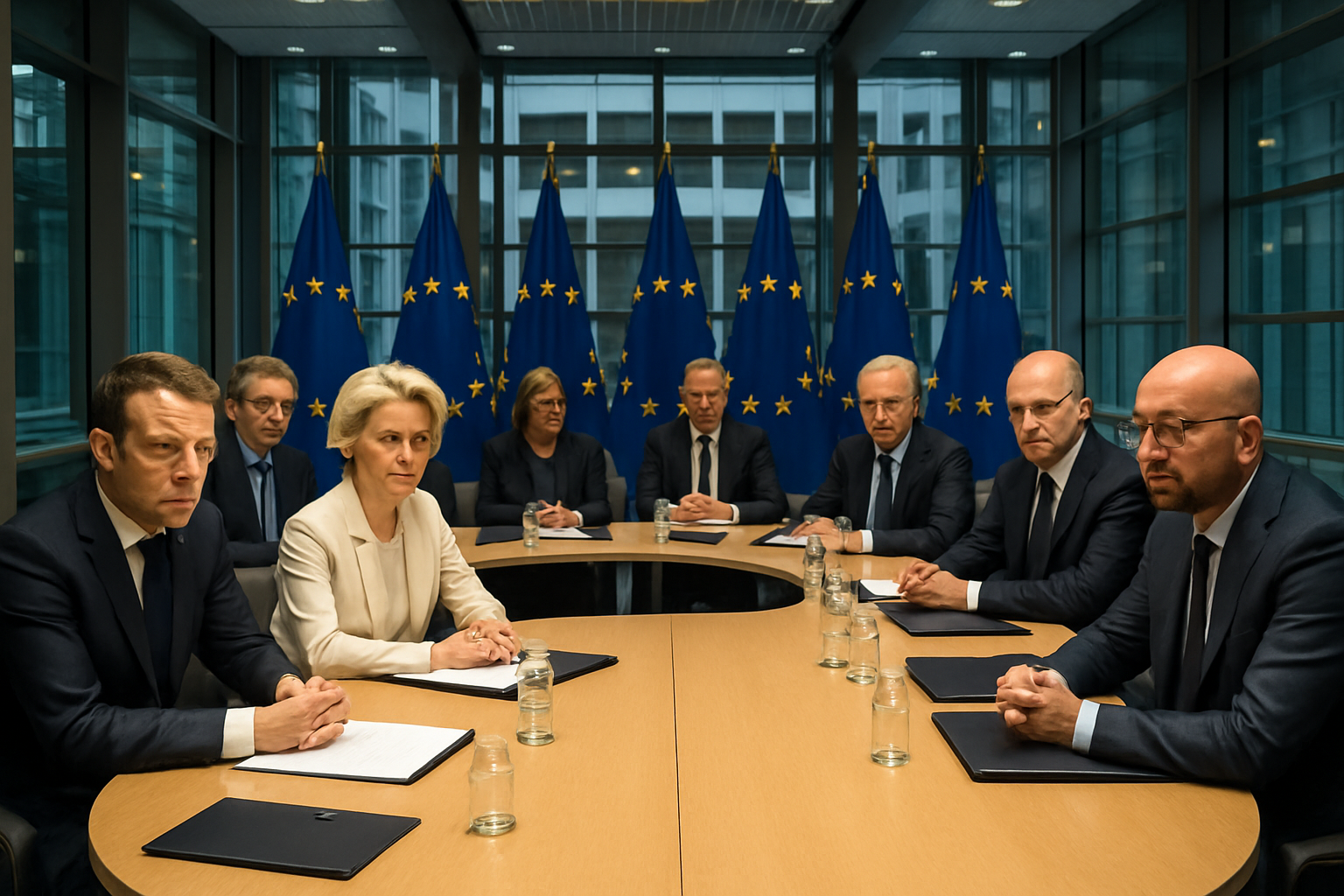
European Union leaders are increasingly turning to "enhanced cooperation" mechanisms to bypass national vetoes and accelerate critical decision-making, following recent informal summits that revealed growing frustration with unanimity requirements amid multiple continental challenges.
The shift toward this procedural workaround was evident during yesterday's informal summit outside Brussels, where 27 EU leaders spent several hours discussing ways to speed up policy implementation without being blocked by individual member states. The mechanism allows at least nine member states to advance policies without requiring unanimous consent from all members.
Defense and Security Cooperation Tensions
The enhanced cooperation discussions come as European security concerns intensify. According to a new Eurobarometer survey, two-thirds of Europeans (68%) consider their country's security threatened, with the highest threat perceptions in France (80%), followed by the Netherlands and Denmark (77%), and Cyprus and Germany (75%).
European Commission President Ursula von der Leyen has emphasized that "Europe must do more" and must "be able to defend itself," particularly as transatlantic relations face new uncertainties. The EU will not participate in President Trump's first Peace Council meeting scheduled for February 19 in Washington, with von der Leyen's spokesperson confirming no EU representatives will attend.
"The alliance with the US is important, a strong EU means a strong NATO"
— Ursula von der Leyen, European Commission President
Despite this stance, 52% of Europeans express confidence that the EU will strengthen security and defense capabilities, providing political backing for enhanced cooperation in defense matters when unanimous agreement proves elusive.
Romanian Perspective on European Security
The security concerns are particularly acute in Eastern Europe. Romanian sources emphasize that two-thirds of Europeans view their national security as threatened, with public opinion supporting greater EU involvement in defense matters. This sentiment provides democratic legitimacy for leaders seeking to circumvent individual country vetoes on security policies.
The Romanian data shows that countries with the greatest threat perception – France at 80%, the Netherlands and Denmark at 77%, and Cyprus and Germany at 75% – are driving demands for more agile EU decision-making processes that don't get stalled by single-country opposition.
A Europe of Multiple Speeds
The enhanced cooperation mechanism represents a fundamental shift toward what critics call a "Europe of two or more speeds," where core groups of countries can advance integration while others remain outside specific policy areas. EU treaties provide for this safety valve when decisions cannot secure agreement from all member states, requiring only nine or more countries to proceed.
This approach has gained momentum as leaders grow frustrated with individual countries blocking progress on critical issues ranging from defense spending to immigration policy. The mechanism allows the EU to maintain forward momentum while accommodating member states with different priorities or domestic constraints.
Transatlantic Relations Under Strain
The enhanced cooperation discussions occur against the backdrop of challenging US-EU relations. The European Commission's decision to skip Trump's Peace Council meeting signals continued diplomatic tensions, despite von der Leyen's public statements about the importance of the US alliance.
The Trump administration's bilateral approach to international relations, including separate trade deals with individual countries like Argentina and India, has created pressure for the EU to develop more unified responses. Enhanced cooperation could provide a mechanism for core European countries to coordinate positions without waiting for consensus from all 27 members.
Democratic Legitimacy and Public Support
The enhanced cooperation trend benefits from strong public backing for greater European unity. Recent polling shows 89% of Europeans demand greater EU unity, while 86% want a stronger global voice, providing democratic mandate for ambitious integration despite internal political friction over specific approaches.
However, critics argue that enhanced cooperation undermines the principle of European solidarity by allowing some members to advance while others are left behind. Supporters contend it prevents the slowest common denominator from paralyzing the entire Union during crisis periods.
Implementation Challenges
The practical implementation of enhanced cooperation faces significant challenges. Any policy area using this mechanism must still respect EU treaties and cannot discriminate against non-participating member states. Additionally, policies developed through enhanced cooperation must remain open to all EU members who wish to join later.
The mechanism has been used successfully in areas like the European Public Prosecutor's Office and the EU's enhanced defense cooperation (PESCO), but extending it to more controversial areas like immigration or fiscal policy could prove more difficult.
Future Trajectory
The growing embrace of enhanced cooperation suggests European leaders are prioritizing effectiveness over inclusivity in policy-making. As global challenges from security threats to economic competition intensify, the EU appears willing to accept a more differentiated approach to integration rather than accept paralysis from unanimous decision-making requirements.
The success of this approach will likely determine whether the EU can maintain relevance as a global actor or continues to struggle with the institutional constraints that have limited its agility in responding to crises. With 68% of Europeans feeling their security is threatened and majority support for stronger EU defense capabilities, the political conditions appear favorable for this institutional evolution.
The enhanced cooperation mechanism represents both an opportunity and a risk for European integration – potentially allowing core groups to advance crucial policies while creating the possibility of a permanently fragmented Union where different members participate in different aspects of European cooperation.