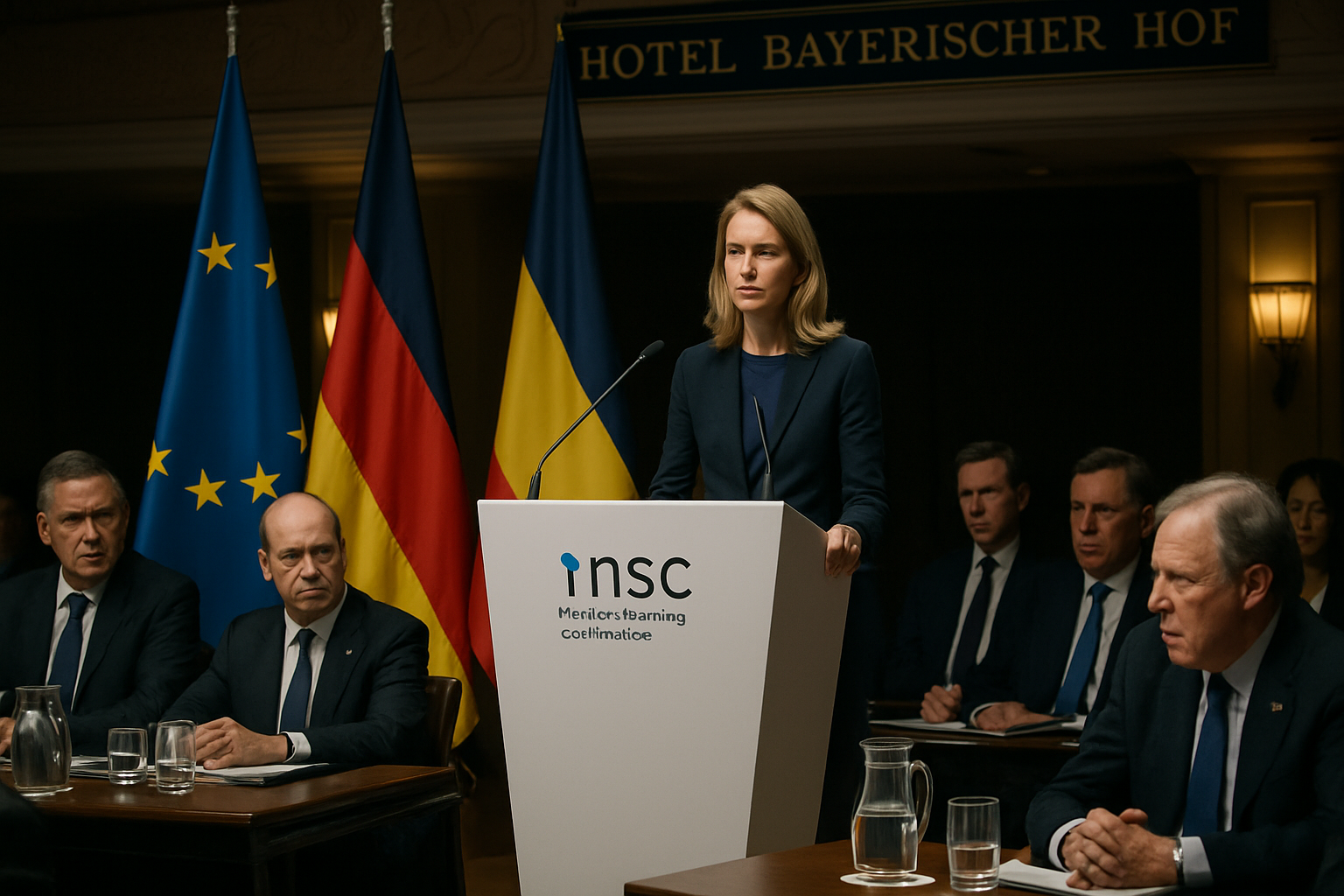
European leaders delivered a forceful rejection of American criticisms characterizing the continent as facing "civilizational decline," with EU foreign policy chief Kaja Kallas leading a defiant pushback at the Munich Security Conference that underscored deepening transatlantic tensions.
Speaking at the annual gathering on Sunday, Kallas dismissed what she termed "European bashing" from the Trump administration while welcoming the message of unity delivered by US Secretary of State Marco Rubio. Her remarks came in direct response to the administration's national security strategy, published in December, which claimed European economic stagnation "pales before the grimmer prospect of civilizational erasure."
European Unity Against American Criticism
"Contrary to what some may say, woke decadent, Europe is not facing civilizational erasure," Kallas declared during a panel titled "Europeans Assemble! Reclaiming Agency in a Rougher World." The Estonian politician, who assumed the EU's top diplomatic post in December, argued that global interest in the European project remains strong, citing that over 40% of Canadians expressed interest in joining the European Union during her recent visit.
Kallas emphasized that citizens across the 27-member bloc want the EU "to take a stronger role in the world, to defend our values, to take care of our people and to push humanity forward." Her comments reflected a broader European sentiment that the continent must assert greater strategic autonomy in response to perceived American disengagement.
Transatlantic Relations at Historic Low
The Munich Security Conference, held under the theme "Era of Disruptive Politics: Challenges to International Order," exposed the deepest strain in US-European relations since the Cold War. The tensions trace back to controversial remarks by US Vice President JD Vance at last year's conference, which European officials described as creating an "unprecedented breach" in alliance relations.
Rubio's participation was viewed as a diplomatic reset attempt, yet his absence from a critical Ukraine supporters meeting with German, French, and Polish leaders was interpreted by European officials as declining American interest in European-led initiatives. The Secretary of State cited scheduling conflicts for missing the session.
"The Europeans are not really clear on what they're dealing with when it comes to the Americans. However, it's clear that the EU wants to become more self-confident and independent - especially when it comes to defense."
— German media analysis
Nuclear Deterrence Discussions Mark Historic Shift
Perhaps most significantly, the conference witnessed the first serious discussions since the Cold War's end about expanding France's nuclear deterrent beyond its national scope. German Chancellor Friedrich Merz confirmed direct talks with French President Emmanuel Macron about nuclear cooperation, with Germany, Poland, and Finland engaging in preliminary conversations about extended deterrence arrangements.
This unprecedented development reflects growing concerns about the reliability of US security guarantees under the Trump administration. The discussions coincide with the expiration of the New START treaty on February 5, creating the first nuclear arms control void between the US and Russia in over 50 years.
Ukraine Crisis Highlights European Resolve
The conference took place against the backdrop of the ongoing Ukraine conflict, where European commitment has remained steadfast despite American policy shifts. The EU approved a historic €90 billion loan package for Ukraine – the largest assistance package ever for a single nation – though Slovakia, the Czech Republic, and Hungary refused participation, showing persistent divisions within the bloc.
Kallas criticized the exclusion of the EU from Ukraine peace negotiations, calling it a mistake. "Without Europeans, there will be no peace," she declared, as negotiations evolve toward a potential Washington venue with a June 2026 deadline established by the Trump administration.
Strategic Autonomy vs. Alliance Solidarity
The tension between maintaining NATO alliance commitments while pursuing European strategic autonomy emerged as a central theme. European leaders emphasized their desire to be "more self-confident and independent" in defense matters, particularly as questions mount about long-term American commitment to European security.
French President Macron's previous statements about Europe becoming a "geopolitical power providing its own security" have gained renewed relevance. The conference highlighted European determination to develop independent capabilities while preserving transatlantic relationships, though the balance remains delicate.
China's Quiet Satisfaction
The transatlantic discord has not gone unnoticed in Beijing. Chinese observers at the Munich Security Conference noted a shift from previous years when China was primarily mentioned to be criticized. Instead, as one seasoned Chinese delegate observed, "things flipped last year when, instead of taking Beijing to task, US Vice-President J.D. Vance targeted Europe."
This dynamic has allowed China to enjoy relative silence while transatlantic tensions dominate discussions, potentially benefiting Beijing's strategic position in the global competition for influence.
Implications for Global Order
The Munich Security Conference exchanges represent more than diplomatic rhetoric – they signal a fundamental reassessment of the Western alliance structure that has underpinned international order since World War II. European leaders' choice of strategic autonomy over traditional American deference marks a potential inflection point in transatlantic relations.
The conference outcomes will influence European security architecture adaptation, conflict resolution mechanisms, and the broader question of whether Western institutions can adapt to 21st-century challenges including authoritarian resistance, technological disruption, and climate security intersections.
Looking Ahead
As the conference concluded, it was clear that the relationship between America and Europe is undergoing its most significant transformation in decades. Whether this leads to renewed Western unity through institutional adaptation or continued fragmentation amid global power competition remains the pivotal question for international relations.
The European pushback against American criticism at Munich may mark the beginning of a new chapter in transatlantic relations – one where Europe asserts itself as an equal partner rather than a junior ally, fundamentally reshaping the Western alliance for the challenges ahead.