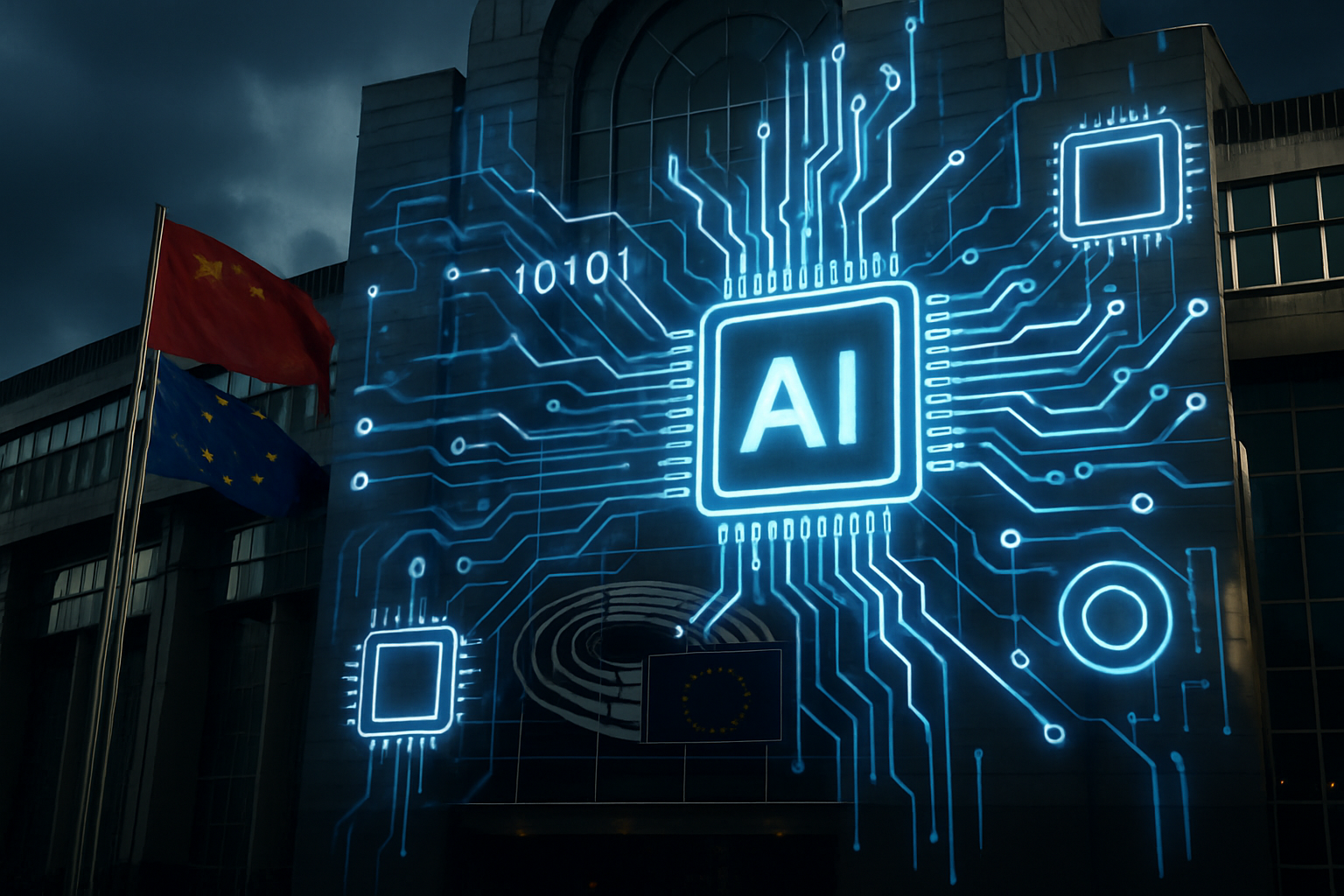
The European Union's ambitious industrial policy designed to challenge China's technological dominance has undergone a dramatic reversal, with EU officials quietly removing artificial intelligence, semiconductors, and quantum computing from a list of strategic technologies that must be "made in Europe" to access billions in government funding.
The significant policy shift, revealed in leaked drafts of the Industrial Accelerator Act (IAA) ahead of its formal unveiling by the European Commission on Wednesday, represents a major retreat from Europe's earlier confrontational stance toward Chinese technological competition. Biotechnology and robotics have also been cut from the strategic technologies list, marking a fundamental recalibration of EU industrial strategy.
From Confrontation to Accommodation
The changes come amid mounting evidence that Europe's initial approach of excluding non-EU producers from strategic technology funding was proving economically and politically unsustainable. The memory behind this shift traces back to February 2026's European competitiveness crisis summit at Alden Biesen castle in Belgium, where EU leaders confronted the reality of China's overwhelming dominance in critical materials production.
China controls 60% of global critical materials production and 90% of refining capacity, creating what European Parliament President Roberta Metsola described as "kill switch" vulnerabilities for European infrastructure. The ongoing global memory crisis, with semiconductor prices surging sixfold and affecting Samsung, SK Hynix, and Micron operations, has exposed Europe's technological dependencies more starkly than ever.
The Price of Strategic Autonomy
The original Industrial Accelerator Act was conceived as Europe's answer to growing concerns about technological sovereignty. However, the reality of implementing such restrictions has proven far more complex than initially anticipated. The global semiconductor shortage, expected to persist until 2027 when new fabrication facilities come online, has forced European policymakers to reconsider their approach to supply chain independence.
"The margins are narrowing and we need bold moves for strengthening competitiveness,"
— Roberta Metsola, European Parliament President
Germany's assessment that China has evolved from a "lucrative market to competitive threat" in high-tech manufacturing illustrates the challenge facing European leaders. German Chancellor Friedrich Merz's recent Beijing visit, which secured 120 Airbus aircraft orders worth billions of euros, demonstrates the practical tensions between economic cooperation and strategic competition.
China's Systematic Technology Advancement
The EU's policy reversal comes as China continues to achieve breakthrough technological capabilities despite existing restrictions. Chinese companies like DeepSeek have successfully trained AI models on Nvidia's restricted Blackwell chips, while companies such as Unitree Robotics have scaled humanoid robot production from 5,500 to 10,000-20,000 units, demonstrating China's ability to circumvent technological constraints through indigenous innovation.
China's comprehensive AI strategy includes the transition from domestic "100 Model War" competition to global leadership ambitions. ByteDance's Seedance 2.0 demonstrates cinema-quality video generation capabilities, while Chinese firms now compete directly with established European manufacturers in sophisticated products across multiple sectors.
The Economic Reality Check
The "SaaSpocalypse" market phenomenon has eliminated hundreds of billions in traditional software market cap as AI systems replace conventional solutions. This disruption has forced European companies to reassess their competitive positioning against both American and Chinese rivals.
The Netherlands, despite having the highest European AI talent density, struggles with funding gaps and brain drain to Silicon Valley, hampering commercialization efforts. Meanwhile, massive infrastructure investments continue globally, with Alphabet committing $185 billion to AI infrastructure in 2026 and Amazon planning over $1 trillion in development.
Regulatory Complexity and Implementation Challenges
The EU's initial approach of comprehensive technology restrictions has been complicated by the reality of implementing such policies across 27 member states with varying economic interests. The success of sector-specific agreements, such as China's reduction of EU dairy import tariffs from 21.9%-42.7% to 7.4%-11.7%, demonstrates the potential for targeted cooperation even amid broader competitive tensions.
European officials have been forced to balance immediate economic needs against long-term strategic concerns. The compressed timeline due to external pressures from both Trump administration bilateral deals and Chinese technological advancement has created additional urgency for policy recalibration.
The Digital Sovereignty Paradox
While the EU retreats from comprehensive technology restrictions, it has simultaneously intensified regulatory oversight in other areas. Spain has implemented the world's first criminal executive liability framework for tech platforms, while France has conducted cybercrime raids on AI companies. This suggests a shift from industrial policy to regulatory governance as the primary tool for managing technological competition.
The European digital independence push continues through initiatives like Deutsche Telekom's Industrial AI Cloud in Munich, representing an alternative approach focused on building indigenous capabilities rather than excluding foreign competition.
Global Implications and Future Outlook
The EU's policy reversal signals recognition that technological sovereignty cannot be achieved through isolation in an interconnected global economy. The success of multilateral frameworks, such as the US-EU-Japan Critical Minerals Partnership encompassing 55 countries, suggests that cooperation rather than exclusion may prove more effective for managing technological competition.
The Industrial Accelerator Act's modification reflects broader questions about democratic societies' ability to maintain economic sovereignty while participating in global technological development. The challenge now is developing frameworks that protect European interests without creating self-defeating isolation from technological progress.
Looking Ahead
As the European Commission officially unveils the modified Industrial Accelerator Act, the focus will shift to implementation and effectiveness. The removal of AI, semiconductors, and quantum technologies from strategic restrictions may provide short-term economic relief but raises questions about Europe's long-term technological competitiveness.
The success of this new approach will depend on Europe's ability to develop alternative mechanisms for maintaining technological sovereignty while participating in global innovation networks. The contrast between nations advancing comprehensive environmental and technological policies versus those retreating from such commitments may ultimately determine global technological leadership for the remainder of the decade.
The February 2026 inflection point represents a fundamental choice between gradual institutional evolution and rapid transformation necessary for 21st-century competitive survival. The modified Industrial Accelerator Act suggests Europe has chosen adaptation over isolation, but the long-term consequences of this strategic pivot remain to be seen.