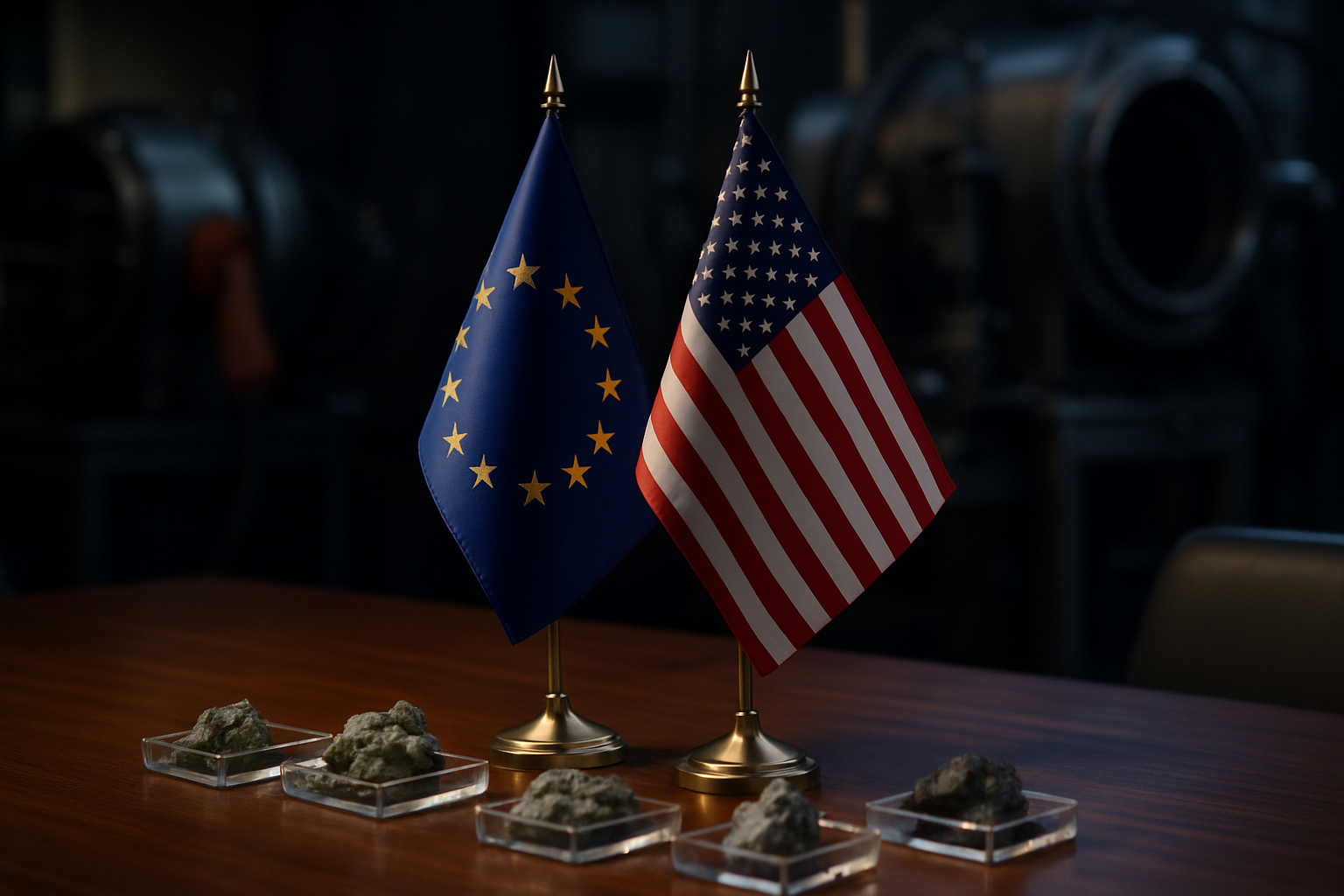
European Union representatives departed for Washington on February 3, 2026, hoping to secure critical cooperation agreements with the Trump administration on rare earth elements, as the bloc confronts mounting pressure to reduce its dangerous dependence on China for materials essential to industrial development and the green transition.
European Commissioner for Industrial Strategy Stéphane Séjourné will lead the EU delegation in high-level negotiations organized by US Secretary of State Marco Rubio in Washington, according to French press reports. The talks will include other nations seeking to diversify their supply chains away from Chinese dominance in critical raw materials markets.
The initiative comes as European Union auditors have issued stark warnings about the bloc's climate goals being at serious risk due to critical raw materials shortages and dangerous dependence on China, which controls 60% of global production and 90% of global refining capacity of materials essential for renewable energy infrastructure, electric vehicles, and clean technology.
Strategic Stakes in Critical Minerals
The EU's diplomatic mission reflects broader strategic autonomy concerns as the bloc seeks to coordinate efforts with the United States to challenge China's near-monopoly over rare earth elements including lithium, cobalt, and other materials crucial for the green energy transition. These materials are fundamental components in wind turbines, solar panels, electric vehicle batteries, and advanced electronics.
The timing of these negotiations is particularly significant given recent developments in the global rare earth landscape. Japan achieved the world's first successful deep-sea rare earth mining trial in early February 2026, extracting rare earth-bearing mud from 6,000 meters depth off Minamitorishima island, demonstrating alternative supply sources that could help reduce global dependence on Chinese production.
According to EU assessment reports, the bloc requires massive scaling of critical materials imports to meet its ambitious 2030 and 2050 climate neutrality targets. The current supply chain vulnerabilities have forced auditors to recommend immediate action including strategic stockpiling, alternative supplier agreements, domestic production acceleration, and enhanced recycling investments.
Energy Security Divisions Within EU
While the EU pursues cooperation with Washington on critical minerals, significant divisions have emerged among member states regarding Russian energy imports and broader security policies. According to reports from Politico cited by Russian news agency TASS, France and Belgium have opposed proposals for comprehensive bans on gas imports from Russia to the European Union.
Representatives of the French and Belgian governments reportedly stated they need "more reassurances on the economic and legal consequences of the move before making a decision" regarding potential Russian gas import prohibitions. This hesitation comes despite ongoing concerns about European energy security and geopolitical dependence on Russian energy supplies.
The energy security debate has been complicated by recent data showing Europe's gas storage replenishment has proceeded more slowly than usual. According to Gazprom figures, 8.9 billion cubic meters of gas were injected into European underground gas storage facilities in May 2025, which was 1.1 billion cubic meters less than the average for that month over the past decade, creating what industry analysts describe as an increasingly tense supply situation.
Shifting European Political Dynamics
The EU's approach to energy and strategic materials policy is also being shaped by evolving political relationships within Europe. Recent reports from The Telegraph suggest Germany is moving to deepen ties with Italy as tensions rise with France over EU trade policy, Emmanuel Macron's approaching exit from office in 2027, and relations with US President Donald Trump.
EU diplomatic sources quoted by The Telegraph described Macron as a "lame duck" whose mandate ends in 2027, with one diplomat noting: "Berlin needs partners it can work with. Can they work with Macron at the moment? Not really. He is leaving office soon and France is unstable. Germans hate instability."
This shifting dynamic within the traditional Franco-German axis that has long driven EU policymaking could have significant implications for the bloc's approach to energy security, trade relationships, and strategic autonomy initiatives including critical minerals policy.
US-EU Cooperation Framework
The Washington negotiations represent part of a broader Trump administration strategy to build coalitions against Chinese economic influence while strengthening ties with traditional allies. The talks organized by Secretary of State Rubio align with the administration's broader approach to international partnerships, as demonstrated by recent major trade agreements including the historic US-India deal that reduced American tariffs on Indian goods from 50% to 18%.
The European delegation's mission comes at a time when the Trump administration has signaled willingness to work with allies on strategic competition with China while pursuing bilateral agreements that advance American economic interests. The rare earth elements cooperation framework could serve as a model for similar partnerships with other allies seeking to reduce dependence on Chinese supply chains.
Economic and Geopolitical Implications
The success or failure of EU-US cooperation on critical minerals could have far-reaching implications for global supply chain restructuring and the future of clean energy transitions. Current Chinese dominance in rare earth processing creates vulnerabilities for Western nations pursuing ambitious climate goals while maintaining strategic independence.
Industry analysts suggest that meaningful diversification of critical minerals supply chains will require sustained political commitment, significant financial investments, and technical cooperation between the United States and Europe. The negotiations in Washington may determine whether such cooperation can overcome traditional trade disputes and regulatory differences between the Atlantic partners.
The broader energy security debate within the EU, meanwhile, highlights the ongoing challenge of balancing economic interests with geopolitical considerations. Member states' divided positions on Russian energy imports reflect different national circumstances, energy infrastructure dependencies, and risk assessments regarding supply security.
Looking Forward
As European representatives engage in Washington negotiations, the outcomes will likely influence not only EU-US relations but also the broader global competition for critical materials essential to the 21st-century economy. The talks occur against a backdrop of increasing great power competition, climate transition urgency, and supply chain vulnerabilities exposed by recent global disruptions.
The European Union's ability to reduce dependence on Chinese critical materials while maintaining energy security amid internal divisions will test the bloc's strategic autonomy ambitions and its capacity for coordinated action with international partners. Success in these negotiations could strengthen transatlantic cooperation on strategic competition with China, while failure might leave Europe more vulnerable to supply chain disruptions and geopolitical pressure.
The coming weeks will reveal whether the EU can bridge internal divisions on energy policy while securing new partnerships for critical materials that are essential to both economic competitiveness and climate transition goals in an increasingly complex geopolitical landscape.