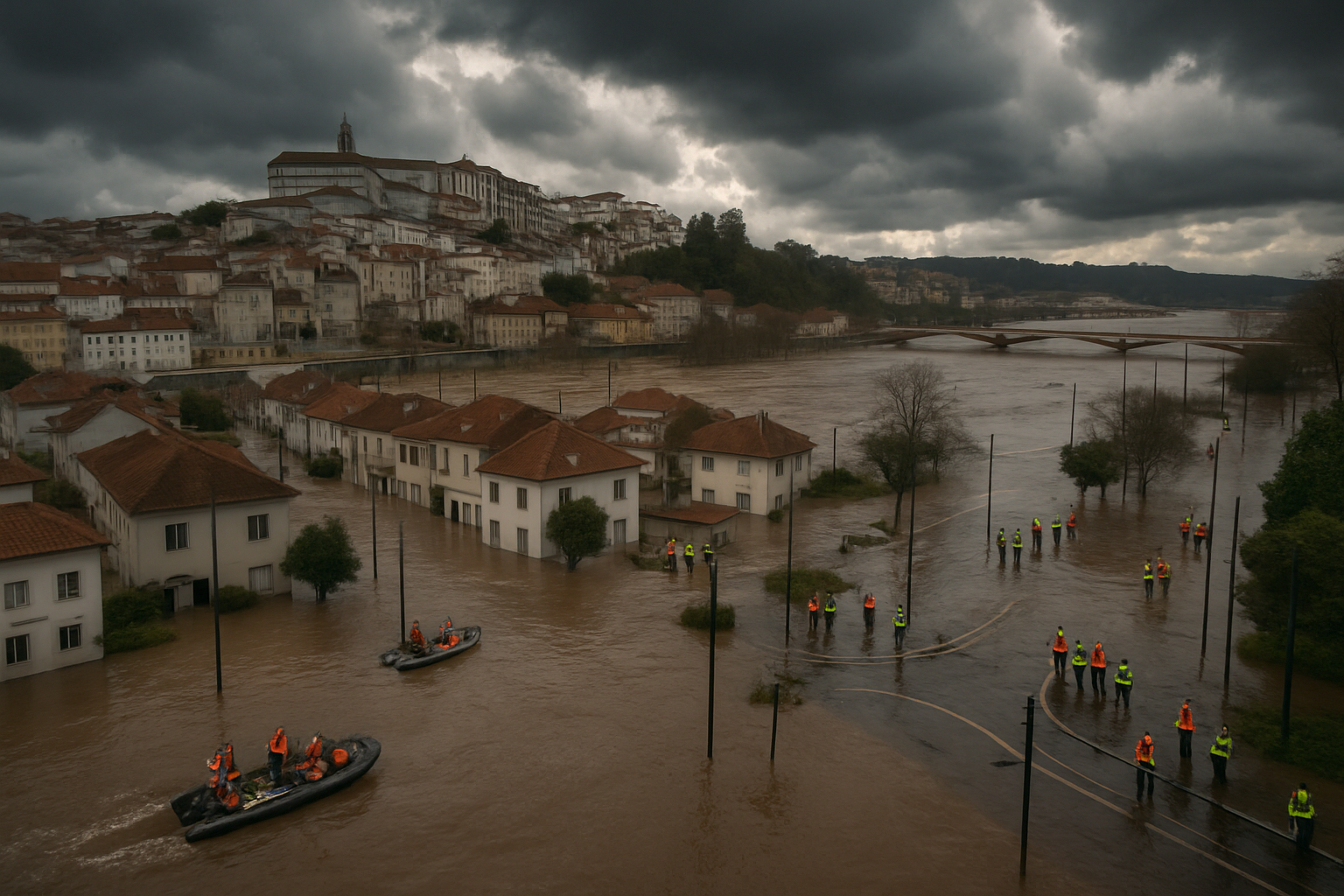
Storm Nils is bearing down on Europe's Atlantic coast with violent winds and torrential rains, prompting French authorities to issue red alerts for flooding across Gironde and Lot-et-Garonne departments as the continent faces its most severe climate crisis in decades.
The approaching tempest, scheduled to hit France's Atlantic facade Wednesday evening before tracking toward the Gulf of Lion and Corsica by Thursday, represents the latest in a devastating succession of extreme weather events that have overwhelmed emergency services and exposed critical infrastructure vulnerabilities across Europe.
Mounting Crisis Across Multiple Nations
Portugal remains under siege as the Mondego River basin faces renewed flood risks, with Civil Protection authorities warning populations in high-risk zones to exercise extreme caution. The situation in Coimbra has become particularly dire, with President Marcelo Rebelo de Sousa assuring preparations for "the worst-case scenario" as river levels continue to rise.
In Almada, emergency services have been forced to evacuate residents from Porto Brandão following dangerous landslides, while the Portuguese Environment Agency and Coimbra's mayor have both acknowledged the acute flooding risks facing the region.
"We are witnessing an unprecedented convergence of extreme weather events that is testing our emergency response capabilities to their absolute limits."
— Portuguese Civil Protection Official
Contributing to the Mondego's rising waters are not only persistent rainfall but also controlled discharges from the Aguieira dam, creating a complex hydrological situation that Prime Minister Luís Montenegro has sought to address with messages of calm reassurance to the public.
Historical Context of Devastation
The current crisis represents the culmination of Europe's most devastating winter weather period in modern history. The continent has endured a brutal succession of Atlantic storms – Kristin, Leonardo, and Marta – that collectively claimed at least 14 lives and required the deployment of over 26,500 emergency personnel in Portugal alone.
This unprecedented emergency response, described as Portugal's largest peacetime rescue operation, involved 1,975 military personnel and 30 naval vessels responding to more than 1,800 weather-related incidents since February 1st. The scale of the disaster has necessitated international cooperation, with Sweden and Denmark providing €246 million in emergency assistance and the activation of the EU Civil Protection Mechanism.
The human cost extends far beyond Portugal's borders. Across Europe, the winter crisis has resulted in over 140 deaths since late January, with infrastructure damage running into the billions of euros. The Douro River reached critical 1997 levels, while flooding in Alcácer do Sal exceeded the catastrophic records set in 1963.
New Zealand's Parallel Crisis
The climate emergency is not confined to Europe. New Zealand's MetService has forecast a dramatic weather transition, with muggy nights giving way to plunging temperatures as heavy rain and severe gales sweep across the country. This pattern mirrors the global nature of the climate crisis, where extreme weather events are occurring simultaneously across multiple continents.

Infrastructure Under Unprecedented Strain
The current crisis has exposed critical vulnerabilities in European infrastructure. Portugal's railway network has been severely compromised, with the Castanheira-Alverca line suspended, affecting thousands of Lisbon commuters. Power outages have left 167,000 residents without electricity, with some communities in Pombal enduring more than 10 days without power.
Transportation networks across the continent have virtually collapsed during peak crisis periods. The Ponte 25 de Abril bridge in Lisbon has had lanes closed, while 169 roads in Cádiz province alone have been rendered impassable. The cumulative effect has paralyzed normal commerce and daily life across vast regions.
Economic and Agricultural Impact
The agricultural sector has borne a particularly heavy burden, with Spanish reservoirs surging to 67.3% capacity as 31 reservoirs reached 100% capacity. While this might seem positive for water security, the rapid accumulation has led to catastrophic flooding of farmland and destroyed countless olive groves and citrus operations.
- Agricultural losses estimated in the billions across the Iberian Peninsula
- Tourism sector facing massive cancellations during peak booking season
- Recovery expected to take months, potentially extending into the 2026 tourism season
- Supply chain disruptions affecting food distribution across Europe
Climate Science and Global Context
The European crisis is unfolding against the backdrop of unprecedented global climate conditions. January 2026 has been confirmed as the hottest month in recorded history, marking the 18th consecutive month exceeding 1.5°C above pre-industrial levels. This warming trend is overriding natural climate variability, including La Niña cooling effects that would typically moderate global temperatures.
The Copernicus Climate Change Service data reveals a troubling acceleration in climate volatility, where record global heat coexists with devastating regional extremes. This pattern demonstrates how global warming enables both unprecedented heat records and extreme regional cold simultaneously through polar vortex disruption and Arctic warming effects.
"We are witnessing climate volatility where record global warmth coexists with devastating regional extremes. This is the new reality of climate change."
— Climate Scientists, Copernicus Service
Democratic Resilience Under Stress
Perhaps most remarkably, the crisis has also tested democratic institutions. Portugal successfully conducted its presidential election on February 8 despite the ongoing emergency, with Socialist António José Seguro achieving a historic landslide victory with 66.82% of the vote. However, 36,000 voters were unable to participate due to storm damage, raising important questions about climate change's impact on democratic processes.
This election has set a precedent for maintaining democratic continuity under environmental emergency conditions, though it highlights the growing intersection between climate change and governance challenges across Europe.
International Response and Cooperation
The scale of the crisis has necessitated unprecedented international cooperation. Beyond the Swedish-Danish assistance package, multiple European nations have contributed resources and expertise. The EU Civil Protection Mechanism's activation represents one of its most significant deployments, coordinating resources across member states to address the multi-national emergency.
Emergency services across Europe report operating at capacity limits, with traditional regional aid complicated by the simultaneous nature of disasters affecting multiple countries concurrently. This has exposed the need for enhanced international coordination frameworks designed specifically for climate-related emergencies.
Looking Forward: Adaptation and Resilience
As Storm Nils approaches, European authorities are implementing lessons learned from the earlier storms. Enhanced early warning systems, improved evacuation procedures, and better coordination between national and international response teams represent immediate improvements.
However, the crisis underscores the urgent need for fundamental infrastructure adaptation. Current systems, designed for historical climate patterns, are proving inadequate for the new reality of extreme weather frequency and intensity. The concept of "building back better" has become central to recovery planning, emphasizing climate-resilient infrastructure over simple reconstruction.
- Enhanced flood defense systems designed for increased precipitation
- Upgraded power grids capable of withstanding extreme weather
- Transportation networks with built-in redundancy and weather resistance
- Improved emergency communication systems for multi-lingual populations
The Human Cost
Beyond statistics and infrastructure damage, the human cost of Europe's climate crisis is mounting. Families have lost homes that represented generations of investment and memories. Small businesses, particularly in tourism-dependent communities, face existential threats. Elderly populations have proven especially vulnerable, with many weather-related casualties occurring during snow removal efforts or flood evacuations.
The psychological impact on communities repeatedly battered by extreme weather is also becoming apparent. Mental health services report increased demand in affected regions, as residents grapple with the trauma of repeated emergencies and uncertainty about future safety.
A Template for the Future
Europe's February 2026 crisis is providing a grim template for climate adaptation challenges worldwide. The convergence of multiple extreme weather events, the strain on emergency services, and the intersection with democratic processes offer crucial lessons for other regions facing similar challenges.
Scientists warn that the frequency and intensity of such events will only increase as global warming progresses. The current crisis represents not an aberration but a preview of conditions that may become routine by the 2030s without significant climate action and adaptation investments.
As Storm Nils approaches the coast, European leaders face a fundamental choice: continue reactive crisis management or invest in the transformative adaptation infrastructure needed for long-term resilience. The lives and livelihoods of millions of Europeans may depend on that decision.