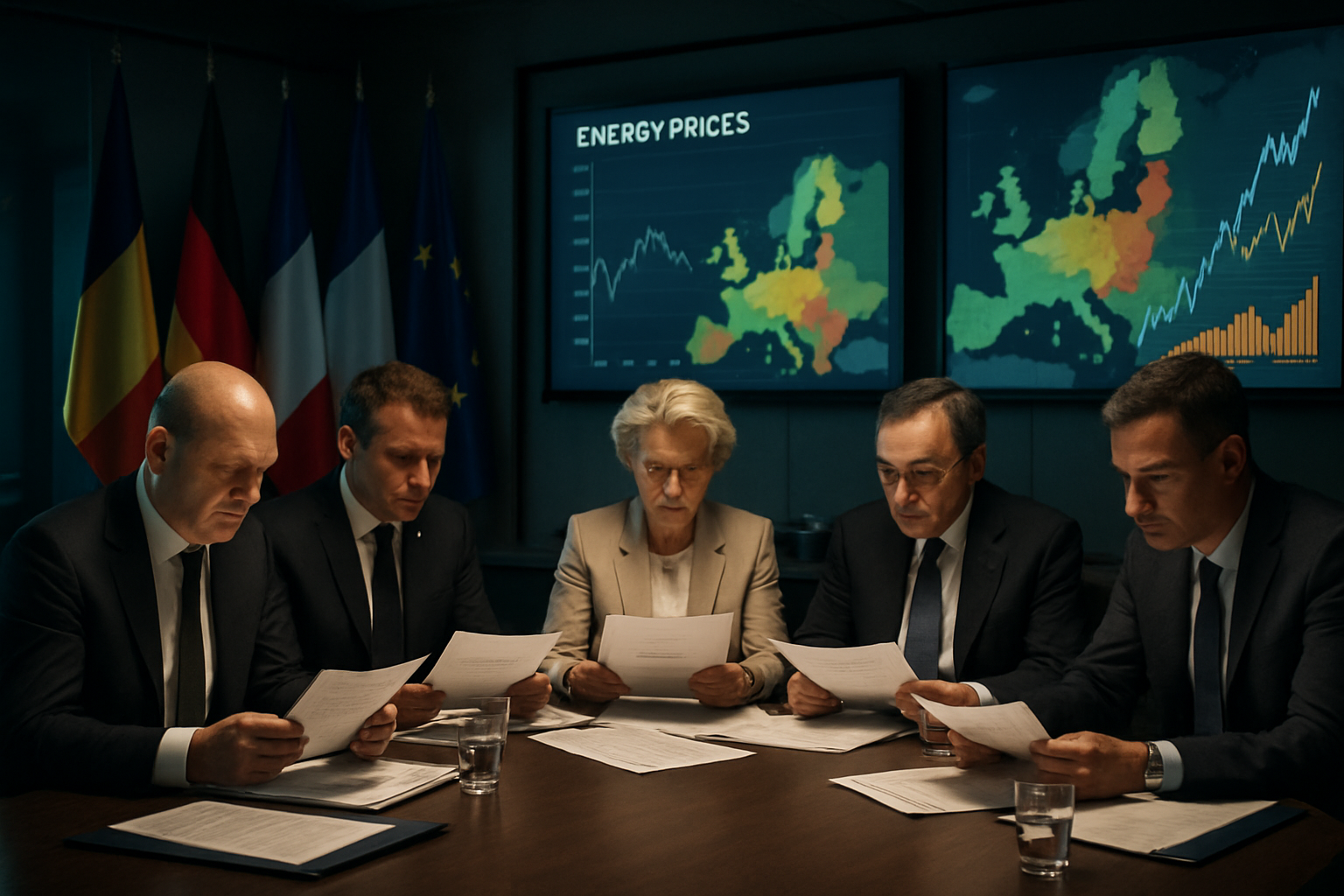
European governments have implemented the most comprehensive emergency energy measures since the 1970s oil crisis as the Middle East conflict continues to drive oil prices above $100 per barrel, creating an unprecedented challenge for both consumers and industry across the continent.
The crisis has prompted Austria's Finance Minister to announce plans for redistributing additional government revenues from high fuel prices, while Germany considers strengthening antitrust laws to prevent gas station price manipulation. Luxembourg faces a new surge in SP 98 gasoline prices, adding 5.1 centimes as the regional energy emergency deepens.
Austria Takes Bold Redistribution Action
Austrian Finance Minister Magnus Brunner has provided the first concrete details of government plans to address soaring fuel prices, announcing a redistribution mechanism for additional tax revenues generated by high energy costs. The proposal comes as Austria experiences fuel price increases of over 20 percent, prompting widespread criticism from trade unions and consumer groups.
"The government plans to redistribute excess revenues from high fuel prices back to Austrian consumers," Brunner stated during a televised interview on "Pro & Contra." The announcement represents a significant policy shift toward direct consumer relief as energy costs strain household budgets across the nation.
Germany Considers Market Intervention
The German Federal Ministry of Economics is preparing legislation to strengthen antitrust laws targeting fuel price manipulation, marking one of the most significant market interventions in modern German energy policy. The proposed measures would enhance regulatory oversight of gas stations and petroleum distributors amid what officials describe as "war-driven price explosions."
Consumer fuel costs in Germany are approaching €2 per liter, prompting calls for immediate regulatory action. The legislation package, currently under coordination between ministries, represents a departure from Germany's traditionally market-oriented energy policies.
Luxembourg Faces Additional Price Pressure
Luxembourg drivers experienced another blow as SP 98 gasoline prices increased by 5.1 centimes, effective Wednesday morning. The latest increase follows a series of fuel price hikes that have strained the country's traditionally fuel-dependent cross-border economy.
The price adjustment affects only premium unleaded gasoline, with other fuel variants remaining unchanged for now. However, energy analysts warn that additional increases are likely as global oil prices continue their volatile trajectory above $100 per barrel.
Global Context: Iran Conflict Drives Energy Crisis
The European energy crisis stems from Iran's Revolutionary Guard declaration of the Strait of Hormuz as "unsafe for shipping," effectively closing the critical waterway that handles 40 percent of global seaborne oil transit. This action has triggered the most severe energy security crisis in decades, with oil prices reaching their highest levels since 2022.
Brent crude peaked at $119.50 per barrel, while West Texas Intermediate jumped 18.98 percent to $108.15 per barrel in the largest single-day increase on record. Natural gas prices have surged 24 percent in Europe and 78 percent in the United States, reaching €47.32 per megawatt-hour—the highest level since February 2025.
Strategic Response Measures Across Europe
European nations have coordinated unprecedented emergency responses to address the crisis. France deployed 500 fuel station inspectors to prevent price manipulation, declaring that "war cannot serve as a pretext for abusive increases." Romania has outlined five scenarios to prevent diesel prices from exceeding 10 lei per liter, including temporary tax and excise reductions.
Slovakia activated its strategic petroleum reserves for the first time under current protocols, while Hungary implemented immediate price caps on gasoline and diesel to protect consumers from what officials termed "war-driven price explosions."
Portugal Reports on Global Crisis Response
According to Portuguese media analysis, countries worldwide are implementing dramatic measures to address fuel scarcity. Sri Lanka has decreed public holidays every Wednesday to conserve fuel amid shortages caused by the conflict between the United States, Israel, and Iran. The global scope of the crisis has prompted tax reductions and emergency conservation measures across multiple continents.
Slovakia's Energy Market Analysis
Slovak energy markets demonstrate the broader European vulnerability to Middle East disruptions. Without renewable energy sources and seasonal demand decreases, European electricity prices would already be approximately one-third higher, according to Slovak energy analysts. The country's strategic reserves activation reflects the critical nature of the current supply situation.
IEA Strategic Reserve Deployment
The International Energy Agency announced its largest strategic petroleum reserve release in 50-year history—400 million barrels from 32 member countries—more than double the 182.7 million barrels released during the 2022 Ukraine crisis. Japan is releasing 80 million barrels starting March 16, the first deployment since the 2011 Fukushima disaster, reflecting the country's 95 percent dependence on Middle Eastern oil imports.
Supply Chain Vulnerabilities Exposed
The crisis has exposed dangerous over-dependence on strategic chokepoints in global energy supply chains. The 21-mile Strait of Hormuz represents a single-point failure in modern logistics, with alternative Arabian Peninsula routes lacking adequate capacity and involving significant time and cost penalties.
Major shipping companies Maersk and MSC have suspended Persian Gulf operations, leaving over 150 oil and LNG tankers stranded with billions in cargo value. This disruption extends beyond energy to consumer goods and industrial materials, affecting manufacturing from automotive to electronics sectors.
Consumer Impact Across Europe
Swedish consumers face electricity increases of 10-20 öre per kilowatt-hour and gasoline price rises of 1-2 kronor per liter, with the Malmö region (Zone 4) most exposed due to continental European market integration. Ireland experiences what officials term "brazen rip-offs" in heating oil prices approaching €2 per liter.
The crisis has triggered panic buying in several European countries, with Montenegro implementing rationing at some fuel stations amid enormous queues. Bosnia-Herzegovina has been reduced to just two days of gas reserves, highlighting the acute vulnerability of smaller European nations to supply disruptions.
Long-term Energy Architecture Transformation
Energy security experts warn that the crisis highlights fundamental vulnerabilities requiring years or decades to address through supply diversification and renewable energy transitions. The over-dependence on volatile geopolitical regions and strategic chokepoints demands revolutionary changes to European energy planning.
Estonia's model of 88 percent renewable electricity and continental Europe's largest battery storage system serving 90,000 households represents one potential pathway toward energy independence. However, the renewable transition timeline leaves Europe vulnerable during the critical interim period.
Financial Market Implications
European financial markets have experienced severe volatility, with energy-intensive industries under particular pressure. Traditional monetary policy tools prove limited in addressing structural geopolitical disruptions, forcing central banks to coordinate emergency liquidity measures.
The European Central Bank and Bank of Japan are coordinating unprecedented responses to prevent financial contagion, while companies across sectors reassess expansion plans and supply chain strategies.
Template-Setting Crisis Management
The current crisis represents a template-setting moment for 21st-century European energy security, testing multilateral cooperation and institutional resilience under extreme pressure. The coordination of national responses with EU-wide frameworks demonstrates efforts to balance sovereignty with collective security needs.
Success in managing this crisis will influence European approaches to energy governance for decades, while failure could accelerate fragmentation and undermine confidence in coordinated responses to future emergencies.
As the situation continues to develop, European leaders face critical decisions balancing immediate consumer relief against long-term energy security architecture transformation. The coming weeks will prove decisive in determining whether Europe can maintain unity and effective crisis response in the face of the most severe energy challenge since the 1970s.