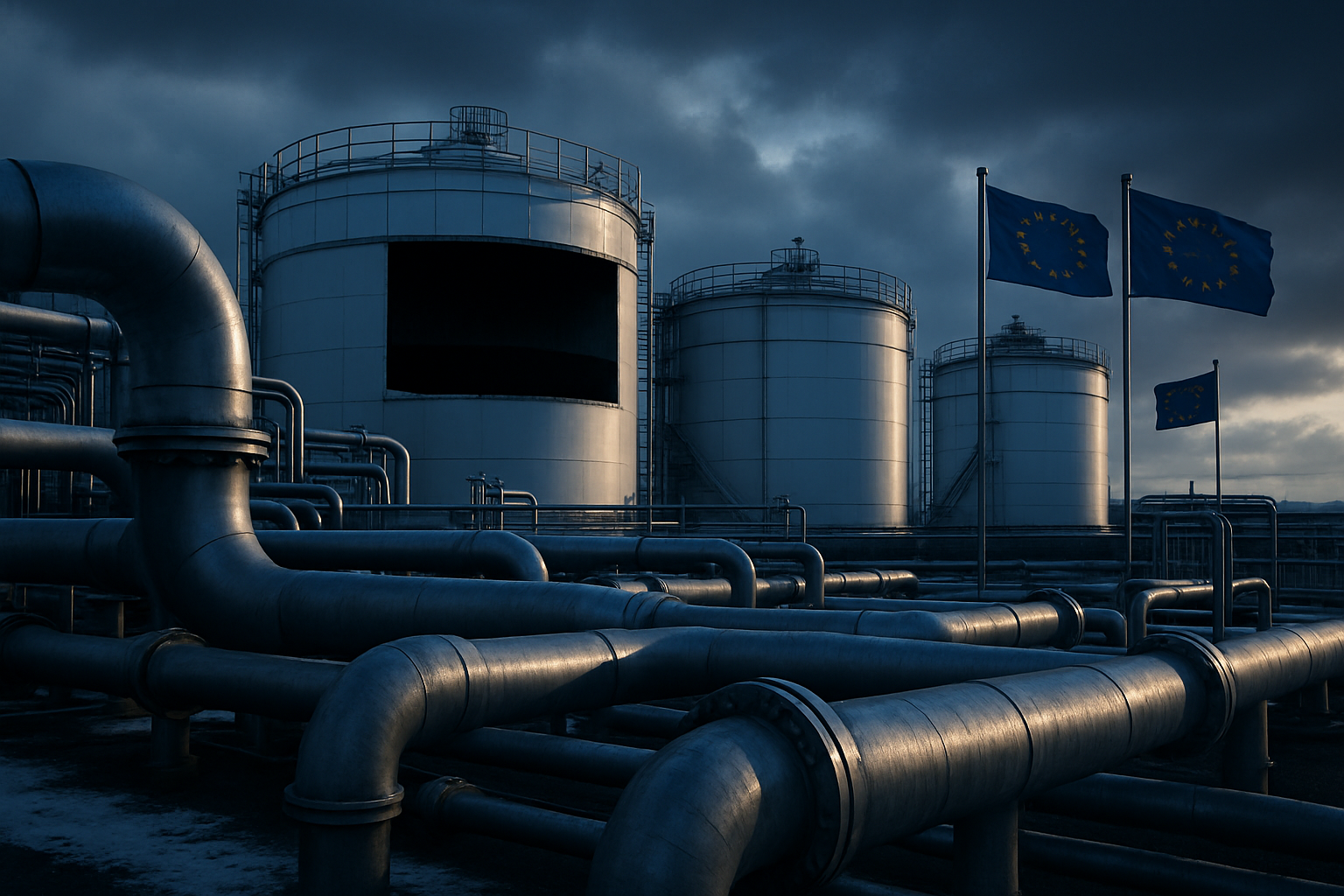
Europe is confronting its most severe energy security crisis in decades as escalating Middle East conflicts threaten critical gas and oil supply routes, leaving some nations with dangerously low reserves and consumers facing unprecedented price increases.
Great Britain has been reduced to just two days of stored fossil gas, according to figures from National Gas, which owns and operates the country's gas transmission system. The dire situation reflects a broader European energy emergency as Middle East conflicts continue to disrupt liquefied natural gas (LNG) deliveries and oil transit routes.
Critical Supply Disruptions
The crisis stems from the ongoing Iran-US-Israel conflict that has effectively closed the Strait of Hormuz, through which 40% of global seaborne oil transits. Iran's Revolutionary Guard declared the vital waterway "unsafe," forcing major shipping companies Maersk and MSC to suspend operations, leaving over 150 oil and LNG tankers stranded in the Persian Gulf representing billions in cargo value.
Great Britain's gas storage fell to 6,999 gigawatt hours (GWh) on Saturday, a significant drop from 9,105 GWh recorded the same period last year. While National Gas insists storage levels remain "broadly in line" with seasonal norms, the dramatic reduction highlights Europe's vulnerability to supply chain disruptions.
Qatar, which supplies approximately 20% of global LNG exports, has halted production at its Ras Laffan and Mesaid facilities following Iranian attacks on energy infrastructure. The Gulf state's Energy Minister Saad Al Kaabi warned that all Gulf exporters may be "forced to declare force majeure" within weeks if the conflict continues, potentially bringing oil prices to $150 per barrel.
Cascading Energy Price Impacts
European natural gas prices have exploded by 50% to €47.32 per megawatt hour (MWh), reaching the highest levels since February 2025. The ripple effects are being felt across the continent, with Sweden predicting electricity price increases of 10-20 öre and gasoline rising by 1-2 kronor, particularly affecting the Malmö region due to its integration with continental European energy markets.
"The situation is far more severe than initially anticipated, with financial markets emerging as the ultimate constraint on prolonged conflict,"
— Damien Boey, Portfolio Strategist
Ireland faces "brazen rip-off" heating oil and motor fuel price increases, while Austria reports fuel costs rising by 20%. Energy analyst Samuel Ciszuk described the crisis as the "most severe energy security crisis in decades," highlighting how single-chokepoint vulnerabilities have been catastrophically exposed.
Malta would face fuel prices 45% higher without government subsidies, according to Prime Minister Robert Abela, while Bangladesh has implemented comprehensive fuel rationing for its 170 million citizens. Bosnia-Herzegovina has been reduced to just two days of gas reserves, demonstrating how the crisis extends far beyond Western Europe.
Aviation and Transportation Chaos
The energy crisis parallels an unprecedented aviation disruption, with over 18,000 flights cancelled worldwide—the most extensive disruption since COVID-19. Eight Middle Eastern countries have simultaneously closed their airspace, including Iran, Iraq, Israel, UAE, Qatar, Syria, Kuwait, and Bahrain.
Dubai International Airport, the world's busiest with over 86 million passengers annually, remains completely shut down due to missile damage. Major carriers including Emirates, Air France-KLM, Wizz Air, and Bulgaria Air have suspended operations indefinitely, affecting hundreds of thousands of passengers globally and severing critical Europe-Asia connectivity through Middle Eastern hubs.
Government Emergency Responses
European governments are scrambling to implement emergency measures. The EU has rapidly developed state aid options for energy-intensive industries, while Cyprus activated its ESTIA evacuation plan for the first time in history, coordinating the extraction of over 2,000 EU nationals from the UAE.
Japan is considering deploying its national oil stockpiles for the first time since the 2011 Fukushima disaster, particularly concerning given that the country relies on the Middle East for 95% of its oil supplies, with 70% transiting through the now-closed Strait of Hormuz.
The US Energy Secretary has confirmed considering lifting additional Russian oil sanctions to help ease global supply shortages, following a 30-day waiver allowing Indian refiners to purchase Russian oil to maintain global supply stability. "Hundreds of millions of barrels of sanctioned oil" could potentially be made available for market stabilization.
Financial Market Meltdown
Global financial markets have crashed in response to the crisis. Pakistan's KSE-100 index suffered its largest single-day decline in history, falling 8.97%. South Korea's KOSPI dropped 12%, triggering circuit breakers, while the Korean won hit a 17-year low. The Dow Jones futures fell 400-570 points, and European markets experienced severe losses across Germany's DAX and Italy's Milan exchanges.
PayPal postponed its $1.1 billion IPO indefinitely due to market volatility, while central banks including the European Central Bank and Bank of Japan are coordinating emergency liquidity provisions to prevent financial contagion.
Nuclear Diplomacy Collapse
The energy crisis emerged from the complete breakdown of US-Iran nuclear negotiations, despite achieving a "broad agreement on guiding principles"—the most progress since the JCPOA collapse in 2018. The diplomatic failure occurred over fundamental scope disagreements, with Iran excluding ballistic missiles and regional proxies as "red lines" in nuclear-only talks, while the US demanded comprehensive agreements including missiles, armed groups, and human rights issues.
This diplomatic collapse led to "Operation Epic Fury," the largest coordinated US-Israeli military operation since 2003, which eliminated Iran's Supreme Leader Ali Khamenei and triggered massive Iranian retaliation through "Operation True Promise 4," systematically targeting US facilities and Gulf allies across the region.
Long-Term Energy Security Implications
The crisis has exposed fundamental vulnerabilities in Europe's energy architecture, demonstrating dangerous over-dependence on strategic chokepoints with limited alternatives. The 21-mile-wide Strait of Hormuz represents a single point of failure in modern logistics, affecting not just energy but consumer goods and industrial materials worldwide.
Traditional monetary policy has proven limited in effectiveness against structural geopolitical disruptions, forcing governments to consider fundamental energy security architecture restructuring to reduce dependence on volatile geopolitical regions.
"This represents the most severe energy security crisis in decades, with single-chokepoint vulnerabilities catastrophically exposed. We're witnessing a template-setting moment for 21st-century crisis management."
— Samuel Ciszuk, Energy Security Analyst
Recovery Timeline Uncertain
Unlike weather-related or technical disruptions, recovery depends entirely on military operations resolution and diplomatic normalization. Aviation industries cannot conduct long-term scheduling with multiple airspaces closed, while energy markets remain volatile with critical transit routes blocked.
The international community faces its greatest test of multilateral cooperation in crisis management during the modern era. Success in containing the escalation could provide a framework for future nuclear crisis resolution and strengthen diplomatic precedents. However, failure may accelerate military solutions that could reshape Middle Eastern geopolitics for decades, encourage nuclear proliferation globally, and undermine diplomatic credibility worldwide.
Template-Setting Crisis
March 2026 represents a watershed moment in global energy security, occurring amid broader nuclear governance breakdown with New START having expired on February 5—the first time in over 50 years without US-Russia nuclear constraints. China's nuclear expansion and what UN Secretary-General António Guterres describes as nuclear risks at their "highest in decades" compound the crisis.
The rapid transition from diplomatic breakthrough to military confrontation demonstrates the fragility of modern crisis management mechanisms in a multipolar era. The stakes extend far beyond energy markets to include regional war prevention, nuclear governance credibility, and international law enforcement of post-WWII order principles—all being tested simultaneously.
As Europe grapples with days-worth of energy reserves and soaring prices, the crisis underscores the urgent need for energy architecture transformation that reduces dependence on volatile regions through supply diversification and renewable energy transitions. The coming weeks will determine whether this becomes a contained regional confrontation or expands into a broader Middle Eastern war with worldwide implications extending decades beyond current events.