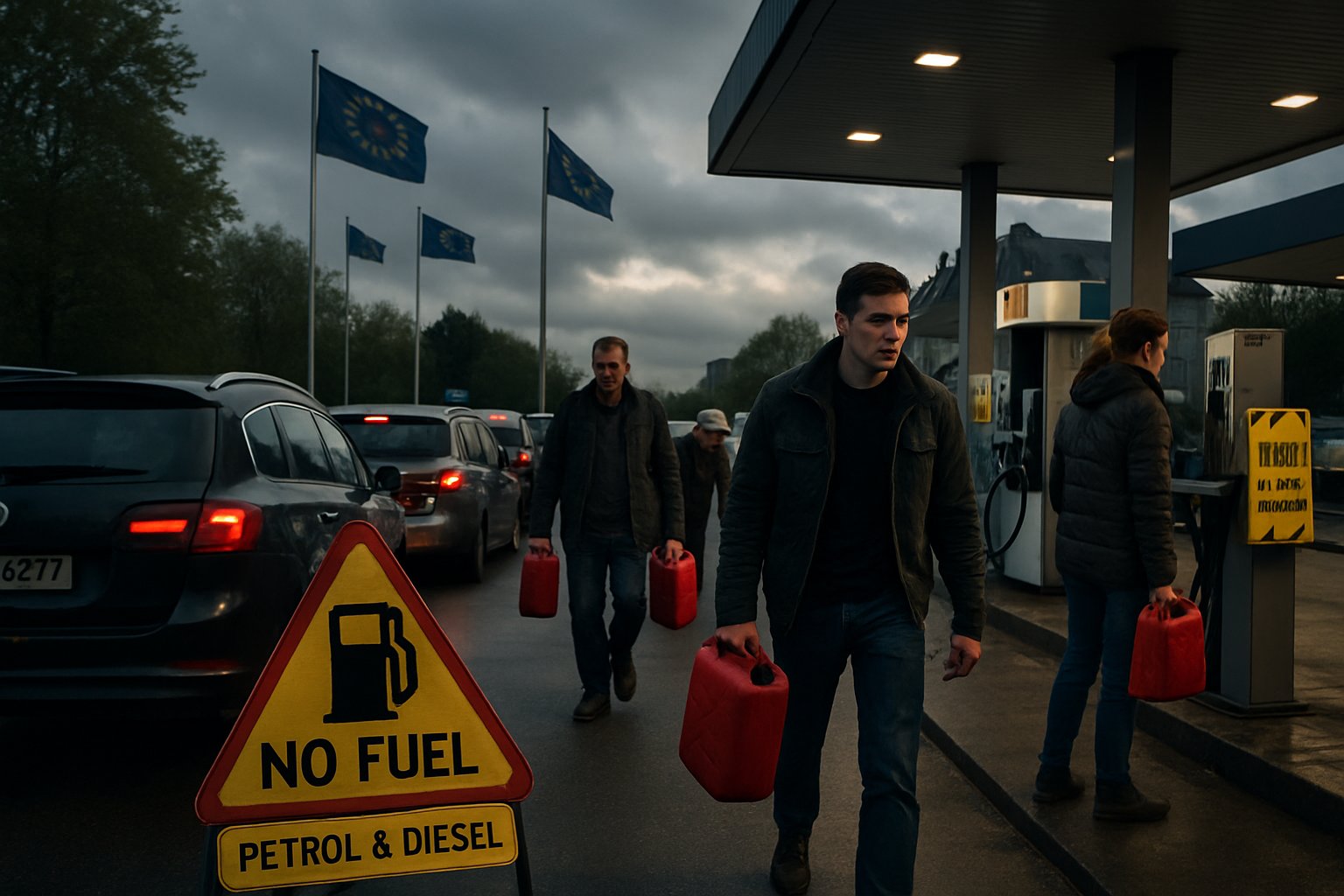
European countries are confronting their most severe energy crisis since the 1970s oil shocks as Iran's Revolutionary Guard has declared the Strait of Hormuz "unsafe for shipping," effectively blocking 40% of global seaborne oil transit and triggering unprecedented fuel shortages across the continent.
The crisis has reached critical levels with Bosnia-Herzegovina down to just two days of gas reserves, while Malta faces fuel prices that would be 45% higher without government subsidies. European natural gas prices have exploded by 24%, reaching €47.32/MWh - the highest level since February 2025.
Iran Blockade Creates Perfect Storm
Iran's closure of the 21-mile Strait of Hormuz chokepoint has created what energy analysts describe as the most severe single-point failure in modern logistics history. The waterway, through which approximately one-fifth of the world's oil passes, has been declared off-limits to commercial shipping following escalating tensions between Iran and Western forces.
The blockade has stranded over 150 oil and LNG tankers in the Persian Gulf, representing billions of dollars in cargo value. Major shipping companies Maersk and MSC have completely suspended operations in the region, with no viable alternative routes offering adequate capacity.
"This is the most severe energy security crisis in decades, exposing our dangerous over-dependence on strategic chokepoints," said Samuel Ciszuk, senior energy analyst.
— Samuel Ciszuk, Energy Security Expert
European Government Emergency Responses
Across Europe, governments are implementing unprecedented emergency measures to manage the crisis. Hungary has imposed immediate price caps on gasoline and diesel to combat what officials describe as "war-driven price explosions." France has deployed 500 fuel station inspectors to prevent price manipulation and ensure fair distribution.
Romania has prepared five emergency scenarios to prevent diesel prices from exceeding 10 lei per liter, while Slovakia has activated its strategic petroleum reserves for the first time under existing protocols. Germany is strengthening antitrust laws targeting gas station price manipulation - representing one of the most significant market interventions in modern German energy policy.
Ireland faces particularly acute challenges, with heating oil prices approaching €2 per liter, prompting consumer groups to denounce what they term "brazen rip-offs" by fuel suppliers. Austria has implemented a fuel price brake system, with Energy Minister Magnus Brunner announcing the redistribution of excess fuel taxes to cushion consumers from price shocks.
Sweden Most Exposed in Continental Market
Sweden faces some of Europe's most severe impacts due to its deep integration with continental European energy markets. Electricity prices have increased by 10-20 öre, while gasoline has risen by 1-2 kronor per liter. The Malmö region, designated as "zone 4," is particularly exposed due to its continental integration.
Danish authorities have released comprehensive fuel-saving guides for consumers, while multiple European nations are exploring temporary fuel tax reductions and retail price caps to protect vulnerable populations from the crisis.
Global Context and Aviation Crisis
The European crisis is part of a broader global energy emergency that has paralyzed international aviation. More than 18,000 flights have been cancelled worldwide - the most extensive disruption since COVID-19. Eight Middle Eastern countries have simultaneously closed their airspace, creating what industry experts describe as an "aviation black hole" in critical Europe-Asia transit corridors.
Dubai International Airport, the world's busiest with 86 million passengers annually, remains completely shut due to missile damage. Major carriers including Emirates, Air France-KLM, and Wizz Air have suspended operations indefinitely as jet fuel costs have soared from $85-90 to $150-200 per barrel - a staggering 122% increase.
International Emergency Response
The International Energy Agency (IEA) has announced the largest strategic petroleum reserve release in its 50-year history, deploying 400 million barrels from 32 member countries - more than double the 182.7 million barrels released during the 2022 Ukraine crisis.
Japan is releasing 80 million barrels starting March 16, marking the first deployment since the 2011 Fukushima disaster. With 95% dependence on Middle Eastern oil, 70% of which transits through Hormuz, Japan faces particularly acute vulnerability. Germany has confirmed participation in the coordinated response, with the United States expected to be the largest contributor.
Supply Chain Vulnerabilities Exposed
The crisis has exposed critical vulnerabilities in global supply chains that extend far beyond energy. The Persian Gulf serves as a crucial trade hub for consumer goods and industrial materials worldwide, with manufacturing in the automotive, electronics, and textiles sectors facing severe disruptions.
China has suspended refined fuel export contracts, canceling committed shipments to international buyers. Singapore retailers report logistics cost increases of up to 30%, with warnings that these increases will inevitably be passed to consumers globally.
Croatia Offers Rare Stability
In contrast to the widespread crisis, Croatia's Prime Minister Andrej Plenković has assured citizens that the country remains "well positioned to manage global energy disruptions" with "no risk of fuel shortages." This stability stems from Croatia's diversified energy portfolio and strategic reserves, offering a model for energy security that other European nations are now studying closely.
Nuclear Diplomacy Breakdown
The current crisis stems from the complete collapse of US-Iran nuclear negotiations, despite what had been described as a Geneva "broad agreement on guiding principles" - the most progress since the 2018 JCPOA breakdown. Iran excluded ballistic missiles and proxy relationships from negotiations, insisting on nuclear-only discussions, while the US demanded comprehensive agreements covering missiles, armed groups, and human rights.
This diplomatic failure led to Operation Epic Fury, the largest coordinated military operation since 2003, followed by Iran's massive retaliation under Operation True Promise 4, with Iran declaring "no red lines remain."
Template-Setting Crisis for 21st Century
UN Secretary-General António Guterres has described the situation as "the greatest test of multilateral cooperation and crisis management in the modern era," with nuclear risks at their "highest level in decades."
"Gulf states may be forced to declare force majeure within weeks if oil approaches $150 per barrel, which could bring down economies of the world."
— Saad Al Kaabi, Qatar Energy Minister
The crisis has highlighted the dangerous over-dependence on strategic chokepoints in global energy architecture. The 21-mile Strait of Hormuz represents a single-point failure in modern logistics with no realistic alternatives capable of handling the diverted volume.
Long-Term Energy Security Transformation
Energy security experts emphasize that strategic petroleum reserves provide only a temporary buffer for sustained disruptions. The crisis has accelerated discussions about fundamental energy architecture transformation, including supply diversification and accelerated renewable energy transitions that may take years or decades to implement.
Financial markets have crashed globally, with traditional monetary policy proving limited in effectiveness against structural geopolitical disruptions. Central banks across Europe, including the ECB, are coordinating emergency liquidity measures to prevent broader economic contagion.
Recovery Timeline Remains Uncertain
Unlike weather-related disruptions, recovery from the current crisis depends entirely on military operations resolution and diplomatic normalization. Aviation industries cannot establish long-term scheduling while multiple airspaces remain closed, and energy markets remain volatile with critical transit routes blocked.
The March 2026 crisis represents a watershed moment in international relations, establishing new paradigms for energy security planning that will require fundamental transformation to reduce dependence on strategic chokepoints. The implications extend decades beyond current events, determining frameworks for diplomatic versus military solutions in 21st-century conflict resolution.
As European leaders continue emergency coordination efforts, the crisis serves as a stark reminder of the interconnected vulnerabilities in modern energy systems and the urgent need for diversified, resilient energy infrastructure in an increasingly volatile geopolitical landscape.