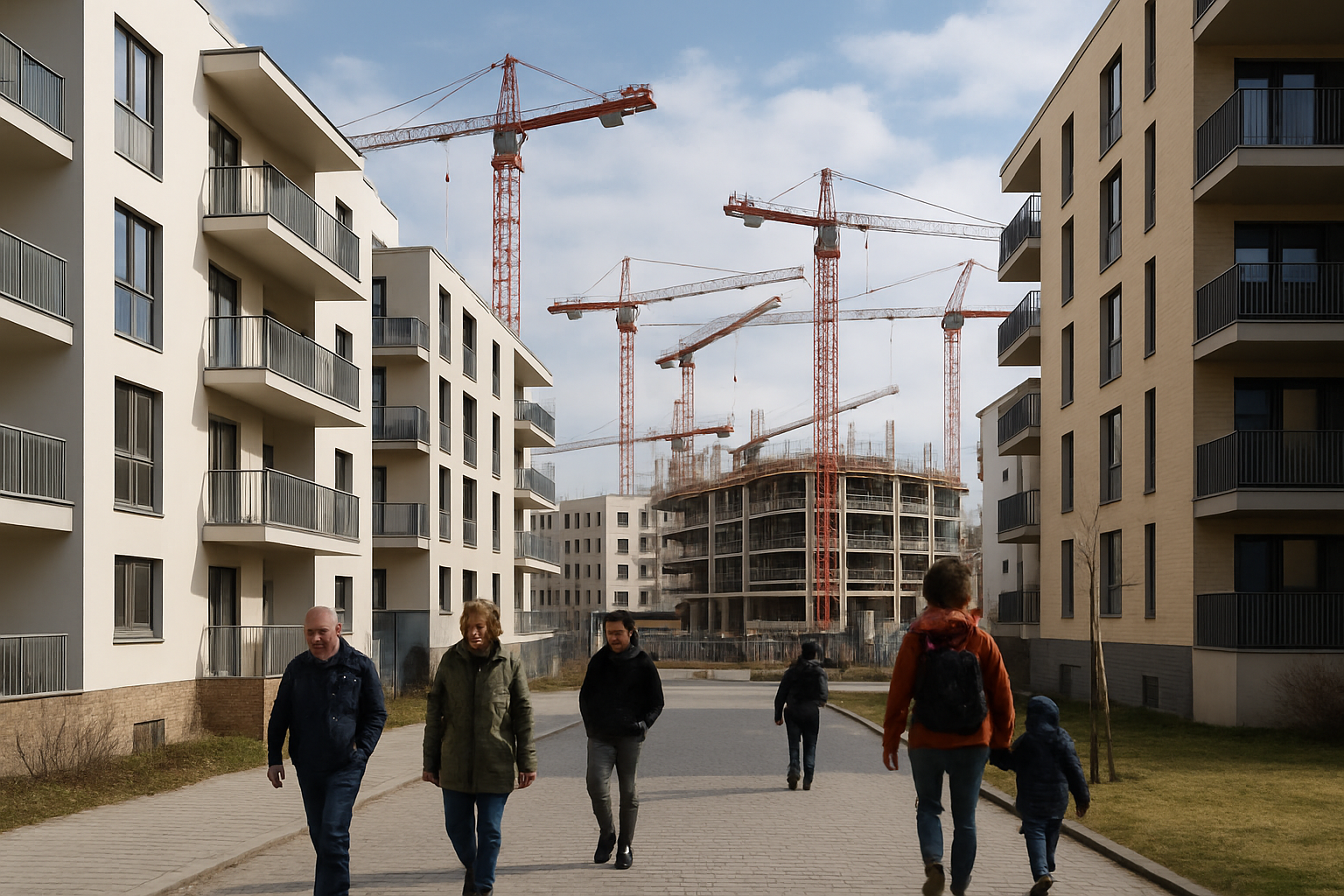
European housing markets are experiencing a complex convergence of stagnant prices, construction challenges, and policy interventions as governments struggle to address persistent affordability crises while the construction industry faces unprecedented cost pressures.
New data from across Europe reveals a housing sector caught between competing pressures: while some markets show price stabilization, construction costs continue rising, and controversial development decisions highlight the tension between housing demand and public safety concerns.
France: Apartment Prices Plateau After Years of Growth
In the Paris region, housing market analysts are signaling a period of stability after years of significant price increases. According to the Notaires du Grand Paris, apartment prices in Île-de-France have returned to approximately 2019 levels, with experts cautioning against expectations of "significant price evolution" in the coming months.
This plateau represents a stark contrast to the dramatic price surges seen across European markets in recent years. The stabilization in France's most expensive housing market suggests that affordability constraints may have reached a natural ceiling, forcing market correction through reduced buyer activity rather than continued price growth.
Netherlands: Safety vs. Housing Demand
A concerning trend has emerged in the Netherlands' Gelderland province, where local councils continue approving housing construction near goat farms despite repeated health warnings about increased pneumonia risks. This practice highlights the intense pressure on Dutch authorities to address housing shortages, even at the expense of public health considerations.
The situation exemplifies the broader European dilemma where housing demand has become so acute that traditional safety and planning standards are being challenged. Dutch government architect officials have warned that the government's plan to develop at least 30 large-scale construction sites will provide little short-term relief to the housing crisis.
Instead, experts suggest that splitting larger existing homes would more quickly address housing shortages than new construction, pointing to immediate solutions that don't require the lengthy development timelines that characterize major projects.
Energy Costs Add New Pressure
Households across the Netherlands are experiencing mixed economic signals as energy bills declined by 2.5 percent to around €1,993 in 2026. While this modest reduction provides some relief, it comes against the backdrop of broader affordability challenges that continue to pressure family budgets.
The energy cost reduction, though welcome, represents a relatively small improvement compared to the scale of housing affordability challenges facing European households. For families already struggling with high housing costs, the marginal energy savings are unlikely to significantly impact their overall financial situation.
Portugal: Mortgage Market Surges Despite Challenges
Portugal's housing credit market has experienced its strongest growth in two decades, with the mortgage portfolio expanding 10.4 percent in January to nearly €112 billion. This growth occurs even as deposit levels decreased compared to December, suggesting strong underlying demand for homeownership despite challenging market conditions.
The surge in Portuguese mortgage activity contrasts sharply with the more cautious approaches seen in other European markets, indicating that Portuguese buyers remain confident about real estate investment opportunities even amid broader economic uncertainty.
Construction Industry Crisis Deepens
The underlying challenge affecting all European housing markets remains the construction industry's struggle with negative profit margins due to rising material costs. This crisis has created a supply-side bottleneck that extends far beyond simple demand-supply imbalances, affecting the fundamental economics of housing development.
The memory chip shortage has added an unexpected layer of complexity, with semiconductor prices surging sixfold due to AI development demand. This affects smart building technologies and modern construction systems, creating additional cost pressures that won't resolve until new fabrication facilities come online in 2027.
"The construction industry faces a fundamental viability question when material costs consistently outpace revenue growth, creating negative margins that discourage new development."
— European Construction Industry Analysis
Regional Policy Coordination Emerges
European Union recognition of housing as a transnational challenge has led to innovative policy coordination efforts. Croatia's program targeting 600,000 empty homes for affordable rental conversion, Cyprus's foreign investment restrictions, and Greece's analysis of regional price variations demonstrate a continent-wide approach to housing challenges.
These coordinated responses represent a significant evolution from isolated national housing policies toward recognition that European housing markets are increasingly interconnected, requiring sophisticated regional approaches rather than purely domestic solutions.
Technology Integration Despite Constraints
Despite supply chain challenges, European housing development continues incorporating advanced technology integration. Smart city systems, sustainable materials, and community-centered design are becoming standard requirements rather than optional features, though the semiconductor shortage has increased implementation costs by 20-30 percent over the past year.
The technology integration represents a long-term investment in housing infrastructure that will provide benefits for decades, but the immediate cost increases add another layer of complexity to an already challenging development environment.
Investment Patterns Shift Toward Localization
European housing investment patterns are increasingly favoring localized strategies that emphasize clear regulatory frameworks and transparent governance structures over geographic diversification. This shift reflects investor recognition that housing markets require deep local knowledge and stable regulatory environments for successful long-term returns.
Success in European housing markets now requires sophisticated approaches that balance affordability requirements with market viability, maintain developer incentives while ensuring accessibility for middle and lower-income populations, and integrate environmental sustainability with financial sustainability.
Future Outlook: Balancing Competing Pressures
The European housing sector in 2026 faces the challenge of balancing immediate housing needs with long-term sustainability requirements. The construction industry's profitability crisis must be resolved to ensure adequate housing supply, while governments must continue addressing affordability challenges that have reached critical levels in many markets.
The convergence of technological advancement, environmental awareness, and international cooperation is creating new development models that prioritize sustainability alongside economic viability. However, the window for effective action is narrowing as demographic pressures, urbanization trends, and climate adaptation requirements create increasingly complex challenges.
Success will require continued innovation in policy coordination, financing mechanisms, and development approaches that can serve diverse regional conditions while maintaining overall market stability and accessibility across all income levels.