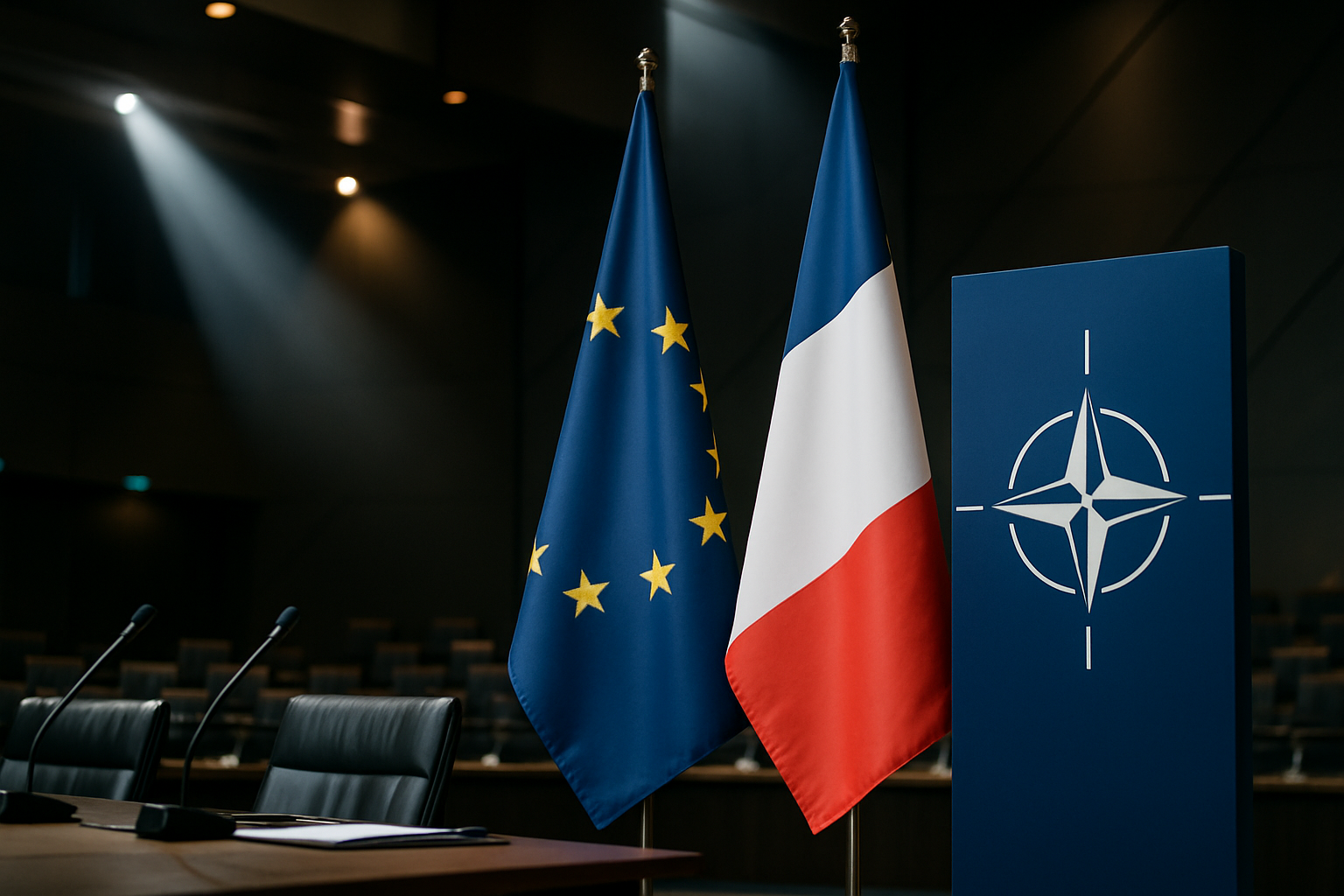
Europe is witnessing its most significant nuclear strategy discussions since the end of the Cold War, as French President Emmanuel Macron and German Chancellor Friedrich Merz confirm unprecedented talks about expanding France's nuclear deterrent beyond its traditional national scope.
The discussions, emerging from the 62nd Munich Security Conference, mark a fundamental shift in European strategic thinking as leaders grapple with doubts over American security guarantees and an increasingly assertive Russian nuclear posture. For the first time in eight decades, European nations are seriously considering alternative nuclear arrangements that do not depend primarily on US protection.
Breaking the Nuclear Taboo
German Chancellor Merz's confirmation of direct negotiations with President Macron represents a seismic shift in post-war European security architecture. The talks, described by European sources as preliminary but substantive, involve Germany, Poland, and Finland in conversations about extended deterrence arrangements that could fundamentally alter the continent's defense calculus.
"This marks the end of a tabú that has been maintained for eight decades," according to expert analysis presented at the Munich conference. The idea centers on extending France's nuclear capabilities to provide security guarantees for other European nations, creating what some analysts describe as a "European nuclear umbrella."
"Europe must become a geopolitical power providing its own security."
— Emmanuel Macron, French President
The French president has opened the door to "strategic dialogue" on nuclear deterrence without offering formal commitments, emphasizing Europe's need for strategic autonomy in an increasingly uncertain global environment.
Strategic Context: Multiple Crises Converge
The nuclear discussions emerge against a backdrop of unprecedented challenges to European security. The expiration of the New START Treaty between the United States and Russia on February 5, 2026, eliminated nuclear arms control constraints between the two superpowers for the first time in over 50 years.
Simultaneously, the ongoing Ukraine conflict has accelerated Russian territorial gains, with Moscow capturing 481 square kilometers in January 2026 compared to 260 square kilometers in December 2025. Russia's systematic targeting of civilian infrastructure, leaving over 1,170 Kyiv buildings without heating during minus-30°C temperatures, demonstrates the weaponization of energy as a tool of warfare.
UN Secretary-General António Guterres has warned of a "grave turning point" with nuclear risks at their highest levels in decades. The collapse of bilateral nuclear governance between the US and Russia has created what experts describe as a verification void that undermines global strategic stability.
Technical and Political Challenges
France's current nuclear force of approximately 290 warheads has historically been viewed as insufficient for extended deterrence covering multiple European nations. Any expansion would require significant modifications to French nuclear doctrine, new legal frameworks, parliamentary approvals, and careful coordination with NATO obligations.
The technical challenges are formidable. Unlike the massive arsenals maintained by the United States and Russia—controlling over 80% of global nuclear weapons—France's deterrent was designed specifically for national defense. Extending this capability would necessitate unprecedented coordination mechanisms and shared decision-making processes that have never been tested in practice.
Political obstacles are equally complex. While Germany, Poland, and Finland have expressed interest in preliminary discussions, other European nations remain skeptical. Spain's Prime Minister Pedro Sánchez has called nuclear rearmament a "historic error," demonstrating the divisions within European leadership on this critical issue.
Eastern European Perspective
Eastern European nations, particularly those with direct exposure to Russian threats, express strong interest in additional deterrent arrangements. The Baltic states and Poland have experienced firsthand Russia's increasingly aggressive posture, from cyberattacks to airspace violations and hybrid warfare tactics.
These nations view expanded European nuclear cooperation as essential insurance against potential American disengagement. The memory of Cold War vulnerability, combined with recent Russian actions in Ukraine, drives their support for alternative security arrangements that do not depend solely on Washington's commitment to Article 5 of the NATO Treaty.

Transatlantic Relations Under Strain
The nuclear discussions reflect deeper strains in transatlantic relations that have intensified under the current US administration. European officials privately express concerns about America's long-term commitment to European security, particularly following controversial statements by US Vice President JD Vance in 2025 that severely damaged alliance relationships.
US Secretary of State Marco Rubio's recent diplomatic reset attempts at Munich, declaring America and Europe "made to be together," have been met with cautious European responses. Notably, Rubio missed a critical meeting with German, French, and Polish leaders supporting Ukraine—an absence European officials interpreted as declining American interest in European-led initiatives.
This uncertainty has accelerated European strategic autonomy discussions across multiple domains, from defense industrial cooperation to space capabilities and cybersecurity frameworks.
Russian Response and Escalation Concerns
Moscow has predictably condemned the European nuclear discussions as "escalatory," threatening countermeasures if such arrangements proceed. Russian officials have characterized any expansion of nuclear deterrence capabilities as a direct threat to strategic stability and a violation of non-proliferation principles.
However, experts note that Russia's own nuclear modernization programs, combined with its withdrawal from multiple arms control agreements, have already undermined the existing strategic balance. The deployment of intermediate-range nuclear forces and tactical nuclear weapons in European theater contexts has altered the regional security landscape regardless of European responses.
Alliance Implications and NATO Coordination
The European nuclear discussions raise complex questions about NATO's nuclear sharing arrangements and command structures. Currently, the alliance relies primarily on American nuclear assets, with limited nuclear sharing agreements involving selected European nations.
Any French nuclear expansion would need to coordinate with existing NATO frameworks while potentially creating parallel European arrangements. This dual structure could either strengthen alliance deterrence or create competing command authorities that complicate crisis management.
British officials have remained notably silent on the French initiative, potentially reflecting concerns about how extended French deterrence might affect the UK's independent nuclear deterrent and its special relationship with the United States.
Financial and Industrial Considerations
Expanding European nuclear capabilities would require massive financial investments, potentially hundreds of billions of euros over the coming decades. The European Union has already approved a historic €90 billion loan package for Ukraine, demonstrating the bloc's willingness to make unprecedented financial commitments for security purposes.
The industrial implications are equally significant. European defense companies would need to develop new technologies, production capabilities, and supply chain networks to support expanded nuclear deterrence. This could accelerate European strategic autonomy in critical defense technologies but would require sustained political and financial commitment across multiple electoral cycles.
Global Nuclear Governance Context
The European nuclear discussions occur within a broader crisis of global nuclear governance. Beyond the US-Russia New START expiration, China's nuclear expansion complicates traditional bilateral frameworks, Iran continues uranium enrichment approaching weapons-grade levels, and North Korea advances its nuclear capabilities.
This multipolar nuclear environment creates new challenges for deterrence theory and arms control mechanisms that were designed for bipolar Cold War competition. European nuclear expansion could either contribute to global strategic stability by creating additional centers of responsible deterrence or accelerate proliferation dynamics that undermine non-proliferation efforts.
Implementation Timeline and Next Steps
European officials emphasize that nuclear cooperation discussions remain in preliminary stages and may not result in formal agreements. Even if political consensus emerges, technical, legal, and military obstacles would require years to address.
The immediate focus involves establishing frameworks for "strategic dialogue" on nuclear deterrence, developing shared threat assessments, and exploring coordination mechanisms that could enhance European security without undermining existing alliance structures.
French officials suggest that even preliminary frameworks would require extensive consultation processes, parliamentary debates, and careful coordination with international legal obligations under the Non-Proliferation Treaty.
Regional and Global Implications
Success in developing European nuclear cooperation could provide a template for other regions facing similar security challenges. Countries in the Indo-Pacific, Middle East, and other theaters might seek comparable arrangements if European experiments prove successful.
Conversely, failure to achieve meaningful cooperation could demonstrate the continued indispensability of American security guarantees, potentially strengthening transatlantic bonds while leaving European nations more dependent on Washington's strategic decisions.
"We are at a historic crossroads where European nations must decide whether to take responsibility for their own security or remain dependent on external guarantees that may not always be reliable."
— Senior European Defense Official
The broader implications extend beyond nuclear policy to fundamental questions about sovereignty, alliance relationships, and the evolution of international security architecture in the 21st century.
Looking Forward: Strategic Choices
The European nuclear defense discussions represent more than technical military planning—they reflect fundamental choices about the continent's strategic future. Whether European nations can develop effective nuclear cooperation while maintaining alliance relationships with the United States will influence international security architecture for decades.
The success or failure of these initiatives will determine whether European strategic autonomy remains an aspiration or becomes operational reality. With multiple crises challenging traditional security frameworks, European leaders face unprecedented pressure to develop innovative solutions that preserve both sovereignty and collective defense.
As the continent grapples with Russian aggression, American uncertainty, and global nuclear proliferation, the nuclear defense discussions may prove decisive in shaping Europe's role in 21st-century geopolitics. The choices made in the coming months could fundamentally alter the strategic balance that has defined European security since the end of World War II.