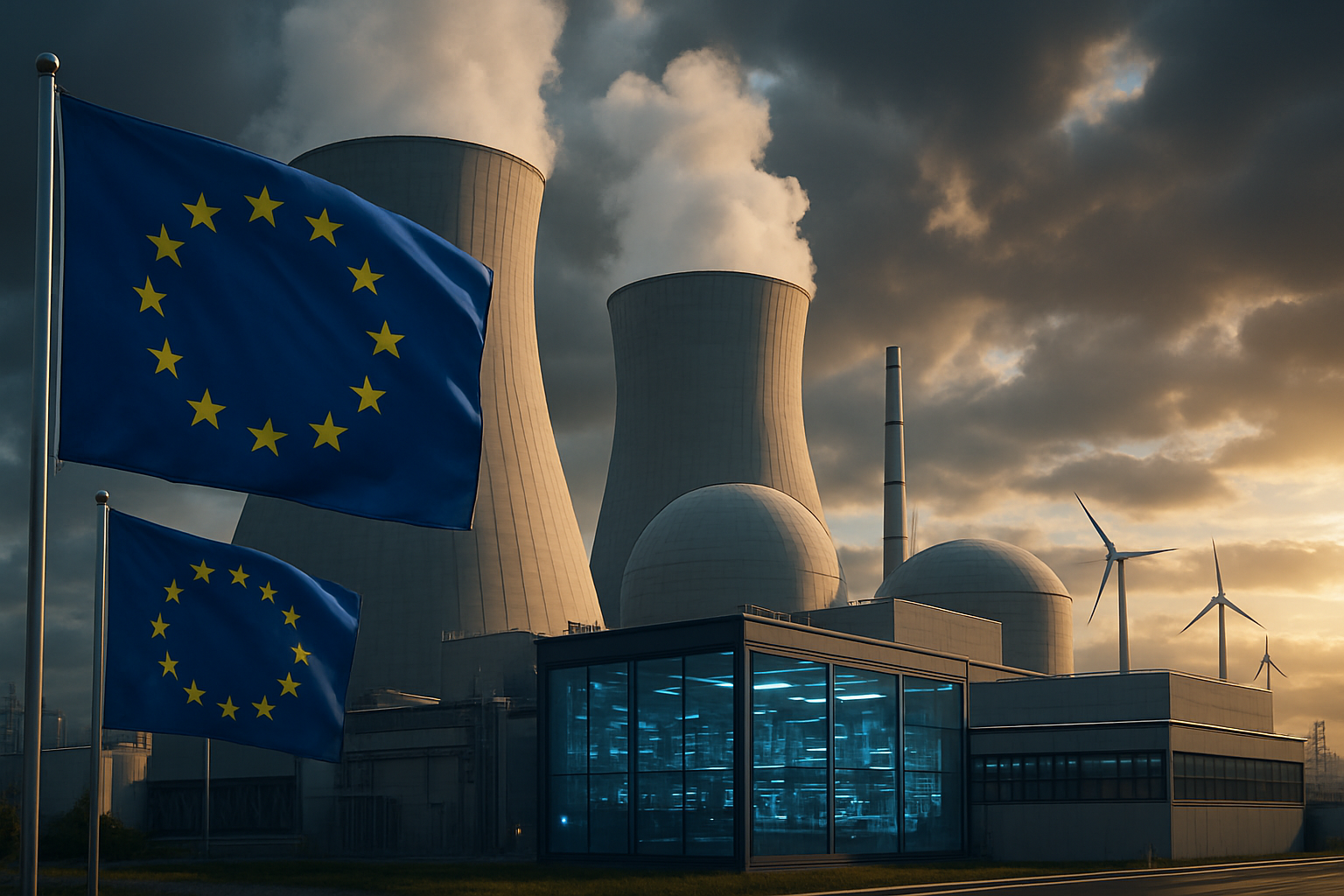
European Commission President Ursula von der Leyen declared the abandonment of nuclear power a "strategic error" as the continent confronts its most severe energy crisis since the 1970s, with the ongoing Iran conflict exposing dangerous vulnerabilities in Europe's energy supply chains.
Speaking at the World Nuclear Energy Summit in Paris on March 10, von der Leyen announced that the European Union would provide guarantees for nuclear energy investments, marking a dramatic reversal of the bloc's previous stance on atomic power. The declaration comes as oil prices surge past $100 per barrel following Iran's closure of the Strait of Hormuz, which handles 40% of global seaborne oil transit.
"The decision to reduce the share of nuclear energy in the European Union's energy mix was a strategic mistake," von der Leyen stated, emphasizing that the EU is neither an oil nor gas producer. "We are witnessing a global renaissance of nuclear power, and Europe cannot afford to be left behind."
Iran Crisis as Catalyst for Change
The current Middle East crisis, triggered by the death of Iran's Supreme Leader Ali Khamenei on March 1 during US-Israeli strikes, has created an unprecedented energy supply shock. Natural gas prices have surged 24% in Europe and 78% in the United States, while over 18,000 flights have been cancelled worldwide as eight countries simultaneously closed their airspace.
The crisis has particularly exposed Europe's vulnerability to energy import disruptions. Qatar, which supplies approximately 20% of global liquefied natural gas exports, halted production at its Ras Laffan and Mesaid facilities following Iranian drone attacks. This has forced European governments to confront the reality of their energy dependence in an increasingly volatile geopolitical environment.
Romanian officials warned that a complete closure of the Strait of Hormuz would have "unpredictable outcomes" that could severely impact European energy security, driving home the urgent need for energy diversification strategies.
Nuclear Renaissance Across Europe
The nuclear revival is already taking concrete form across European capitals. Hungary has launched construction of the Paks II nuclear power plant, representing Europe's largest nuclear construction project with $39.1 billion in Russian investment extending through the 22nd century. The project incorporates Russia's latest VVER reactor technology with advanced safety systems and digital monitoring capabilities.
Slovakia has positioned nuclear energy as essential for achieving carbon neutrality while improving competitiveness and creating new high-skilled jobs. The country's energy minister described nuclear power as having the potential to "energetically save the EU" despite some member states' continued resistance.
Even traditionally nuclear-skeptical Greece is reconsidering its position. Prime Minister Kyriakos Mitsotakis announced plans to establish a ministerial committee to explore small modular reactors (SMRs) for the Greek power system, stating: "The time for my country has come to explore if nuclear power and especially if small nuclear reactors can play a role in the Greek power system."
"There is tremendous innovation and we know that our need for electricity is only going to grow. So no matter how much we expand renewables, we will need long-term, predictable base load power and no technology can match what nuclear can offer us."
— Kyriakos Mitsotakis, Greek Prime Minister
Strategic Shift in EU Policy
The European Commission's new stance represents a fundamental departure from the bloc's previous energy strategy. Von der Leyen emphasized that nuclear power is "reliable, providing electricity all year, 24 hours a day," directly comparing it to renewable energy sources as essential for Europe's energy transition.
This policy shift comes as European nations grapple with the limitations of renewable energy systems during extreme weather events and supply chain disruptions. Estonia, despite achieving 88% renewable electricity production and operating continental Europe's largest battery storage facility serving 90,000 households, recognizes the need for nuclear baseload power to complement intermittent renewables.
Latvia's Wind Energy Association has warned of insufficient local generation capacity amid high electricity prices, while the European Scientific Advisory Board on Climate Change has cautioned that the EU is inadequately prepared for accelerating climate impacts, requiring urgent investment in resilient energy infrastructure.
Small Modular Reactors Leading Innovation
The nuclear renaissance is being driven partly by advances in small modular reactor technology, which offers enhanced safety features, reduced construction costs, and greater deployment flexibility compared to traditional large-scale nuclear facilities.
Romania has emerged as a European leader in next-generation nuclear energy through its innovative SMR project in Deutschești, incorporating cutting-edge safety systems including digital monitoring, automated control mechanisms, and passive safety features that prevent reactor meltdowns.
The Commission President announced plans for expanding small modular reactor deployment across the European Union, viewing these technologies as crucial for achieving energy independence while maintaining climate commitments. The modular approach allows for factory manufacturing and phased construction, significantly reducing financial risks and construction timelines.
Addressing Supply Chain Vulnerabilities
The nuclear pivot also addresses critical vulnerabilities in Europe's renewable energy supply chains. EU auditors have warned that climate goals are threatened by Chinese dominance in critical materials production, with China controlling 60% of global production and 90% of refining capacity for lithium, cobalt, and rare earth elements essential for renewable infrastructure.
The US-EU-Japan Critical Minerals Partnership, involving 55 countries and seven African alternative suppliers, requires billions in investment and years of development to reduce these geopolitical vulnerabilities. Nuclear power offers a pathway to clean electricity generation that is less dependent on these constrained supply chains.
Opposition and Challenges
The nuclear renaissance faces significant opposition from some member states and environmental groups. Austria's environment commissioner strongly criticized the EU's nuclear pivot, describing it as a "dangerous path" that contradicts claims about "sustainable atomic power."
Spain's government has expressed reservations about nuclear expansion, emphasizing the importance of international legality and environmental protection. The debate reflects deeper divisions within Europe about the role of nuclear power in the continent's energy future.
"Nuclear energy is confiable, proporcionando electricidad todo el año, las 24 horas del día. Es un error darles la espalda a una fuente confiable y asequible de energía baja en emisiones."
— Ursula von der Leyen, European Commission President
Global Context and Competition
Europe's nuclear renaissance occurs within a broader global context of renewed interest in atomic energy. The United States recently approved TerraPower's sodium-cooled small modular reactor in Wyoming, while Japan has restarted the world's largest nuclear facility at Kashiwazaki-Kariwa.
This international competition for nuclear technology leadership adds urgency to European efforts. The continent risks falling behind in what many experts view as a critical technology for achieving carbon neutrality while maintaining energy security in an increasingly unstable world.
Economic and Employment Benefits
The nuclear expansion promises significant economic benefits, including thousands of specialized, high-paying jobs and stable electricity pricing that reduces energy cost volatility. Hungary's Paks II project alone is expected to create employment opportunities extending through the 22nd century, demonstrating the long-term economic value of nuclear infrastructure.
Estonia's experience with renewable energy leadership, while impressive, illustrates the intermittency challenges that drive interest in nuclear baseload power. The country's success with battery storage technology complements rather than replaces the need for reliable, round-the-clock electricity generation.
Looking Forward
The Iran crisis has served as a wake-up call for European policymakers, highlighting the continent's vulnerability to supply disruptions from volatile regions. As von der Leyen emphasized at the Paris summit, Europe can no longer afford to ignore nuclear power as a solution to its energy security challenges.
The success of Europe's nuclear renaissance will depend on overcoming political opposition, ensuring public acceptance, and developing the skilled workforce necessary to build and operate next-generation nuclear facilities. However, the current crisis has demonstrated that energy security cannot be achieved through renewable sources and good intentions alone.
As European leaders grapple with the most challenging energy crisis in decades, nuclear power is increasingly viewed not as a relic of the past, but as an essential component of a secure, sustainable energy future. The question is no longer whether Europe will embrace nuclear power, but how quickly it can deploy these technologies at the scale required to ensure energy independence in an uncertain world.