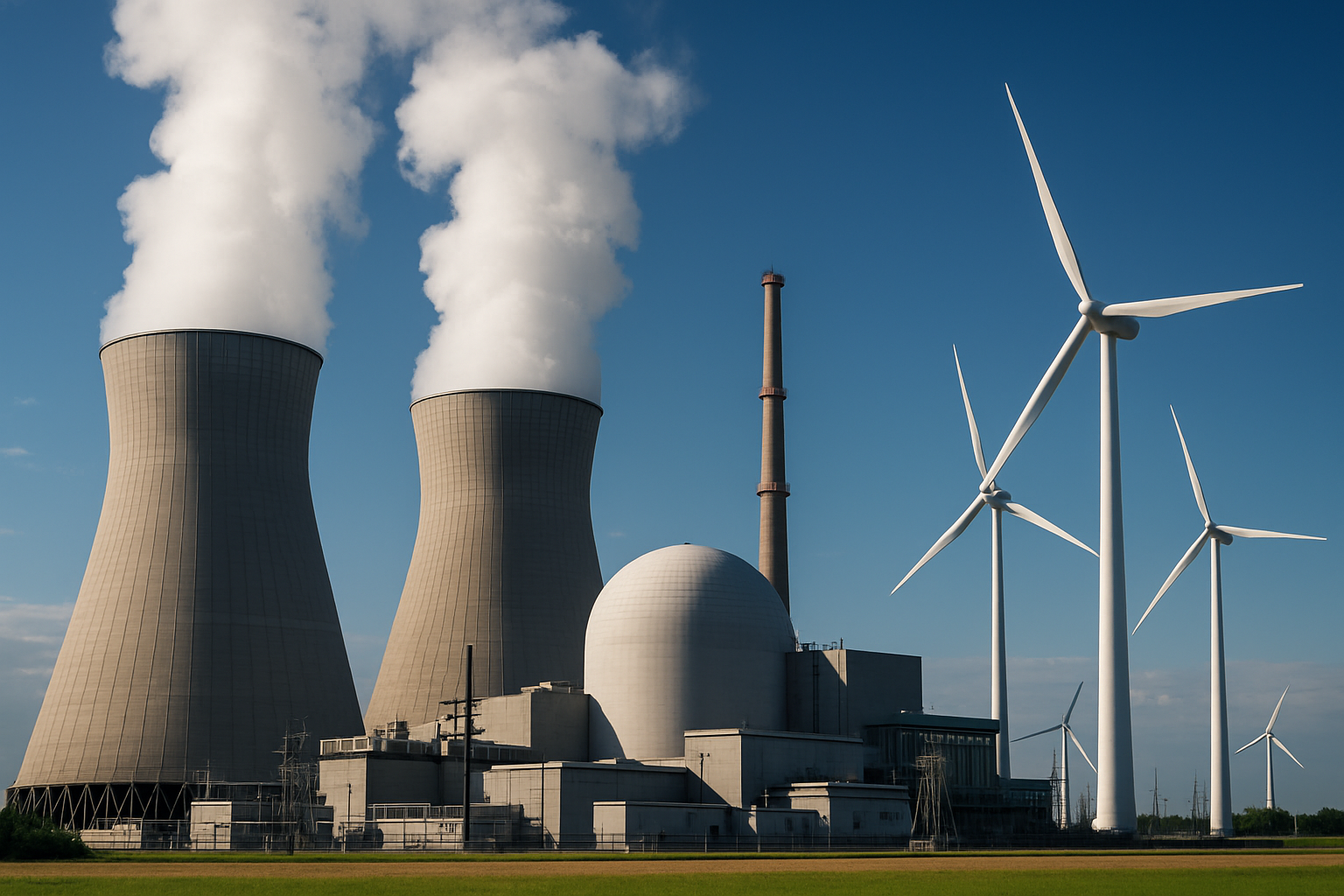
European Commission President Ursula von der Leyen's declaration that nuclear power abandonment was a "strategic error" has crystallized into concrete action across the continent, as countries rapidly advance both nuclear and renewable energy projects while grappling with an energy crisis that has exposed critical vulnerabilities in supply chains and infrastructure.
The shift represents the most dramatic energy policy transformation in Europe since the post-Fukushima nuclear phase-out decisions over a decade ago. Now, amid soaring energy costs triggered by Middle East conflicts and Chinese dominance over critical materials, European nations are pursuing a dual strategy combining nuclear baseload power with accelerated renewable deployment.
Greece-France Nuclear Partnership Takes Shape
Prime Minister Kyriakos Mitsotakis's announcement of a ministerial committee to explore small modular reactors (SMRs) has evolved beyond preliminary discussions into active cooperation with France. Sources close to the negotiations reveal that the Greek-French "nuclear gambit" represents a calculated shift toward energy independence, with Mitsotakis viewing SMR technology as essential for achieving carbon neutrality while maintaining grid stability.
The initiative builds on the established Greek-French partnership that has already yielded significant diplomatic and economic benefits. Unlike traditional large-scale nuclear facilities, SMRs offer enhanced safety through digital monitoring systems, automated controls, and passive safety features that dramatically reduce construction costs and timelines.
Sweden Presents Comprehensive Nuclear Program
Swedish Energy and Business Minister Ebba Busch unveiled what she described as "the totality of the Swedish nuclear program" during a press conference, emphasizing that "we must dare to build big." The announcement includes plans for a new application process and investigations into the state's expanded role in nuclear development.
"We must dare to build big. The government is now presenting the entirety of the Swedish nuclear program."
— Ebba Busch, Swedish Energy and Business Minister
Sweden's approach represents a significant departure from previous cautious nuclear policies, driven by recognition that the country's renewable-heavy grid requires reliable baseload power to maintain stability as demand grows and weather patterns become increasingly unpredictable.
European Union Shifts Tone on Nuclear Power
Von der Leyen's transformation from nuclear skeptic to advocate reflects broader institutional changes within the European Union. At the World Nuclear Energy Summit in Paris, her announcement of EU investment guarantees for nuclear projects marked a watershed moment for continental energy policy.
This shift coincides with mounting evidence of supply chain vulnerabilities that threaten renewable deployment. China controls 60% of global production and 90% of refining capacity for lithium, cobalt, and rare earth elements essential for renewable technologies. Meanwhile, memory chip shortages have increased prices sixfold, affecting smart grid systems crucial for renewable integration.
Crisis as Catalyst for Change
The current energy crisis, triggered by Iran's closure of the Strait of Hormuz affecting 40% of global oil transit, has exposed Europe's dangerous dependence on volatile geopolitical regions. Oil prices surging past $100 per barrel and natural gas costs jumping 24% in Europe have provided unprecedented political momentum for energy independence initiatives.
The crisis has also highlighted the limitations of purely renewable strategies during transitional periods. Estonia, despite achieving 88% renewable electricity and operating continental Europe's largest battery storage facility serving 90,000 households, is now exploring nuclear options as a complement to its renewable infrastructure.
Nuclear Technology Innovation Drives Revival
The new generation of SMR technology addresses many concerns that previously limited nuclear expansion. Factory manufacturing enables modular deployment with controlled environment construction, dramatically reducing the cost overruns and construction delays that plagued previous nuclear projects.
Advanced safety systems include digital monitoring, automated control mechanisms, and passive safety features that operate without human intervention or external power sources. These innovations have convinced even traditionally nuclear-skeptical nations to reconsider atomic energy as part of their climate strategies.
Opposition and Environmental Concerns
The nuclear renaissance faces significant resistance from environmental groups and some member states. Austria's environment commissioner criticized the "dangerous path" of nuclear expansion, while Spain maintains reservations about the international legality and environmental implications of renewed atomic energy development.
Greenpeace has denounced the shift as a "betrayal of the European Green Deal," arguing that resources should focus on renewable energy efficiency rather than nuclear technology. These organizations point to unresolved nuclear waste storage challenges and the catastrophic risks demonstrated by Chernobyl and Fukushima.
Global Competition Context
European nuclear development occurs within an international technological competition that includes the United States' TerraPower Wyoming SMR approval and Japan's restart of the world's largest nuclear facility at Kashiwazaki-Kariwa. The strategic implications extend beyond energy security to encompass technological sovereignty and influence in global energy markets.
Hungary's Paks II construction represents Europe's largest nuclear project at $39.1 billion, while Romania advances SMR technology at Deutschești with advanced safety systems. Slovakia positions nuclear power as central to its carbon neutrality goals, demonstrating the breadth of European nuclear enthusiasm.
Economic and Employment Benefits
Nuclear projects promise substantial economic multiplier effects through specialized high-paying employment, stable electricity pricing, and long-term job creation spanning century-plus operational lifetimes. The economic benefits extend to research and development, advanced manufacturing, and supporting services around nuclear facilities.
Unlike renewable projects that require ongoing materials imports from geopolitically sensitive regions, nuclear facilities provide decades of energy independence once constructed, with fuel requirements representing a small fraction of operational costs.
Integration with Climate Framework
European leaders increasingly view nuclear power as complementary to renewable sources rather than competitive with them. Nuclear provides weather-independent baseload electricity that addresses grid stability requirements as renewable penetration increases, while offering resilience during extreme weather events that can compromise wind and solar generation.
This integrated approach allows countries to achieve ambitious climate goals while maintaining industrial competitiveness and energy security. The combination of nuclear baseload and renewable generation provides a pathway to carbon neutrality without sacrificing economic growth or energy reliability.
Strategic Energy Architecture Implications
Von der Leyen's acknowledgment that nuclear abandonment was a "strategic mistake" represents a fundamental shift in European thinking about energy security and strategic autonomy. The recognition that over-dependence on energy imports from geopolitically unstable regions poses unacceptable risks has driven rapid policy reversals across the continent.
The nuclear option provides a pathway to achieving both climate commitments and security requirements simultaneously, while reducing vulnerability to supply chain disruptions and geopolitical manipulation. This strategic pivot will likely determine continental energy architecture for decades to come.
Implementation Timeline and Pressures
The current Iran crisis has accelerated policy changes that might otherwise have taken years to implement. European leaders find themselves navigating between climate commitments and immediate security requirements, with nuclear power offering a solution that addresses both challenges simultaneously while maintaining public acceptance and environmental protection standards.
Success or failure in implementing this nuclear renaissance will test whether Europe's strategic energy pivot can deliver on its promises during the critical decade for climate action. The coming years will demonstrate whether the continent can successfully balance its environmental ambitions with the practical realities of energy security in an increasingly volatile world.