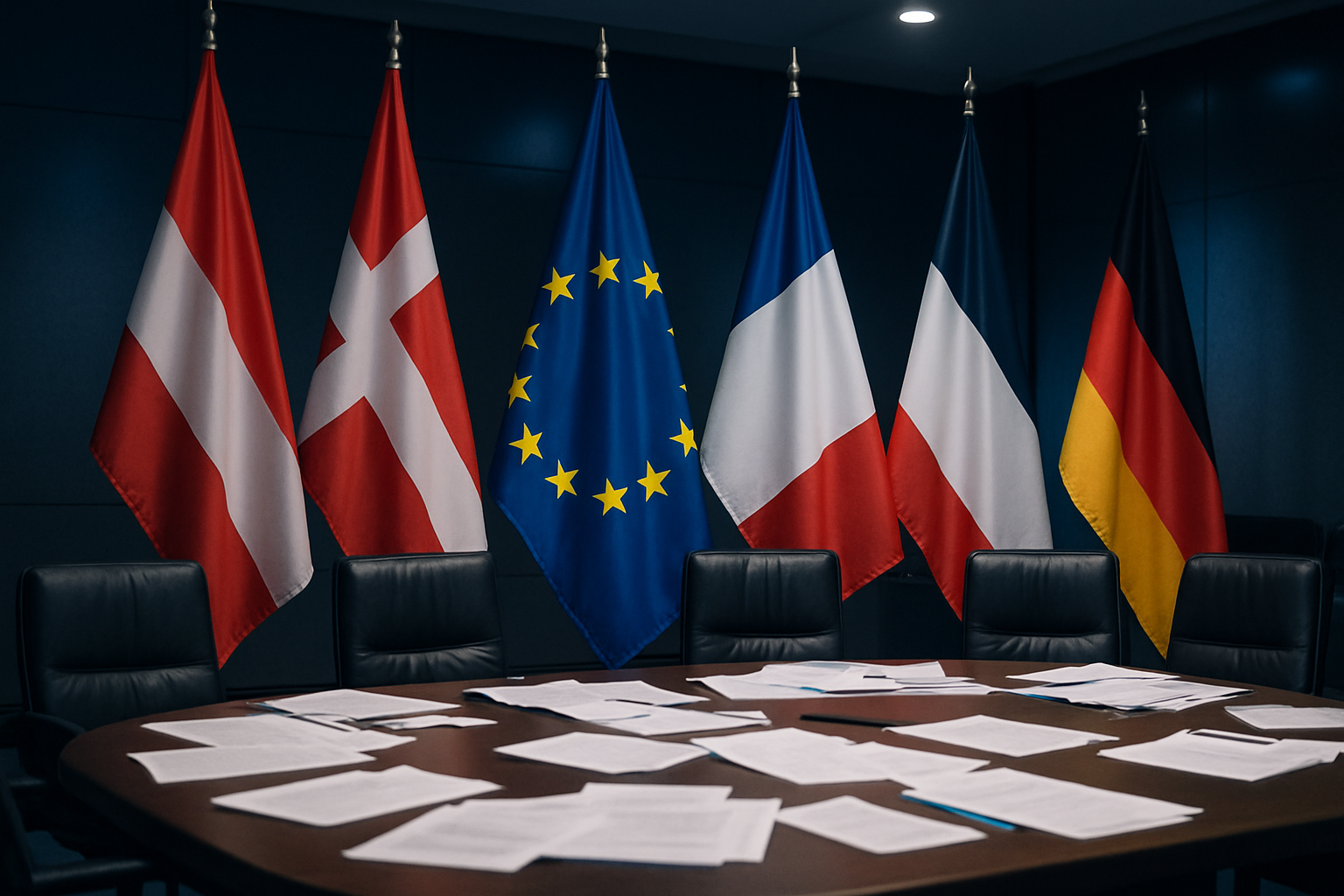
A wave of political instability is reshaping the European landscape as Austria grapples with coalition tensions, Denmark confronts electoral uncertainty, France prepares for a pivotal municipal election preview, and Germany witnesses the collapse of the Free Democratic Party in what analysts describe as the most challenging period for continental democracy since World War II.
Austria: Coalition Harmony Under Severe Strain
Austria's governing coalition is experiencing unprecedented internal fractures as political tensions reach a critical juncture. Last week saw a dramatic escalation of conflicts within the ruling partnership, with opposition forces gaining momentum amid growing public dissatisfaction.
The coalition's stability has been severely tested by mounting policy disagreements, rebellious political actors, and fundamental ideological differences that are exposing the structural weaknesses of the current arrangement. These fault lines have become increasingly visible to the Austrian public, raising serious questions about the government's ability to maintain effective governance.
"Too many issues, unruly actors and substantive differences have exposed the fracture lines of the coalition," observed political analysts following this week's developments.
— Austrian Political Commentary
The opposition Social Democratic Party (SPÖ) under Andreas Babler has capitalized on this instability, with Babler receiving an overwhelming 81.51% mandate from party delegates in recent leadership elections. This strong showing positions the SPÖ as a credible alternative to the current government, with party leadership emphasizing their focus on combating inflation and strengthening healthcare provision.
Denmark: The Failed 'Greenland Effect' Strategy
Denmark's political landscape has been dramatically altered following Prime Minister Mette Frederiksen's catastrophic electoral gamble. Her Social Democrats suffered their worst performance since 1903, securing only 21.9% of the vote in what was intended to be a sovereignty-boosting campaign.
The so-called "Greenland effect" – Frederiksen's February snap election strategy betting that the sovereignty crisis popularity surge against territorial ambitions would overcome domestic concerns – failed spectacularly. Despite international solidarity measures including France-Canada Nuuk consulates and NATO's Arctic Sentry mission, Danish voters prioritized cost-of-living concerns, inflation, and housing issues over foreign policy successes.
King Frederik X has now appointed a royal investigator following the historic 12-party parliamentary fragmentation that created unprecedented coalition mathematics. Neither left nor right blocs achieved the crucial 90-seat majority needed for stable governance, marking the first government formation crisis under the new monarch and testing democratic institutions during what experts call "the most challenging period for continental democracy since World War II."
France: Presidential Race Preview and Political Violence
France is preparing for crucial developments that will shape the 2027 presidential race, with former Prime Minister Dominique de Villepin emerging as a potential candidate following his recent Sorbonne address. While refusing to formally announce his candidacy, de Villepin delivered what observers characterized as a presidential program to hundreds of supporters at the prestigious Parisian university.
The political atmosphere remains tense following the February Lyon violence that resulted in the death of Quentin Deranque, a far-right activist. Seven individuals have been charged with intentional homicide, including Jacques-Elie Favrot, a parliamentary assistant to La France Insoumise deputy Raphaël Arnault. This incident has deepened fractures within the French left and influenced the ongoing municipal elections.
Marine Le Pen's National Rally continues its "authoritarian innovation" strategy, evolving from rural populism to sophisticated urban campaigning. However, the party faces uncertainty regarding Le Pen's political future, as she awaits a July 2026 Court of Appeal ruling that could impose a five-year public office ban, potentially eliminating her from the 2027 presidential race.
Administrative Controversies
The Interior Ministry's controversial reclassification of La France Insoumise from "left" to "extreme left" for electoral purposes has triggered legal challenges at the Council of State, raising concerns about administrative manipulation of democratic processes. This unprecedented move has further complicated the already fragmented political landscape.
Germany: Liberal Party Faces Complete Collapse
Germany's Free Democratic Party (FDP) is confronting an existential crisis as Chairman Christian Dürr and the entire federal executive board announced their resignations at the May 2026 conference. The party's consecutive failures to clear the 5% threshold in state elections have led to what analysts describe as an "inevitable downfall."
The FDP crisis represents a broader challenge to Germany's post-Merkel political landscape. Coalition weakness has inadvertently strengthened extremist forces as traditional partners focus on internal struggles rather than addressing citizens' concerns. The Alternative for Deutschland (AfD) has exploited this instability, nearly doubling its support to 18% in Baden-Württemberg, demonstrating the far-right's capacity for western breakthrough sophistication.
"The teetering Liberals are electing new leadership again, there are already two candidates. But many are waiting for a very specific third one," noted German political observers, highlighting the party's desperate search for renewal.
— Political Analysis, FAZ
Wolfgang Kubicki has emerged as a potential savior figure for the struggling liberals, though many within the party await his decision on whether to contest the leadership. The crisis extends beyond personnel issues to fundamental questions about the FDP's ideological confusion and electoral irrelevance after serving as a historical coalition kingmaker.
Broader European Democratic Crisis
These national developments occur within a broader continental crisis that has seen unprecedented challenges to democratic institutions across Europe. Recent polling shows that 89% of Europeans demand greater EU unity according to Eurobarometer surveys, yet political reality demonstrates increasing fragmentation, sovereignty assertions, and institutional friction.
The rise of far-right movements employing "authoritarian innovation" – sophisticated strategies working within democratic systems while gradually eroding liberal norms – has been documented across multiple member states. This includes Sweden's Liberal Party abandoning decades of opposition to Sweden Democrats cooperation, Spain's Vox achieving a 55% surge in Aragón, and Germany's AfD breakthrough in traditionally stable western states.
Foreign Interference Concerns
Intelligence sources have documented sophisticated foreign interference operations targeting European electoral processes. The most explicit case involves allegations of Russian operatives supporting Viktor Orbán in Hungary's upcoming elections, but similar concerns extend across multiple European democracies where traditional mechanisms of parliamentary coalitions and media scrutiny appear insufficient to contain these new challenges.
Testing Democratic Resilience
Despite these unprecedented challenges, European institutions have demonstrated fundamental resilience by conducting credible elections and maintaining constitutional governance. Slovenia successfully conducted elections despite foreign interference allegations, France has channeled political tensions through electoral rather than extra-legal means, and Denmark has responded constitutionally to sovereignty challenges.
The critical test will be whether European democracies can address the underlying concerns driving extremism – inequality, immigration, and sovereignty issues – while maintaining the institutional frameworks that have underpinned European success since 1945.
Strategic Implications
The coming months will be decisive for Europe's democratic future. French municipal elections in March, Danish coalition negotiations, and German coalition stability will establish templates for democratic governance under pressure. Success in managing extremism and institutional strain could strengthen European integration through demonstrated resilience. Failure risks accelerating fragmentation that threatens foundational European cooperation principles.
"Europe is writing the template for 21st-century crisis management that will determine the continental trajectory for decades ahead," noted a senior EU official.
— European Union Leadership
Looking Forward: The Stakes for European Integration
As Europe navigates this unprecedented period of political turbulence, the stakes extend far beyond individual national governance to the continent's role in global democratic leadership. The success or failure of current crisis management efforts will determine whether European democratic institutions can adapt to 21st-century pressures while preserving their fundamental values.
The convergence of coalition crises, electoral uncertainties, and democratic challenges across Austria, Denmark, France, and Germany represents a stress test for the European project itself. How these nations resolve their internal political tensions while maintaining their commitments to European cooperation will establish precedents for democratic governance in an increasingly complex global environment.
International observers are closely monitoring these developments as potential templates for democratic societies worldwide facing similar pressures from populist movements, foreign interference, and institutional strain. The European experience in managing political extremism through democratic institutions rather than authoritarian measures could provide crucial insights for global democratic resilience in the 21st century.