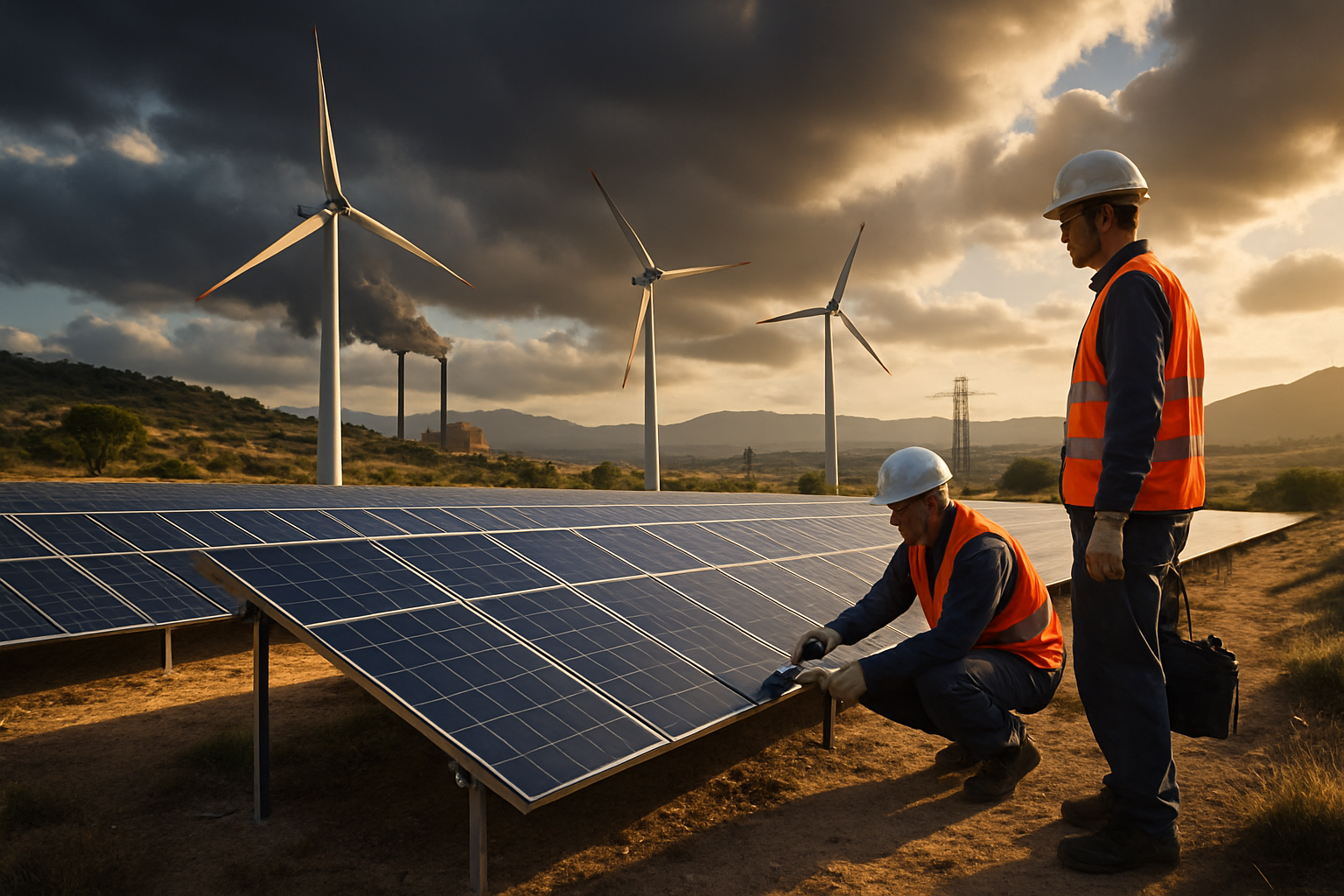
European nations are grappling with unprecedented challenges in their renewable energy transition, as Cyprus implements drastic solar output cuts, Latvia develops innovative wildlife protection technology for wind farms, and Portugal debates nuclear power's role in achieving climate goals.
The continent's renewable energy sector faces a critical convergence of technical, environmental, and supply chain obstacles that threaten to derail ambitious climate targets even as governments accelerate clean energy deployment. These challenges have emerged against the backdrop of 21 consecutive months of global temperatures exceeding 1.5°C above pre-industrial levels, creating urgent pressure for rapid decarbonization.
Cyprus Solar Crisis Exposes Grid Limitations
Cyprus is confronting a renewable energy paradox that exemplifies broader European challenges. Despite massive investment in rooftop solar installations, thousands of households with solar panels face a dual crisis: all stored energy accumulated through net metering and net billing schemes will be wiped by the end of March, while output cuts continue through at least April.
The Electricity Authority of Cyprus (EAC) confirmed that renewable output currently exceeds 1,000MW while grid demand stands at around 450MW, making significant production cuts necessary. This surplus capacity, rather than representing success, has become a major infrastructure challenge requiring sophisticated grid management solutions.
"The stored kilowatt-hour reset is required under contract terms based on old Energy Ministry decisions, and will apply to all consumers with ripple control systems,"
— Electricity Authority of Cyprus
The situation underscores a critical gap in renewable energy planning: the need for advanced grid infrastructure and storage systems to manage intermittent clean energy sources. Cyprus households already face higher electricity bills due to rising fuel costs linked to Middle East conflicts, making the solar energy cuts particularly problematic for consumers who invested in renewable technology expecting long-term savings.
Latvia Pioneers Wildlife-Wind Energy Coexistence
While Cyprus struggles with excess capacity, Latvia is addressing another critical renewable energy challenge: protecting wildlife while expanding wind power infrastructure. Latvian companies LMT and AS Latvenergo have launched an innovative research project developing homegrown technology for automatic detection and identification of birds at wind turbine farms.
This initiative represents a sophisticated approach to environmental protection that could serve as a model for wind energy development across Europe. The technology aims to prevent bird strikes while maintaining optimal wind turbine operation, addressing one of the most persistent environmental criticisms of wind power expansion.
The project demonstrates how countries are moving beyond simple trade-offs between renewable energy and environmental protection toward integrated solutions that advance both objectives simultaneously. Such technological innovations are becoming essential as Europe faces pressure to rapidly scale wind energy capacity while maintaining biodiversity protection standards.
Portugal's Nuclear Energy Debate
Portugal's energy discourse has taken an unexpected turn with arguments that renewable sources alone may be insufficient for Europe's decarbonization needs. A significant debate has emerged around nuclear power's role in achieving climate targets, with proponents arguing that nuclear energy represents one of the safest forms of electricity production despite dramatic accidents being highly publicized.
The Portuguese discussion reflects broader European conversations about energy mix optimization. While accidents can be catastrophic, nuclear power advocates point to statistical safety records and the technology's capacity to provide reliable baseload electricity that complements weather-dependent renewable sources.
This debate is particularly relevant given Europe's experience with renewable energy intermittency challenges, as demonstrated by Cyprus's grid management issues. Nuclear power's ability to provide consistent electricity output regardless of weather conditions makes it attractive to policymakers seeking to balance renewable energy expansion with grid stability requirements.
Supply Chain Vulnerabilities Threaten Green Transition
Behind these national challenges lies a broader European vulnerability: dependence on Chinese-controlled supply chains for critical renewable energy materials. China controls approximately 60% of global production and 90% of refining capacity for lithium, cobalt, and rare earth elements essential for renewable energy infrastructure.
This dependency creates strategic risks for Europe's renewable energy transition, as demonstrated by recent supply chain disruptions. Memory chip shortages have led to sixfold price increases affecting smart grid and renewable control systems, with impacts expected to continue until new fabrication facilities come online in 2027.
The US-EU-Japan Critical Minerals Partnership, involving 55 countries and seven African alternative suppliers, represents an attempt to address these vulnerabilities through supply chain diversification. However, developing alternative supply sources requires massive investment and years of infrastructure development, creating timing challenges for urgent climate action.
Regional Success Stories Provide Templates
Despite challenges, some European nations demonstrate successful renewable energy integration. Estonia maintains European renewable leadership with 88% renewable electricity and operates continental Europe's largest battery storage facility serving 90,000 households. This combination of high renewable penetration and substantial storage capacity offers a template for other nations facing grid management challenges.
Hungary's €39.1 billion Paks II nuclear construction project, backed by the International Atomic Energy Agency, represents Europe's largest nuclear project and demonstrates how countries are pursuing diverse approaches to decarbonization. The project incorporates advanced safety systems and digital monitoring, showing how nuclear technology continues evolving.
Romania is advancing a €1 billion Battery Energy Storage System with 2,500 MW capacity across multiple locations, demonstrating large-scale commitment to grid-level energy storage solutions. These initiatives show how European nations are developing complementary approaches to renewable energy challenges.
Technology Integration Drives Innovation
Successful renewable energy deployment increasingly requires sophisticated technology integration combining digital monitoring, smart grid management, automated efficiency systems, and predictive maintenance capabilities. These technologies enable real-time optimization of renewable energy flows and improved reliability in managing intermittency challenges.
Latvia's bird detection technology exemplifies this trend toward intelligent renewable energy systems that can adapt to environmental conditions while maintaining optimal performance. Such innovations are becoming standard requirements rather than premium options as countries scale renewable infrastructure.
The integration of artificial intelligence, environmental DNA sampling, and satellite monitoring with traditional ecological knowledge creates comprehensive frameworks for sustainable renewable energy development. This technological sophistication helps address both technical challenges and environmental concerns that have historically created barriers to clean energy expansion.
International Cooperation Essential for Success
The European experience demonstrates that effective renewable energy transition requires unprecedented international cooperation. Environmental challenges transcend boundaries through atmospheric systems, supply chains, and species migrations, making coordinated responses essential for success.
Knowledge sharing between countries like Estonia's battery storage expertise, Latvia's wildlife protection innovations, and Cyprus's grid management experiences creates learning networks that strengthen collective European renewable energy capabilities. This peer-to-peer cooperation model offers alternatives to traditional North-South technology transfer approaches.
Supply chain diversification initiatives, including the Critical Minerals Partnership, show how strategic cooperation can address vulnerabilities while supporting renewable energy scaling. However, success depends on sustained political commitment across electoral cycles and enhanced coordination mechanisms.
Critical Juncture for European Energy Policy
March 2026 represents a critical juncture for European renewable energy policy, where the choice between reactive crisis management and proactive ecosystem service management will determine whether clean energy deployment can keep pace with accelerating environmental change.
The environmental action window is narrowing as ecological systems approach critical thresholds that could trigger irreversible changes affecting global food security, climate stability, and human settlements. European renewable energy initiatives provide essential momentum during this decisive climate action decade.
Success requires rapid scaling of comprehensive approaches that address multiple challenges simultaneously: grid infrastructure modernization, wildlife protection, supply chain diversification, and technology innovation. The tools, knowledge, and cooperation frameworks exist, but implementation must match the speed and scale of environmental challenges.
The convergence of Cyprus's grid management crisis, Latvia's wildlife protection innovation, and Portugal's energy mix debates illustrates both the complexity and the opportunity inherent in Europe's renewable energy transition. These challenges, while significant, also represent catalysts for the technological innovation and international cooperation essential for achieving planetary sustainability during humanity's most environmentally challenging period in recorded history.