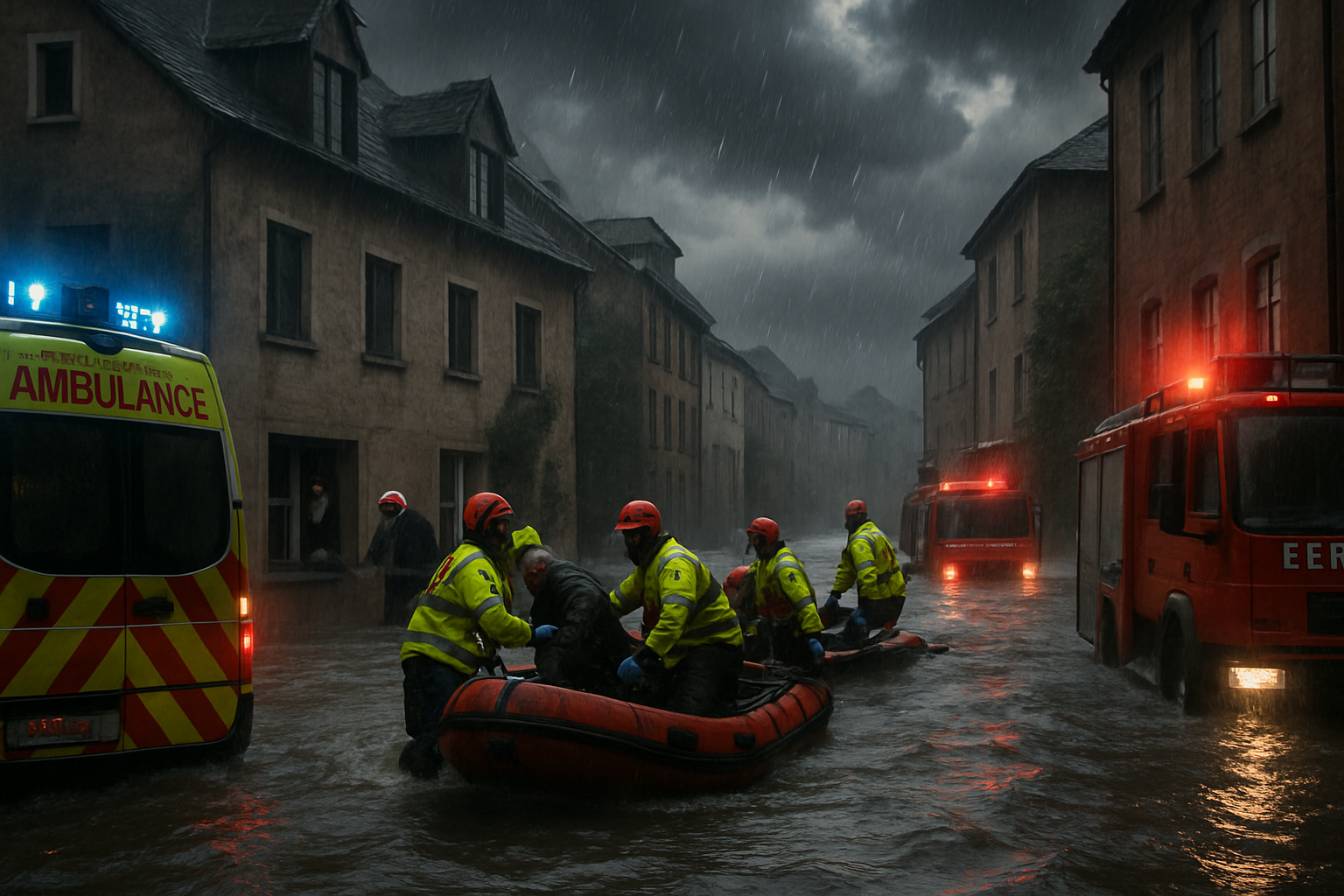
Portugal and Spain are bracing for another severe weather emergency as Storm Marta strikes the Iberian Peninsula on February 7, 2026, marking the third major Atlantic storm system to hit the region in just two weeks following the devastating impacts of Storms Kristin and Leonardo.
The latest weather system, named Storm Marta by meteorological services, arrived Saturday morning with winds reaching 120 km/h and waves up to 13 meters along the Portuguese coast. Portuguese authorities have extended the national calamity status through February 15 as the country continues to deploy its largest peacetime rescue operation, involving 1,975 military personnel and 30 naval vessels responding to over 1,800 weather-related incidents since February 1.
Infrastructure Under Siege
The cumulative impact of three successive storms has pushed European infrastructure to breaking points across multiple countries. In Portugal, the Douro River has overflowed its banks in Porto and Vila Nova de Gaia, reaching critical levels not seen since 1997. The flooding in Alcácer do Sal has exceeded the catastrophic records set in 1963, with one confirmed death from the Sado River overflow.
Transportation networks remain severely disrupted. The Portuguese railway line between Castanheira and Alverca remains suspended, affecting thousands of Lisbon commuters. In the capital, the Ponte 25 de Abril bridge has closed its left lanes in both directions due to dangerous wind conditions, while the Campo Grande tunnels remain closed due to flooding risks.
"The continuous rise of water on the right bank of the Mondego River is reaching the center of Montemor-o-Velho, in the area of the municipal market, putting some houses in the low area of the town at risk."
— Municipal President of Montemor-o-Velho
Portuguese Civil Protection has recorded 256 weather-related incidents between midnight and 10 AM Saturday alone, predominantly affecting the Greater Lisbon area, Setúbal Peninsula, and the western regions. In Alenquer, authorities evacuated 75 people from their homes as flood waters continued to rise.
Spain Maintains Emergency Alerts
Spanish authorities remain on high alert after Storm Leonardo forced the evacuation of over 8,000 people from Andalusia provinces. The town of Grazalema recorded an extraordinary 1,500 liters per square meter of rainfall in 36 hours during Leonardo's passage—exceeding Madrid's entire annual precipitation total.
The Spanish meteorological agency AEMET continues to monitor conditions closely as the saturated ground from previous storms cannot absorb additional rainfall, significantly increasing the risk of new floods and landslides. Spanish reservoirs have surged to 67.3% capacity, with 31 facilities now at 100% capacity following the recent deluges.
Greece Faces Separate Weather Crisis
Compounding Europe's weather emergency, Greece is dealing with its own severe storm system that has claimed at least one life. Torrential rains and strong winds have caused widespread flooding and infrastructure damage across multiple regions. A bridge in Trifilia suffered partial collapse due to the intense rainfall, highlighting the vulnerability of aging infrastructure to extreme weather events.
Greek emergency services report extensive damage to roads and buildings, with rescue operations ongoing in the worst-affected areas. The storms have disrupted transportation networks and forced the closure of several key routes.
Cultural and Economic Disruption
The repeated weather emergencies have forced unprecedented cultural closures in Portugal. Lisbon's major tourist attractions including the Museum of Art, Architecture and Technology (MAAT), the Monument to the Discoveries, and São Jorge Castle have all closed their doors due to Storm Marta's passage—a rare occurrence that underscores the severity of the conditions.
The economic impact continues to mount, with agriculture and tourism sectors bearing the brunt of the damage. The repeated flooding has devastated crops and infrastructure, while the tourism industry faces significant losses during what should be a peak period.
European Winter Weather Extremes
While the Iberian Peninsula battles storms and flooding, Northern and Central Europe continue to endure some of the harshest winter conditions in decades. Berlin Brandenburg Airport remains closed for a second consecutive day due to black ice conditions, despite intensive overnight de-icing efforts.
Denmark has implemented emergency protocols with nationwide school closures and all public transport canceled in Aarhus due to "extremely treacherous" black ice conditions. Police have issued strong advisories against unnecessary travel, with fines of 1,000 kroner for drivers without adequate winter tires.
Sweden's meteorological service SMHI has issued orange warnings for Skåne province—its highest alert level—with police urging residents to stay home. Multiple municipalities have canceled school transport services, and the E4 highway has experienced numerous accidents near Markaryd.
Record-Breaking Cold and Power Demands
Estonia set a new electricity consumption record at 1,723 megawatts during what meteorologists describe as the coldest winter in 25 years. The extreme conditions have pushed energy infrastructure to its limits across the continent, with natural gas prices surging 24% in Europe due to unprecedented heating demands.
Poland's railway system remains partially paralyzed, with trains literally frozen to tracks in the Lower Silesia region, requiring specialized equipment for liberation. Norway has issued yellow warnings for eastern regions, predicting 25 centimeters of additional snow and dangerous snowdrift conditions.
Climate Context and Historical Perspective
The current crisis occurs paradoxically during what climate scientists confirm was the hottest January on record globally, with 18 of the past 19 months exceeding 1.5°C above pre-industrial levels. This represents a concerning demonstration of climate volatility, where global warming trends override natural cooling cycles while simultaneously enabling more extreme regional weather events.
The succession of Storms Kristin, Leonardo, and now Marta represents an unprecedented challenge to European emergency response capabilities. Storm Leonardo alone forced evacuations of over 8,000 people across Spain and caused severe infrastructure damage throughout Portugal. Storm Kristin, which preceded Leonardo by just days, resulted in five confirmed deaths in Portugal.
"We are seeing a pattern of extreme weather events that tests our infrastructure and emergency response systems to their limits. The frequency and intensity of these storms is concerning."
— European Emergency Services Coordinator
International Response and Cooperation
The crisis has triggered significant international cooperation, with Sweden and Denmark announcing a €246 million emergency assistance package for affected regions. The European Union has activated its Civil Protection Mechanism, coordinating resources and expertise across member states.
Portuguese President Marcelo Rebelo de Sousa has reinforced vigilance measures, while Prime Minister Luís Montenegro has guaranteed "all resources" will be deployed to address the emergency. The Portuguese government's extension of the national calamity status through February 15 demonstrates the expected duration of recovery efforts.
Looking Ahead: Recovery and Resilience
Emergency services across Europe warn that recovery from this succession of extreme weather events will likely extend weeks to months. The scale of infrastructure damage, from collapsed bridges in Greece to frozen railway systems in Poland, requires comprehensive reconstruction efforts that go far beyond immediate emergency response.
The crisis highlights critical vulnerabilities in European climate adaptation infrastructure and the urgent need for enhanced resilience measures. As meteorologists continue to track additional Atlantic storm systems developing, the continent faces the reality that such extreme weather patterns may become increasingly frequent.
The Portuguese presidential election scheduled for February 8 will proceed despite the infrastructure disruptions—electoral law prohibits national postponement—creating an unprecedented intersection of democratic processes and climate emergencies that may become a template for future challenges.
As Europe confronts this multi-faceted weather crisis, the events of February 2026 are likely to be remembered as a pivotal moment that tested the continent's emergency response systems and highlighted the urgent need for enhanced climate adaptation strategies in an era of increasing weather volatility.