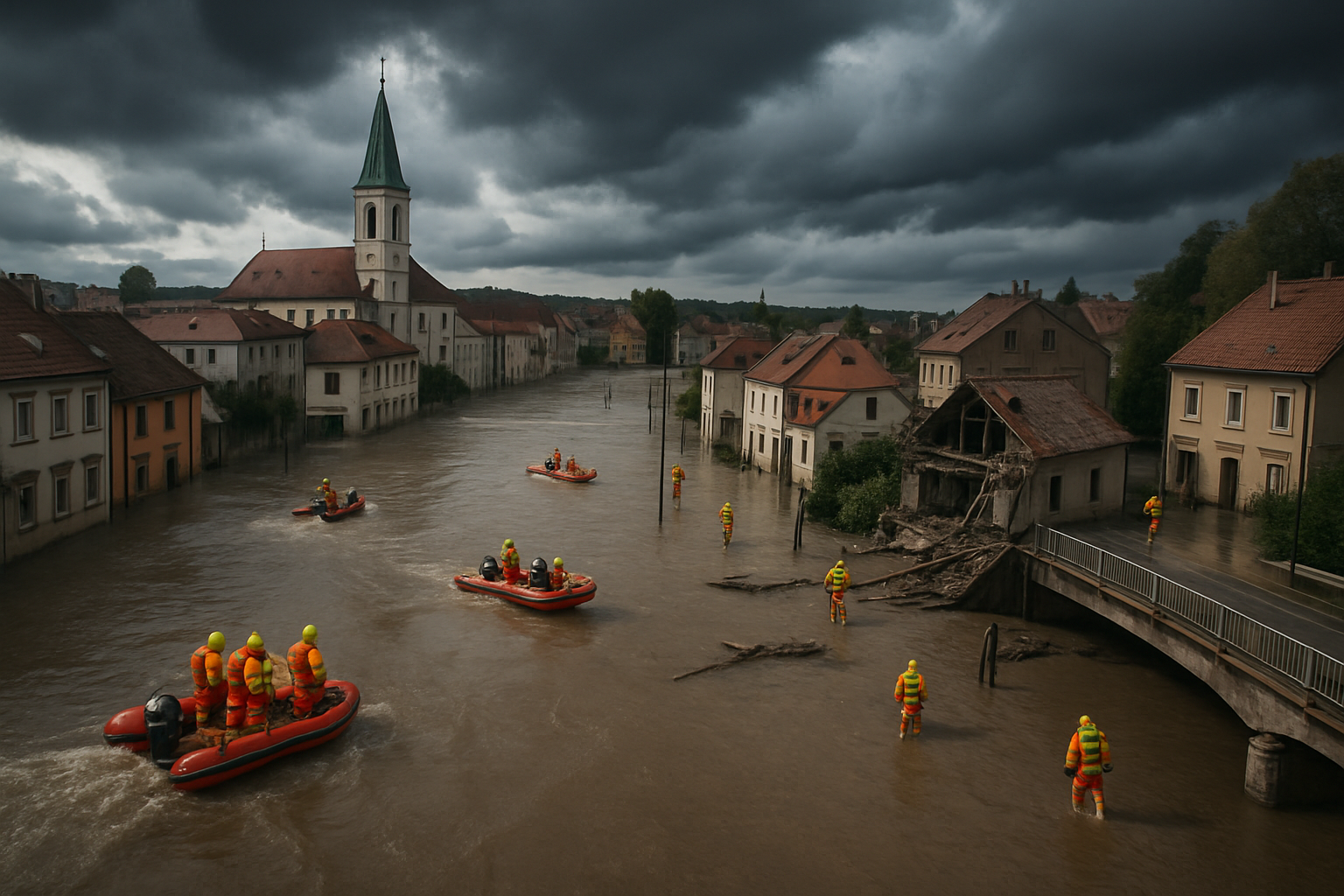
Storm Nils, the fourth consecutive major Atlantic storm to strike Europe in February 2026, has brought devastating flooding and infrastructure damage to France and Portugal, with France's flood alert agency working at "record pace" and authorities warning of no "return to normal for the prochains jours" (coming days).
The latest storm system has pushed emergency services to breaking point across southwestern Europe, with the Garonne river in France maintained under red alert for flooding throughout Saturday and Sunday in the Gironde and Lot-et-Garonne departments. According to Vigicrues, France's flood monitoring agency, "we have exceeded all our records," as relentless rainfall over the past month has completely saturated soils.
France Battles Record-Breaking Flooding
France's flood alert system has been operating around the clock for the past month amid what officials describe as an unprecedented series of winter storms. The head of the flood monitoring agency told AFP on Saturday that the system has been working at a record pace as saturated soils can no longer absorb the continuous rainfall.
Ten departments in western France have been placed under orange weather alerts as Storm Nils brings violent winds and additional flood risks to already overwhelmed regions. The crisis follows the devastating passage of previous storms in the Atlantic succession, which has claimed multiple lives and caused billions in damages across the Iberian Peninsula.
Portugal's Infrastructure Crisis Deepens
In Portugal, the situation has reached critical levels with authorities warning of potential "centennial flooding" in some regions. The storm succession beginning with Kristin, followed by Leonardo and Marta, has now culminated with Nils threatening to push river systems beyond their breaking points.
The Douro region has been particularly hard hit, with thousands of euros in damages already reported from destroyed terraces, uprooted vines, and severed access roads. Viticulturists in the region are pleading for government support as their livelihoods face destruction from the unprecedented weather conditions.
Power outages continue to plague the country, with thousands of residents in Leiria remaining without electricity for 18 consecutive days. Local authorities estimate that damages in the municipality alone could reach hundreds of millions of euros, representing one of the most significant weather-related disasters in recent Portuguese history.
Emergency Response at Breaking Point
Portugal has maintained what officials describe as the largest peacetime rescue operation in the country's history, with 26,500 personnel deployed including 1,975 military staff and 30 naval vessels. The emergency response has been handling over 1,800 weather-related incidents since February 1, stretching resources to unprecedented limits.
The crisis has already resulted in significant infrastructure damage, including the collapse of the A1 highway viaduct near Coimbra due to Mondego River flooding. Infrastructure Minister Miguel Pinto Luz confirmed that repairs would take "several weeks," effectively severing the critical Lisbon-Porto transportation corridor.
Civil protection services are maintaining heightened alert status, with the emergency support structure continuing to receive aid requests. Already, 34,000 applications have been submitted for the €10,000 reconstruction aid package for homes in the Centro and Lisboa e Vale do Tejo regions.
Isolated Communities and Humanitarian Crisis
The village of Ereira remains completely isolated for more than a week, with Navy, firefighters, and Army units continuing to guarantee supplies and population transport. The isolation of entire communities has become a recurring theme throughout this weather emergency, highlighting the vulnerability of rural infrastructure to extreme weather events.
Emergency services report that the Tejo and Mondego river basins continue to be sources of major concern, with water levels remaining dangerously high despite recent stabilization efforts. The threat to Coimbra, Portugal's historic university city, has been described as potentially catastrophic should flood levels reach centennial marks.
Broader Climate Context
The current crisis occurs within the broader context of extraordinary climate conditions across Europe. January 2026 was confirmed as the 18th consecutive month to exceed 1.5°C above pre-industrial levels, demonstrating how global warming is overriding natural climate cycles and enabling extreme regional weather events.
This storm succession represents the most severe test of European emergency response systems in recent memory. The frequency and intensity of the Atlantic storm systems have overwhelmed traditional disaster management approaches, forcing authorities to deploy military assets typically reserved for national security threats.
The European Canoeing Championships, scheduled for June in Montemor-o-Velho and crucial for Olympic qualification, may be at risk due to infrastructure damage. The sporting venue has been completely submerged, adding cultural and economic dimensions to the crisis.
International Response and Recovery
The European Union has activated its Civil Protection Mechanism in response to the crisis, with Sweden and Denmark providing a €246 million assistance package. This represents one of the largest coordinated European weather emergency responses in recent history.
Recovery efforts are expected to take months rather than weeks, with authorities emphasizing the need to "build back better" with climate-resilient infrastructure. The crisis has exposed fundamental vulnerabilities in European infrastructure designed for historical rather than future climate conditions.
Economic implications span multiple sectors, with agriculture, tourism, and transportation facing unprecedented disruption. Spanish reservoirs have surged to 67.3% capacity, with 31 reservoirs at 100% capacity, while agricultural losses across the Iberian Peninsula are estimated in the billions.
Looking Ahead
Weather forecasters warn that additional Atlantic storm systems are developing, suggesting that this crisis may persist for several more weeks. The situation represents what climate scientists describe as a "new normal" of extreme weather frequency and intensity that requires fundamental adaptation of European emergency response capabilities.
The current emergency has become a template for understanding how climate change intersects with governance, democracy, and daily life. Portugal's presidential election on February 8 proceeded despite the crisis, though 36,000 voters were unable to participate, demonstrating both democratic resilience and the increasing challenges posed by extreme weather to fundamental civic processes.
As Storm Nils continues to impact the region, authorities stress that citizens should remain vigilant and prepared for continued disruption. The crisis has fundamentally changed how European societies must approach emergency preparedness, infrastructure design, and climate adaptation for an era of unprecedented weather volatility.