European allies delivered a decisive rebuff to President Trump's escalating demands for an international naval coalition to secure the Strait of Hormuz, with Germany's Defense Minister Boris Pistorius leading the resistance by asking "What does Donald Trump expect a handful of European frigates to do that the powerful US Navy cannot?"
The rejection comes as the Iran crisis enters its most dangerous phase, with oil prices breaching $100 per barrel for the first time since 2022 and over 18,000 flights cancelled worldwide in the most severe aviation disruption since COVID-19.
Germany Leads European Resistance
Germany's explicit refusal to participate in Trump's military coalition marks the most significant NATO rift in recent years. Foreign Minister Johann Wadephul confirmed that Germany "will not be an active part of war," emphasizing the distinction between European territorial defense and Middle East military operations.
The German position reflects broader European skepticism about American military adventurism, with officials citing "Iraq lessons" and warning against repeating "the same mistakes made in Iraq." European leaders view the conflict as Trump's optional war rather than a collective security necessity.
"Germany will not participate in US-Israeli military operations against Iran. We will focus on defensive measures only and diplomatic solutions."
— Johann Wadephul, German Foreign Minister
France has also rejected Trump's request for warship deployment, with the Foreign Ministry stating Paris would not deploy additional forces despite the critical nature of the Strait of Hormuz carrying 40% of global oil transit.
Asia-Pacific Allies Join Resistance
The rejection extends beyond Europe, with Japan and Australia explicitly declining to send naval vessels despite direct US requests. This represents a significant blow to Trump's coalition-building efforts, particularly given Japan's 90% dependence on Middle Eastern oil and 70% reliance on Strait of Hormuz transit.
Australia has indicated wariness about military deployment even as 115,000 Australian nationals remain trapped in the region during the largest international evacuation since the Arab Spring of 2011.
Escalating Crisis Creates Global Emergency
The allied refusal comes amid the most dangerous international crisis since the Cold War, with Iran's Revolutionary Guard declaring "no red lines remain" in their systematic targeting of Western assets across the Middle East.
Iran has deployed 2,000-6,000 naval mines throughout the 21-mile Strait of Hormuz chokepoint, effectively closing the waterway that handles 40% of global seaborne oil transit. The US has destroyed 16 Iranian mine-laying vessels, but the critical shipping lane remains impassable.

The International Energy Agency has released a record 400 million barrels from strategic reserves - the largest intervention in the agency's 50-year history. Japan is releasing 80 million barrels for the first time since the 2011 Fukushima disaster.
European Territorial Defense vs. Middle East Operations
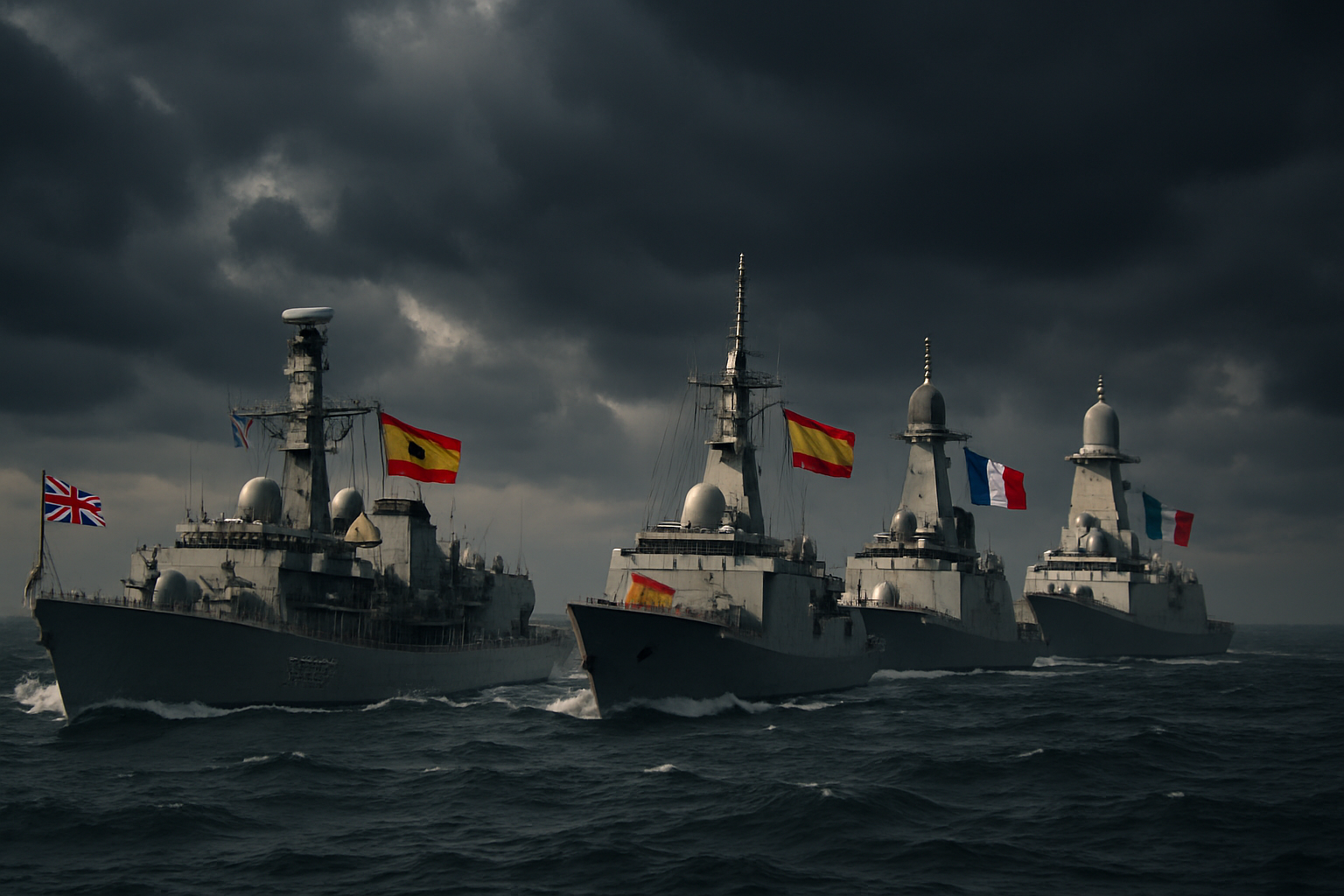
Despite refusing to join Trump's Gulf operation, European allies have demonstrated unprecedented unity in defending their own territory. Following the first attack on European soil since World War II - Iranian drone strikes on RAF Akrotiri Cyprus - European nations deployed an impressive naval coalition.
HMS Dragon leads British forces, while Spanish frigates, Italian vessels, and French ships including the frigate Languedoc protect the Eastern Mediterranean. The EU activated the ESTIA Cyprus evacuation plan for the first time in the bloc's history.
"No war with Iran, but solidarity with Cyprus as an EU country and victim."
— Pedro Sánchez, Spanish Prime Minister
Congressional Opposition Mounts at Home
Trump faces mounting pressure not only from international allies but also from Congress, where bipartisan lawmakers are demanding answers about strategy, costs, and potential ground troop deployment. Operation Epic Fury has cost $11.3 billion in just the first week, with the Pentagon preparing operations through September - far beyond the initial 4-6 week timeline.
Senator Richard Blumenthal stated he is "more concerned than ever" about ground troops, while the conflict maintains only 25% public support - described as "almost unprecedented" unpopularity for early-stage military operations.
The USS Charlotte submarine's sinking of Iranian frigate IRIS Dena near Sri Lanka, killing 80+ crew members, marked the first enemy vessel sunk by a US submarine since World War II, expanding the conflict beyond traditional Middle Eastern boundaries.
Diplomatic Breakdown Catalyst
The current military confrontation emerged from the complete collapse of US-Iran nuclear negotiations, despite achieving "broad agreement on guiding principles" in Geneva - the most diplomatic progress since the 2018 JCPOA collapse.
The fundamental disagreement proved insurmountable: Iran insisted on nuclear-only talks excluding ballistic missiles and proxy forces as "red lines," while the US demanded comprehensive agreements covering missiles, armed groups, and human rights.
Iran continues uranium enrichment at 60% purity with over 400kg of weapons-grade material - sufficient for multiple nuclear weapons. The crisis occurs against the backdrop of the New START treaty's expiration in February 2026, leaving the world without US-Russia nuclear constraints for the first time in over 50 years.
Regional Coalition Under Severe Strain
The unprecedented consensus among Saudi Arabia, UAE, Qatar, and Egypt supporting diplomatic solutions has been severely threatened by Iranian retaliation targeting their territories directly.
The UAE suffered one civilian death in Abu Dhabi, Kuwait recorded 32 injuries from airport drone strikes, and Qatar intercepted 65 missiles and 12 drones, resulting in 8 injuries despite Patriot missile defenses. Egypt's President Sisi condemned attacks on "sisterly Arab countries," warning of "comprehensive chaos spreading across the region."
Template-Setting Crisis for 21st Century
UN Secretary-General António Guterres has called the crisis the "greatest test of multilateral cooperation and crisis management in the modern era." The rapid transition from diplomatic breakthrough to military escalation demonstrates the fragility of crisis management in the multipolar era.
The allied rejection of Trump's naval coalition represents a fundamental shift in how partners view military intervention, with implications extending decades beyond the current conflict. European strategic autonomy has found its most concrete expression through coordinated defensive responses while refusing participation in what they view as American military adventurism.
Global Economic Implications
Financial markets have crashed worldwide, with Pakistan's KSE-100 recording its largest single-day decline in history at -8.97%. South Korea's KOSPI fell 12% with circuit breakers triggered, while the Korean won hit a 17-year low.
Supply chains for automotive, electronics, and textiles manufacturing face severe disruption due to their dependence on Gulf logistics networks. The 21-mile Strait of Hormuz has been exposed as a single-point failure in modern logistics with no realistic alternatives to handle diverted shipping volume.
Natural gas prices have exploded 24% in Europe and 78% in the US, while Qatar's halt of LNG production affects approximately 20% of global exports, threatening European energy supplies.
Looking Forward: Alliance Under Strain
The European refusal to join Trump's Gulf coalition while simultaneously defending European territory from Iranian attacks establishes new precedents for alliance obligations versus sovereign decision-making. The crisis tests whether NATO can maintain unity when members distinguish between collective defense and what they perceive as optional military adventures.
With Trump demanding Iran's "unconditional surrender" and claiming the right to personally choose Iran's next Supreme Leader, diplomatic solutions appear increasingly remote. The elevation of Mojtaba Khamenei as Iran's new Supreme Leader - the first hereditary succession in the Islamic Republic's 47-year history - further complicates prospects for negotiation.
March 17, 2026, represents a watershed moment in international relations, determining whether 21st-century disputes will be resolved through diplomatic frameworks or military confrontation. The success or failure of managing this crisis will establish precedents for decades, affecting nuclear proliferation, territorial sovereignty enforcement, and the credibility of both diplomatic and military solutions worldwide.