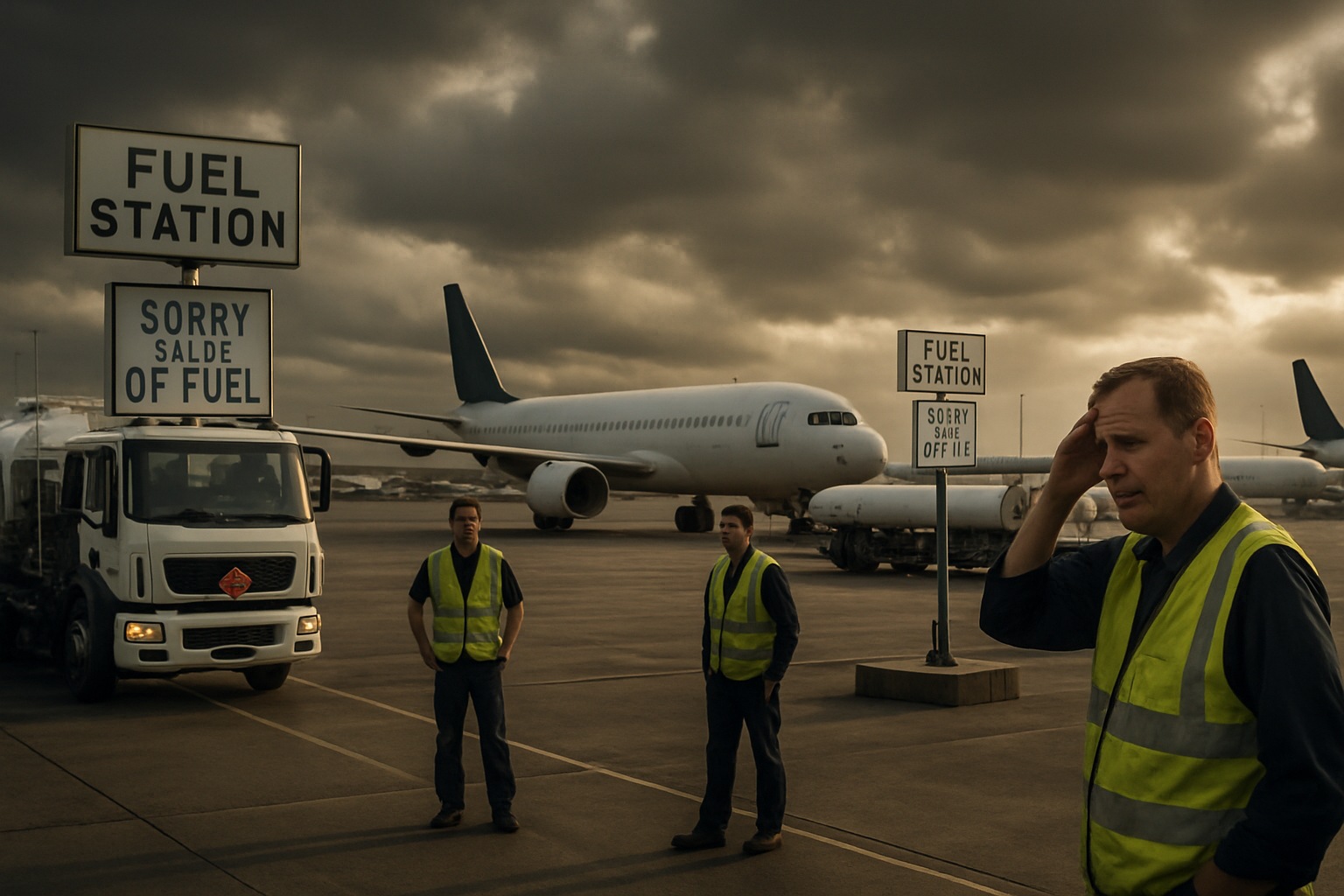
European aviation faces its most severe fuel crisis in modern history as ongoing Middle Eastern conflicts drive jet fuel prices to unprecedented levels, threatening widespread flight cancellations during the crucial summer travel season of 2026.
The crisis stems from Iran's Revolutionary Guard closure of the Strait of Hormuz, a critical chokepoint handling 40% of global oil transit, which has sent shockwaves through the aviation industry worldwide. International Energy Agency (IEA) Director Fatih Birol has issued an unprecedented warning that Europe has "perhaps six weeks of jet fuel" supplies remaining before widespread flight cancellations become inevitable by early June.
Airlines Sound Emergency Warnings
Ryanair CEO Michael O'Leary has been conducting daily emergency calls with fuel suppliers across Europe as the crisis threatens to devastate the peak summer travel season. Multiple Italian airports are experiencing severe fuel limitations, including Brindisi, Bologna, Milan Linate, Treviso, Venice, Reggio Calabria, and Pescara, with some facilities temporarily operating without adequate supplies.
Wizz Air CEO József Váradi has reported reactive jet fuel shortages at three Italian airports, while Lufthansa has been forced to ground up to 27 aircraft and permanently closed its CityLine subsidiary, citing unsustainable fuel costs. The German carrier's drastic measures highlight the industry-wide struggle with fuel expenses that have surged 122% from $85-90 to $150-200 per barrel.
"We are facing an unprecedented situation where the cost of fuel has made certain operations completely unviable. This is not just about economics—it's about the fundamental ability to operate flights safely and reliably."
— Industry source speaking on condition of anonymity
Escalating Crisis from Iran War
The current crisis represents an escalation from the March 2026 energy emergency, when Iran's Revolutionary Guard declared the Strait of Hormuz "unsafe for shipping." This action effectively blockaded the 21-mile waterway through which 40% of global seaborne oil transits, creating what experts describe as a dangerous single-point failure in the modern global logistics system.
Over 150 oil and LNG tankers remain stranded in the Persian Gulf, representing billions of dollars in cargo value. Major shipping companies Maersk and MSC have suspended all operations in the region, while Iran has deployed an estimated 2,000-6,000 naval mines to enforce the blockade.
The aviation crisis has reached COVID-19 pandemic levels, with over 18,000 flights cancelled worldwide. Eight Middle Eastern countries maintain simultaneous airspace closures—Iran, Iraq, Israel, UAE, Qatar, Syria, Kuwait, and Bahrain—creating what industry officials describe as an "aviation black hole" that has severed critical Europe-Asia flight corridors.
Economic Impact on Airlines
The financial strain on airlines has been severe. Air France-KLM has implemented emergency surcharges of 50 euros for economy class and 200 euros for business class on long-haul flights. Norwegian Air deployed 125 additional flights after SAS was forced to cancel over 1,000 flights due to fuel costs.
Dubai International Airport, the world's busiest with 86 million annual passengers, remains completely shut down due to missile damage, while major carriers including Emirates, Air France-KLM, Wizz Air, and Bulgaria Air have suspended operations indefinitely.
The crisis has prompted the most significant emergency interventions in aviation fuel markets since the 1970s oil shocks. The IEA has deployed its largest strategic petroleum reserve release in 50 years—400 million barrels from 32 countries, more than double the 2022 Ukraine crisis response.
Government Emergency Responses
European governments have implemented unprecedented emergency measures to address the crisis. Hungary has imposed immediate price caps on fuel to combat "war-driven explosions" in costs. France has deployed 500 fuel inspectors to prevent price manipulation, while Romania has outlined five emergency scenarios to prevent diesel prices from exceeding 10 lei per liter.
Slovakia has activated its strategic petroleum reserves for the first time, and Germany has strengthened antitrust laws to prevent gas station price manipulation—representing the most significant market intervention in modern German energy policy.
Japan is releasing 80 million barrels from its strategic reserves, the first such deployment since the 2011 Fukushima disaster. This is particularly significant given Japan's 95% dependence on Middle Eastern oil, with 70% typically transiting through the now-blocked Strait of Hormuz.
Global Aviation Paralysis
The crisis extends far beyond Europe. Chinese airlines are canceling flights to and from Singapore during Golden Week holidays as global jet fuel prices have more than doubled. Several airlines worldwide have implemented emergency surcharges and are cutting capacity to manage the unprecedented fuel costs.
Virgin Australia is investigating impacts on jet fuel supplies from multiple sources, while Air New Zealand has been forced to cut over 1,000 flights, affecting 44,000 passengers. The Caribbean and Pacific regions are seeing similar disruptions as the global nature of the jet fuel supply chain makes regional isolation impossible.
Diplomatic Breakdown Context
The current crisis emerged from the complete collapse of US-Iran nuclear negotiations despite what had been described as a "broad agreement on guiding principles"—the most diplomatic progress since the 2018 JCPOA breakdown. The fundamental scope disagreement proved insurmountable, with Iran maintaining that ballistic missiles and proxy forces were "red lines" to be excluded from any agreement, while the US demanded comprehensive coverage including missiles, armed groups, and human rights issues.
This diplomatic failure led to Operation Epic Fury, described as the largest coordinated operation since 2003, prompting Iranian retaliation under "Operation True Promise 4" with Revolutionary Guards declaring that "no red lines remain." The nuclear dimension has been complicated by the February 2026 expiration of New START, leaving the world without US-Russia nuclear constraints for the first time in over 50 years.
Energy Security Architecture Under Threat
The crisis has exposed fundamental vulnerabilities in global energy architecture. Qatar's Energy Minister Saad Al Kaabi has warned that Gulf states may be forced to declare force majeure "within weeks," with oil potentially reaching $150 per barrel, which could "bring down the economies of the world."
Natural gas prices have exploded 24% in Europe and 78% in the United States, reaching €47.32/MWh—the highest levels since February 2025. Qatar has halted LNG production at its Ras Laffan and Mesaid facilities, which represent approximately 20% of global LNG exports, due to extensive damage from Iranian attacks.
Energy security expert Samuel Ciszuk has described this as "the most severe energy security crisis in decades, with single-chokepoint vulnerabilities fully exposed." The 21-mile Strait of Hormuz has proven to be a dangerous single-point failure for modern logistics, with no realistic alternative routes capable of handling the diverted volume.
Financial Markets in Turmoil
The crisis has triggered historic crashes in financial markets worldwide. Pakistan's KSE-100 index suffered its largest single-day decline in history at -8.97%, while South Korea's KOSPI fell 12%, triggering circuit breakers and sending the Korean won to 17-year lows.
PayPal postponed its $1.1 billion IPO indefinitely due to market volatility, while central banks including the ECB and Bank of Japan have coordinated emergency liquidity measures. However, traditional monetary policy has proven to have limited effectiveness against structural geopolitical disruptions.
Consumer Impact Worldwide
The crisis has severely impacted consumers globally. Bangladesh has implemented fuel rationing for 170 million people, while Pakistan has instituted wartime austerity measures including four-day government work weeks, with fuel prices at Rs321.17 per liter—the highest in South Asia.
In Europe, Sweden faces electricity increases of 10-20 öre and gasoline increases of 1-2 kronor, with the Malmö region most exposed due to continental market integration. Ireland is experiencing heating oil approaching €2 per liter, prompting warnings about "brazen rip-offs," while Bosnia-Herzegovina has been reduced to just two days of gas reserves.
Summer Travel Season at Risk
The timing of the crisis poses particular challenges as Europe approaches its peak summer travel season. The European aviation industry, which typically sees its highest passenger volumes from June through August, now faces the prospect of systematic shutdowns just as millions of Europeans prepare for summer holidays.
Airlines have been forced to implement emergency contingency planning, with many considering route diversification to reduce dependence on Middle Eastern aviation hubs. However, the global nature of the jet fuel market means that geographical isolation from the crisis is nearly impossible.
The International Air Transport Association (IATA) has warned that months will be needed for fuel supply recovery even after Middle East refining capacity disruptions are resolved, suggesting that the aviation sector faces unique recovery challenges beyond broader market stabilization.
Template-Setting Crisis Management
UN Secretary-General António Guterres has called this "the greatest test of multilateral cooperation in the modern era," with nuclear risks at their "highest in decades." The crisis represents the most dangerous international situation since the end of the Cold War, simultaneously affecting regional war prevention, global energy security, nuclear governance credibility, and international law enforcement based on post-WWII order principles.
The recovery timeline remains uncertain as it depends on military operations and diplomatic resolution rather than predictable weather patterns or technical disruptions. Aviation cannot maintain long-term scheduling with multiple airspaces closed and energy markets volatile due to blocked transit routes.
Success in containing the crisis could provide a framework for nuclear crisis resolution and strengthen diplomatic precedents for 21st-century conflict management. However, failure could accelerate military solutions, reshape Middle Eastern geopolitics for decades, encourage nuclear proliferation globally, and undermine diplomatic credibility worldwide.
Looking Ahead: Energy Architecture Transformation
The crisis has demonstrated the urgent need for fundamental transformation of global energy architecture to reduce dependence on strategic chokepoints. While strategic petroleum reserves provide temporary buffering, they cannot address sustained disruptions of this magnitude. Supply diversification and renewable energy transitions require years or decades of implementation, but the urgency has been dramatically accelerated by current events.
Estonia's model of 88% renewable electricity generation and Europe's largest battery storage system supporting 90,000 households has proven valuable during the crisis, demonstrating a potential pathway toward energy independence. However, such transitions require sustained investment and political commitment over many years.
As Europe faces potentially its most challenging summer travel season in modern history, the aviation industry must navigate not only immediate fuel supply constraints but also the broader implications of a fundamental shift in global energy security paradigms. The choices made in the coming weeks will likely influence international crisis management frameworks and energy security planning for decades to come.
April 17, 2026, represents a watershed moment in global energy security, with European aviation serving as the critical test case for whether diplomatic solutions can prevent the systematic shutdown of one of the world's most vital transportation networks during its peak operational period.