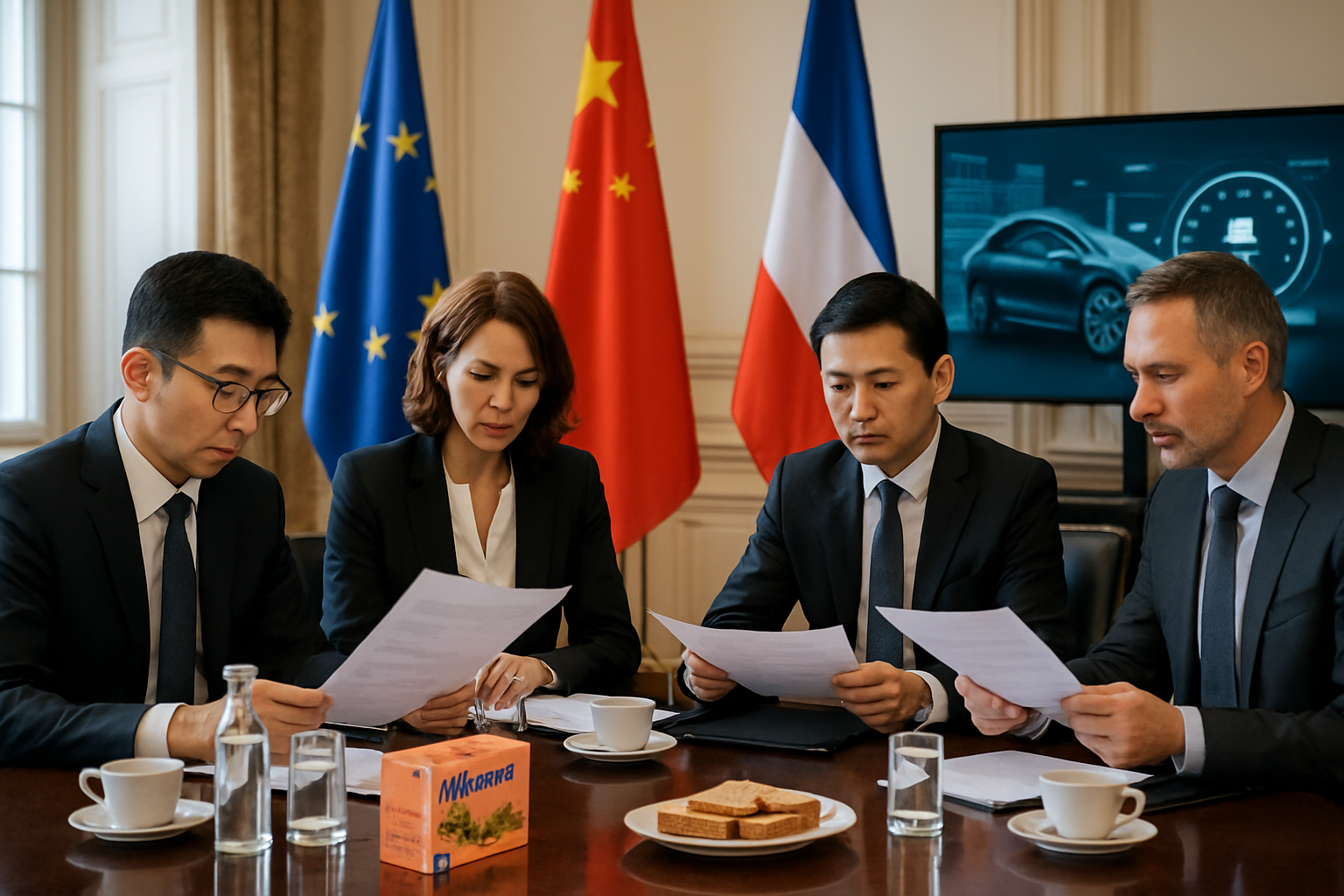
European markets are witnessing significant corporate expansion and strategic positioning as Chinese automotive giant BYD officially opened its first showroom in Bulgaria, while Austrian confectionery manufacturer Manner articulates ambitious international growth plans, signaling broader economic confidence despite global market volatility.
The convergence of these developments on March 28, 2026, underscores the dynamic nature of European business landscapes, where traditional industries and emerging technologies are finding new pathways for growth and market penetration across regional boundaries.
Chinese Automotive Expansion into Bulgarian Market
BYD (Build Your Dreams), the world's largest manufacturer of electrified vehicles, marked a significant milestone with the official opening of its first Bulgarian showroom in Sofia. The launch coincided with a spring weekend festival celebrating Chinese automobiles across six major Bulgarian cities, including Plovdiv, Burgas, Varna, Ruse, and Gabrovo.
The expansion represents more than just a retail establishment—it signals China's strategic penetration into Central and Eastern European automotive markets. BYD's entry comes at a time when the company has achieved remarkable technological breakthroughs, including its Megawatt Flash Charging system capable of delivering 400km range in just 5 minutes, and the Blade Battery 2.0 technology that functions effectively in temperatures as low as -30°C.
"This represents a fundamental shift in the European automotive landscape, where Chinese manufacturers are no longer just competing on price but leading in technological innovation."
— Industry Analysis, March 2026
The Bulgarian market entry is facilitated through Auto Union, BYD's official representative in Bulgaria, in partnership with China Motor Company. The showroom openings are part of a coordinated effort that includes dealership centers for DONGFENG vehicles, creating a comprehensive Chinese automotive ecosystem in the region.
Austrian Confectionery Giant Charts International Course
Meanwhile, in Austria, Manner's new CEO Dieter Messner outlined the company's strategic approach to international expansion, particularly addressing the challenges of entering the notoriously difficult German market. In an exclusive interview, Messner acknowledged that Austria's beloved cult confectioneries are often considered "too sweet" for German palates, highlighting the complexities of cross-border food industry expansion within Europe.
Messner's candid assessment of European food markets reveals deeper insights into regional consumer preferences and the strategic considerations facing traditional manufacturers. His observation about the German market being "the toughest food market in Europe" reflects broader challenges that established European brands face when expanding beyond their traditional territories.
The Manner CEO's approach emphasizes organic growth and market adaptation rather than revolutionary changes to core products. This strategy reflects a mature understanding of brand heritage balanced with market realities—an approach that contrasts sharply with the disruptive technological advances seen in sectors like automotive and technology.
Italian Economic Stability Amid Global Turbulence
Adding to the picture of European economic confidence, Italian Finance Minister Giancarlo Giorgetti addressed concerns about fiscal stability, particularly in the context of ongoing geopolitical tensions including the Iran crisis. Speaking about the Transition 5.0 program, Giorgetti emphasized Italy's "relative solidarity" in facing current challenges.
Giorgetti noted that Italy's economic fundamentals, while not exceptional, remain "decidedly positive," with public finances capable of absorbing external shocks. This assessment comes as European markets have demonstrated remarkable resilience despite oil prices surging past $100 per barrel for the first time since 2022, with Brent crude peaking at $119.50 during the recent Iran-related energy crisis.
Broader Economic Context and Market Dynamics
These corporate developments unfold against a backdrop of significant global economic shifts. The European Union has recently completed its comprehensive free trade agreement with Australia after eight years of negotiations, creating new opportunities for 475 million consumers across both regions and establishing alternative supply chains for critical minerals.
The automotive sector, in particular, is experiencing unprecedented transformation. China maintains approximately 60% of global critical materials production and 90% of refining capacity for lithium, cobalt, and rare earth elements—materials essential for electric vehicle production. This dominance has prompted the US-EU-Japan Critical Minerals Partnership involving 55 countries and seven African suppliers to seek supply chain diversification.

Technology Integration and Infrastructure Development
The success of companies like BYD in European markets reflects broader technological maturation in the electric vehicle sector. Recent battery longevity studies reveal that Tesla Model S vehicles from 2012-2014 with over 200,000 miles retain 85-92% of their battery capacity, while Nissan Leaf vehicles from 2011-2013 maintain 75-85% capacity after a decade of operation. These findings suggest practical EV battery lifespans of 15-20 years, far exceeding early industry predictions.
European infrastructure development has accelerated to support this technological shift. Austria has doubled its EV charging capacity with 1,000 additional stations, while Estonia maintains European leadership with 88% renewable electricity and the continent's largest battery storage system serving 90,000 households.
Supply Chain Challenges and Opportunities
However, the expansion of both traditional and technology sectors faces significant supply chain challenges. Memory chip shortages continue to drive semiconductor prices to six times normal levels, affecting everything from automotive control systems to smart manufacturing equipment. These shortages are expected to persist until new fabrication facilities come online in 2027.
For traditional manufacturers like Manner, supply chain considerations involve different but equally complex factors, including sourcing sustainable ingredients, managing packaging costs, and navigating increasingly sophisticated regulatory frameworks around recycling and environmental compliance.
Climate Context and Sustainability Imperatives
The urgency driving much of this business transformation cannot be understated. January 2026 marked the 18th consecutive month of temperatures exceeding 1.5°C above pre-industrial levels, demonstrating that human-induced climate change is now overriding natural climate variability. This context makes the transition to electric vehicles and sustainable business practices not just economically attractive but environmentally essential.
Companies across sectors are recognizing that environmental protection has evolved from an external cost consideration to a central financial risk factor. The shift is particularly evident in how businesses approach long-term strategic planning, with sustainability considerations now integral to market expansion decisions.
Strategic Implications for European Markets
The convergence of these developments signals several important trends for European business strategy. First, the successful penetration of Chinese automotive technology into European markets demonstrates that technological innovation, rather than just cost advantages, is driving competitive dynamics.
Second, traditional European manufacturers like Manner are finding that authentic brand heritage, combined with strategic market adaptation, remains a powerful competitive advantage even in an era of rapid technological change.
Third, government policies—from Italy's fiscal management to Bulgaria's openness to foreign investment—continue to play crucial roles in shaping business expansion opportunities across the European Union.
"We are witnessing a fundamental realignment of global business dynamics where emerging market companies are demonstrating sophisticated policy frameworks that challenge traditional developed economy leadership assumptions."
— European Business Analysis, March 2026
Looking Forward: Integration and Cooperation
As these various corporate strategies unfold, the success of European business expansion—whether by Chinese automotive companies entering new markets or Austrian confectionery companies adapting to international tastes—increasingly depends on sophisticated coordination across multiple stakeholders.
The template emerging from March 2026's business developments suggests that successful 21st-century economic expansion requires balancing technological innovation with cultural sensitivity, regulatory compliance with market flexibility, and international cooperation with domestic expertise.
For BYD, success in European markets will depend not just on technological superiority but on understanding local consumer preferences, regulatory requirements, and service expectations. For Manner, international growth requires maintaining brand authenticity while adapting to diverse market conditions and consumer tastes.
The broader implications of these developments extend beyond individual corporate success stories. They represent a maturing global economy where businesses must navigate complex international relationships, rapidly evolving technologies, and increasing environmental imperatives while serving diverse stakeholder interests.
As European markets continue to demonstrate resilience and adaptability, the combination of traditional business acumen with technological innovation appears to be creating new models for sustainable economic growth that could influence business development strategies worldwide for decades to come.