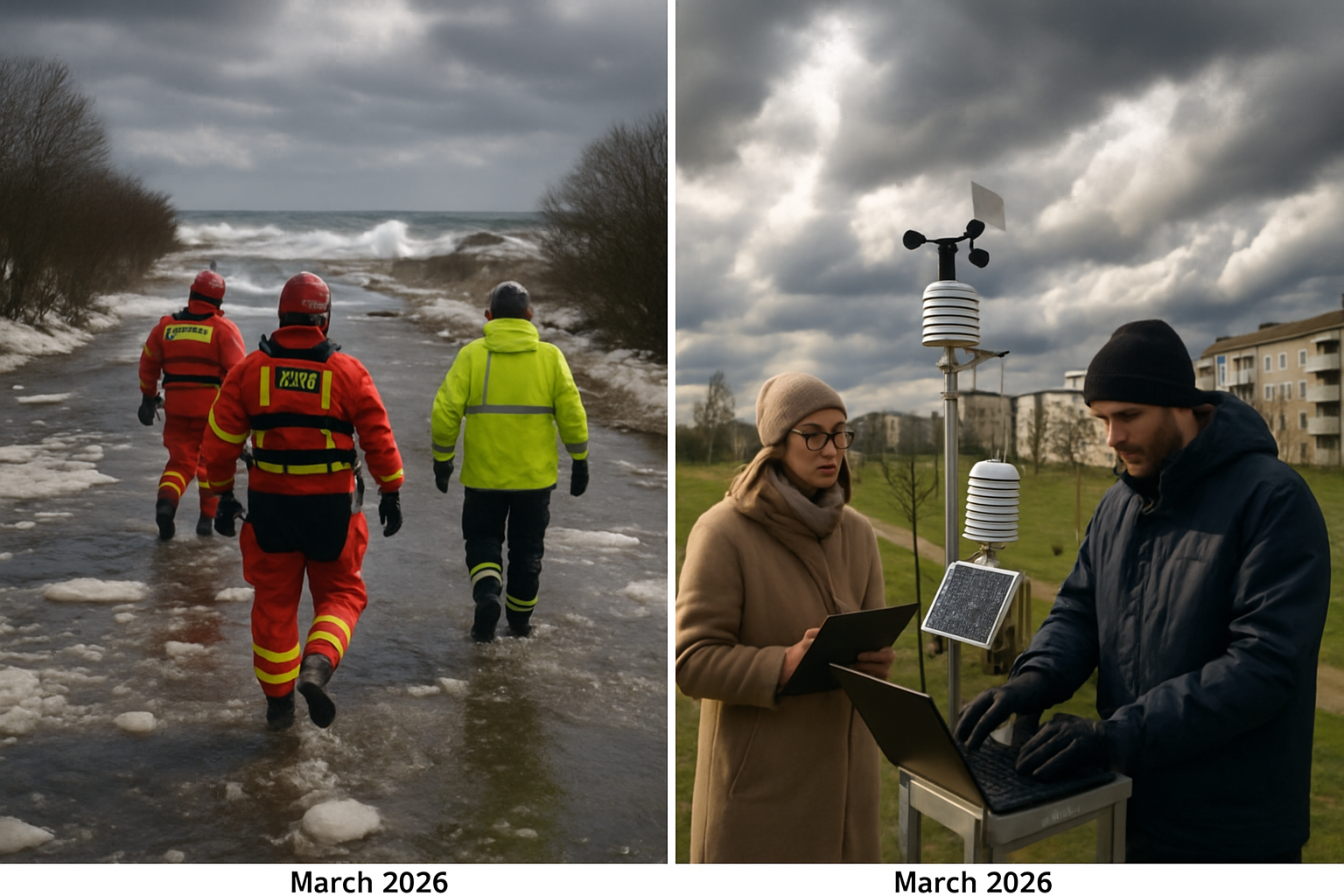
Europe confronts a dangerous convergence of extreme weather events spanning from the Mediterranean to the Baltic Sea, as Cyprus experiences rare mountain snowfall, Latvia battles severe flooding, and Germany pioneers urban forest carbon absorption studies—all occurring during the 21st consecutive month of global temperatures exceeding 1.5°C above pre-industrial levels.
The week's weather emergencies underscore the continent's growing vulnerability to climate volatility, with emergency services across multiple nations reporting strain on response capabilities designed for sequential rather than simultaneous disasters.
Unprecedented Mediterranean Weather Patterns
Cyprus meteorological services report unusual conditions affecting the eastern Mediterranean island, with weak low-pressure systems bringing rare mountain snowfall to regions typically enjoying mild winter weather. Winds reaching force 5 to 6 on southern coasts have generated rough seas, while temperatures across the island range from 17°C on most coasts to 10°C in higher mountain areas, with some peaks dropping to 3°C.
The island's agriculture ministry confirmed that Minister Maria Panayiotou has been monitoring agricultural impacts of the unexpected weather patterns, which represent a significant departure from typical Mediterranean climate conditions for mid-March.

Baltic Region Flood Emergency
Latvia's environmental authorities report widespread flooding as most of the country's rivers experience ice breakup following rapid temperature fluctuations. The Latvia Environment, Geology and Meteorology Center confirms that water discharge has increased across most regions except parts of Kurzeme, creating dangerous conditions for communities near riverbanks and floodplains.
Emergency protocols have been activated in several municipalities, with authorities warning residents to avoid flood-prone areas during what officials describe as one of the most dramatic seasonal transitions on record.
Urban Forest Carbon Breakthrough
German climate research has revealed that urban trees can potentially offset vehicle emissions on peak summer days, according to new studies highlighted by ARD's Tagesschau. The research, conducted by scientist Jan Kerckhoff, demonstrates that strategically planned urban forests can absorb significant amounts of carbon dioxide during optimal weather conditions.
"On certain summer days, trees store more carbon than cars release into the atmosphere in the same urban areas."
— Jan Kerckhoff, Climate Researcher
The findings come as European cities increasingly recognize urban green spaces as essential climate adaptation infrastructure rather than mere aesthetic enhancements.
Greece Faces Weather System Changes
Greek meteorological services report shifting weather patterns across the mainland, with increased cloud cover and localized rain affecting the Ionian regions and western mainland areas. The changes represent part of broader atmospheric instability affecting southeastern Europe during what climatologists describe as an unprecedented period of global warming.
Climate Context and Global Implications
These European weather events occur within the context of 21 consecutive months of global temperatures exceeding the critical 1.5°C threshold above pre-industrial levels—the longest sustained warming period in recorded human history. According to World Meteorological Organization data, human-induced climate change has now fundamentally overridden natural climate variability, including La Niña cooling effects that would typically moderate global temperatures.
The sustained warming creates what climate scientists term a "climate volatility paradox," where global heat records coincide with devastating regional weather extremes through disrupted atmospheric circulation patterns and polar vortex instability.

Emergency Response Challenges
Emergency management experts across Europe report that traditional mutual aid mechanisms, designed to handle sequential regional disasters, are proving inadequate when multiple countries face simultaneous extreme weather events. The European Union's Civil Protection Mechanism has been repeatedly activated, with recent Sweden-Denmark assistance operations totaling €246 million—the largest coordinated European weather response on record.
Transportation networks, power grids, and communication systems built according to historical climate patterns are operating beyond their intended design parameters as extreme weather events exceed operational thresholds with increasing frequency.
Infrastructure Vulnerabilities Exposed
The current weather crisis highlights critical vulnerabilities in European infrastructure systems. Traditional flood defenses in Latvia were designed for historical water levels that no longer represent reliable planning baselines. Similarly, Mediterranean transportation and energy systems in Cyprus struggle with weather patterns that fall outside their operational specifications.
Urban drainage systems across the affected regions face challenges from precipitation patterns that alternate between extreme intensity and unusual timing, requiring fundamental reassessment of infrastructure designed for climate conditions that no longer exist.
Technology and Traditional Knowledge Integration
Successful climate adaptation efforts across Europe demonstrate the importance of integrating cutting-edge technology with traditional ecological knowledge. German urban forest research combines satellite monitoring and environmental DNA analysis with centuries of European forestry expertise. Latvia's flood management integrates advanced meteorological forecasting with traditional river management practices developed by rural communities.
Economic and Social Implications
The economic impact of simultaneous weather emergencies extends far beyond immediate response costs. Agricultural sectors face mounting losses from extreme weather destroying crops during critical growing seasons. Tourism industries experience extended cancellations and infrastructure damage during what should be peak revenue periods.
Mental health services report increased demand for support related to climate anxiety and repeated extreme weather trauma, as communities face the psychological burden of unprecedented environmental volatility.
International Cooperation Under Strain
Environmental challenges transcend political boundaries, as atmospheric systems and ocean currents carry climate effects across continents regardless of national borders. The simultaneity of current European disasters tests international cooperation mechanisms that were developed assuming stable regions could assist others during isolated emergencies.
Success in addressing these transnational challenges requires coordinated policy frameworks, shared monitoring systems, and innovative financing mechanisms that recognize environmental protection as essential infrastructure for human prosperity and planetary sustainability.
Looking Ahead: Critical Decisions
March 2026 represents a watershed moment for European climate preparedness. Climate scientists warn that current conditions provide a preview of routine circumstances expected in the 2030s without immediate and comprehensive climate adaptation investment.
The choice between reactive crisis management and proactive climate resilience building becomes increasingly critical as the window for effective climate action narrows. Infrastructure systems require fundamental reassessment for what experts term the "new normal" of extreme weather volatility, where traditional seasonal patterns no longer provide reliable planning frameworks.
"We're seeing the convergence of multiple climate stressors that our traditional emergency response systems weren't designed to handle simultaneously."
— European Climate Adaptation Expert
Tools, knowledge, and cooperation frameworks exist for comprehensive environmental protection, but success depends on unprecedented speed of implementation, sustained international cooperation, and recognition that environmental protection functions as essential infrastructure rather than optional enhancement.
Adaptation Innovations Emerge
Despite the challenges, innovative adaptation strategies are emerging across Europe. Communities demonstrate remarkable resilience through hybrid approaches that integrate traditional knowledge with modern technology. Estonia combines agricultural wisdom developed over centuries with advanced climate monitoring systems. German cities test integrated urban planning that treats green spaces as climate infrastructure rather than amenities.
The diversity of climate adaptation approaches across different European contexts provides resilience against single-solution dependencies, offering multiple pathways for addressing the complex, interconnected challenges of accelerating climate change.
Strategic Significance for Global Climate Action
The convergence of extreme weather events, infrastructure vulnerabilities, and emergency response limitations across Europe underscores the urgent need for coordinated international action during what climatologists describe as the decisive climate action decade.
European experiences provide crucial lessons for other regions preparing for similar challenges, demonstrating both the vulnerabilities of systems designed for historical climate patterns and the potential for innovative adaptation strategies that combine technological advancement with community engagement.
Success in building climate resilience will determine not only Europe's ability to maintain prosperity and security but also provide templates for global climate adaptation strategies that could influence environmental protection approaches for generations to come.