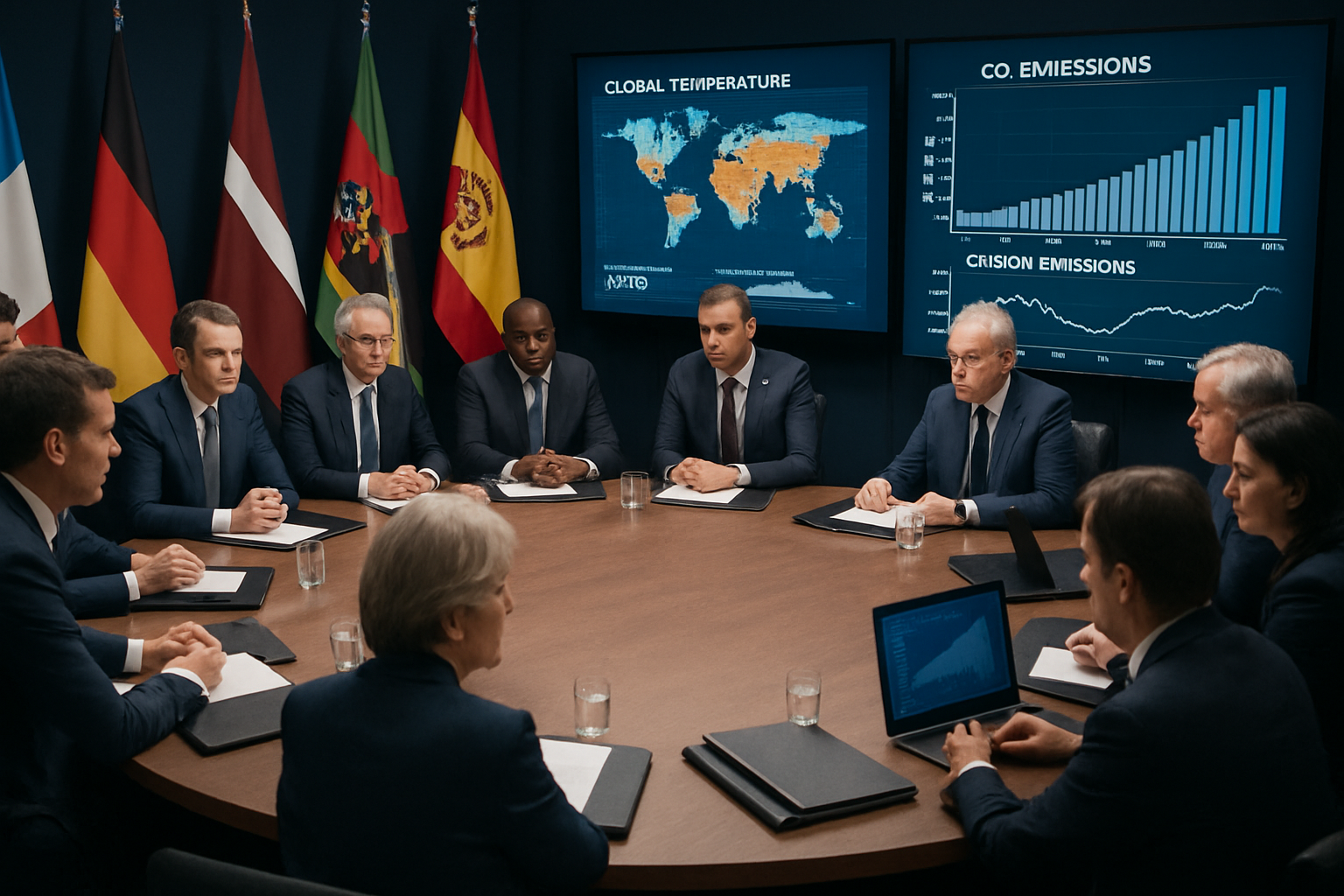
European climate policies face their gravest test as multiple nations acknowledge dramatic shortfalls in emission reductions while environmental crises accelerate worldwide, with France's carbon cuts falling three times below required levels and Germany expressing deep skepticism about achieving climate neutrality by 2045.
A comprehensive analysis of climate developments across France, Germany, Latvia, Mozambique, Spain, and the United Kingdom reveals a dangerous convergence of policy failures and environmental acceleration that threatens to undermine global climate commitments at their most critical juncture.
France's Carbon Reduction Crisis
French authorities confirmed that the nation's greenhouse gas emissions are declining at a rate three times slower than required to meet climate targets, according to new estimates from Citepa, a specialized monitoring organization. The stark assessment comes amid France's broader energy crisis, highlighting how geopolitical instability is undermining environmental progress.
The findings represent a significant setback for France's climate leadership ambitions within the European Union, where member states committed to a historic 90% emissions reduction by 2040. The gap between current reduction rates and required targets exposes fundamental challenges in translating climate commitments into effective policy implementation.
German Climate Skepticism Deepens
A new comprehensive survey reveals a troubling disconnect in German public opinion regarding climate action. While a substantial majority of Germans support achieving climate neutrality, they simultaneously express deep skepticism about the country's ability to reach this goal by the 2045 target date.
The poll results, published exclusively by FAZ, underscore growing concerns about the practicality of Germany's climate transformation amid economic pressures and energy security challenges. German respondents indicated strong environmental commitment while questioning whether current policies and technological capabilities can deliver the required emission reductions.
"The majority of Germans want the country to become climate neutral, but they don't believe it will actually happen."
— FAZ Survey Analysis
Latvia's Transportation Sector Failures
Latvia faces significant risks of failing to meet its 2030 climate targets in the transportation sector, according to a damning State Audit Office report released April 8th. The audit identified fragmented policy coordination, scattered support instruments, and poorly directed public resources as critical barriers to progress.
The report highlights how even relatively progressive European nations struggle with sector-specific climate implementation, particularly in transportation where technological transitions require massive infrastructure investments and behavioral changes across entire populations.
Spain's Energy Crisis Response
Spain's environmental discourse has taken a dramatic turn following the Iran conflict, which has made the necessity of cutting petroleum dependence more evident than ever. Spanish analysts argue that the war provides an essential "electroshock" for accelerating renewable energy transitions and reducing fossil fuel dependency.
Despite representing 60% of Spain's petroleum imports now threatened by Middle Eastern instability, transportation electrification remains at critically low levels. The crisis has exposed Spain's vulnerability to energy supply disruptions while highlighting the economic and security advantages of domestic renewable energy development.
UK's North Sea Drilling Controversy
Senior climate experts have warned that opening new oil and gas fields in the North Sea would "send a shock wave around the world," fundamentally undermining international climate targets and the UK's environmental leadership credentials.
The UK government faces intense pressure from the oil industry, Conservative politicians, Reform UK, trade unions, and parts of the Treasury to approve new fossil fuel extraction despite clear evidence that additional drilling would neither reduce consumer energy prices nor significantly impact energy security.
"Opening new oil and gas fields in the North Sea would send a shock wave around the world, imperiling international climate targets and undermining the UK's climate leadership."
— Senior Climate Experts Warning
Mozambique's Climate Reality
President Daniel Chapo delivered a stark warning that climate change "is no longer a distant threat" while visiting flood-stricken communities in Gaza province. Speaking from Guija district, Chapo emphasized how climate change represents "a reality worsening the vulnerability of our productive system and our rural communities."
Mozambique's experience illustrates how climate impacts disproportionately affect developing nations with limited adaptive capacity. The country's agricultural systems and rural communities face mounting pressures from extreme weather events that threaten food security and economic stability.
Global Context of Climate Acceleration
These European policy challenges unfold against unprecedented global warming acceleration. Recent analysis confirms that 2026 has witnessed the longest sustained warming streak in recorded human history, with temperatures consistently exceeding the critical 1.5°C threshold above pre-industrial levels.
The sustained warming demonstrates how human-induced climate change has fundamentally altered atmospheric systems, overriding natural climate variability including La Niña cooling effects that previously provided temporary temperature reductions.
Technology and Policy Integration Challenges
Successful climate policy requires sophisticated integration of cutting-edge technology with traditional approaches and community engagement. European experiences demonstrate that technological solutions alone cannot overcome policy coordination failures, funding gaps, and implementation challenges.
The crisis across multiple European nations reveals how climate action depends on sustained political commitment, transparent governance frameworks, economic incentives that make environmental protection financially viable, and adaptive management capable of responding to rapidly changing conditions.
Economic Implications of Climate Policy Failures
Environmental degradation costs—including healthcare expenses from air pollution, infrastructure damage from extreme weather, and agricultural losses—increasingly exceed the investments required for proactive environmental protection. European nations implementing comprehensive climate policies demonstrate greater economic resilience and attract sustainable investment across multiple sectors.
However, the gap between climate commitments and implementation creates economic uncertainty that undermines long-term planning and investment in clean technologies. The disconnect between stated environmental goals and actual policy delivery threatens to damage European competitiveness in the emerging global clean energy economy.
International Cooperation Under Strain
Climate change represents a fundamentally transnational challenge where atmospheric systems, ocean currents, and environmental effects cross national boundaries. The European policy failures occur precisely when international cooperation faces unprecedented strain from geopolitical tensions, economic pressures, and competing national priorities.
Success requires unprecedented coordination across multiple scales and sectors, with knowledge sharing, innovative financing mechanisms, and coordinated policy frameworks that address immediate protection needs while building long-term climate adaptation capabilities.
Critical Action Window Narrowing
April 2026 represents a critical juncture where the choice between reactive crisis management and proactive ecosystem service management will determine whether climate protection efforts can keep pace with accelerating environmental change during this decisive climate action decade.
The environmental action window continues narrowing as ecological systems approach critical thresholds that could trigger irreversible changes affecting global food security, climate stability, and human settlements. Tools, knowledge, and cooperation frameworks exist for comprehensive environmental protection, but success depends on rapid scaling through enhanced international cooperation and sustained financial commitments.
The European experience provides crucial lessons for the global community: climate targets without effective implementation mechanisms remain merely symbolic gestures, while the costs of inaction continue mounting faster than the investments required for transformation. The coming months will determine whether European nations can bridge the gap between climate ambition and policy delivery, potentially influencing the trajectory of global environmental protection for generations to come.