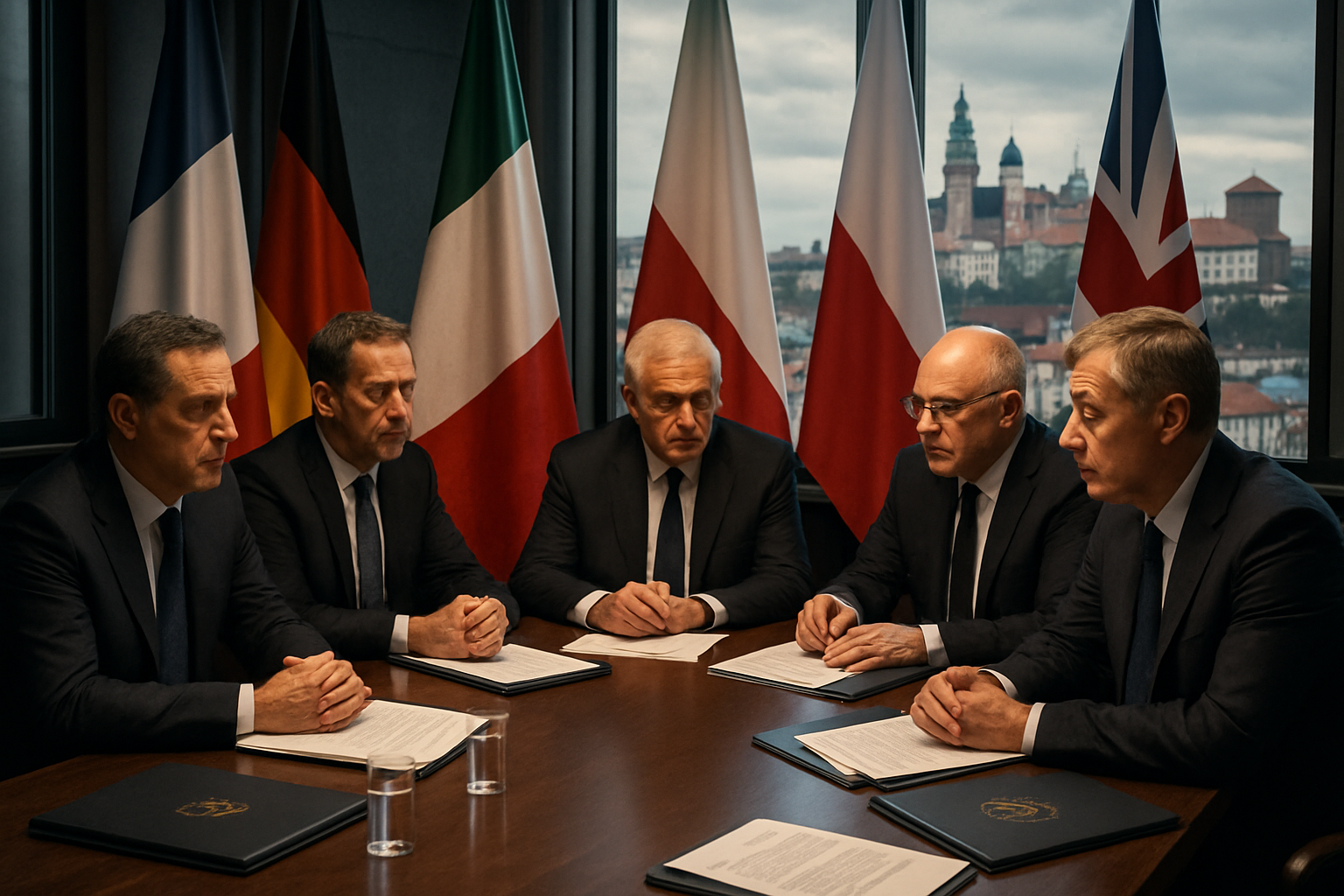
Europe's five largest defense powers have announced a groundbreaking multi-million euro collaboration to develop low-cost air defense systems, marking a decisive shift toward European strategic autonomy in the face of evolving security challenges and questions about American alliance commitments.
The European Group of Five Defense Ministers, comprising France, Germany, Italy, Poland, and Britain, committed to bringing autonomous interceptor drones and affordable air defense missiles into production within 12 months during their meeting in Krakow, Poland on February 20, 2026.
Ukraine War Lessons Drive Innovation
The ambitious project draws directly from Ukraine's battlefield experiences, where autonomous interceptor drones have proven remarkably effective against Russian missile and drone attacks while costing significantly less than traditional air defense missiles. Ukrainian forces have demonstrated that these systems can provide credible alternatives to expensive Patriots and other Western air defense platforms.
"It's a multi-million pound, multi-million euro commitment to step up this technology," declared Britain's Minister for Defence Readiness, outlining the scope of European collaboration that would have been unthinkable just years ago.
According to Polish Defense Minister Władysław Kosiniak-Kamysz, the European nations will leverage Ukrainian operational experience to develop cost-effective production methods for both defensive drones and anti-UAV systems. This represents a fundamental shift from traditional high-cost, low-volume defense procurement toward mass-producible, affordable solutions.
Strategic Context: Growing European Autonomy
The Krakow meeting occurs against the backdrop of increasingly strained transatlantic relations and growing European concerns about long-term American security guarantee reliability. Recent Munich Security Conference discussions revealed unprecedented conversations about expanding France's nuclear deterrent beyond national scope, with Germany, Poland, and Finland engaging in preliminary extended deterrence arrangements.
German Defense Minister Boris Pistorius has been particularly vocal about developing European multi-domain task forces, drawing parallels to the Five Eyes intelligence alliance but focused on European capabilities. "Now we need unconventional ideas," Pistorius emphasized, reflecting broader European thinking about security independence.
The timing is particularly significant given NATO's ongoing Arctic Sentry mission, where European allies have assumed leadership roles. The UK is doubling its Norway troop presence to 2,000, while Sweden deploys Gripen jets for Greenland exercises. These initiatives demonstrate European willingness to shoulder greater defense responsibilities.
Technical Innovation and Rapid Deployment
The 12-month timeline represents an extraordinary acceleration compared to traditional European defense procurement cycles, which typically span years or decades. The emphasis on "low-cost" systems reflects lessons learned from Ukraine, where expensive Western missiles are being used to intercept relatively cheap Russian drones and missiles – an unsustainable economic equation.
Industry sources indicate the project will focus on several key technologies:
- Autonomous interceptor drones capable of engaging multiple target types
- AI-powered target recognition and engagement systems
- Swarm coordination capabilities for overwhelming attacks
- Rapid manufacturing processes enabling mass production
- Integration with existing NATO air defense networks
The systems are designed to complement, not replace, existing high-end air defense capabilities. By providing cost-effective solutions for intercepting cheaper threats, they preserve expensive interceptors for high-value targets like ballistic missiles.
Broader European Defense Transformation
This initiative forms part of a comprehensive European defense transformation accelerated by the Ukraine conflict and concerns about American commitment reliability. The European Union has already approved a historic €90 billion loan package for Ukraine – the largest single-nation assistance package in EU history.
Romania's participation in these discussions particularly emphasizes the need for EU internal defense production capabilities. Eastern European NATO members, facing direct Russian threats, have become increasingly vocal about requiring credible, affordable defense solutions that don't depend entirely on American systems.
"European countries must take greater responsibility for continental security and work toward a more European NATO."
— Joint E5 Declaration, Krakow
The five nations have committed to strengthening their deterrence and defense capabilities specifically in response to Russian threats and pressure for increased military spending. This represents the most significant European defense cooperation initiative since the creation of NATO.
International Implications and Russian Response
Russian officials have dismissed the European initiative as evidence of Western "desperation" and accused NATO of escalating tensions. However, the project's focus on defensive systems and the lessons learned from Ukraine's successful resistance provide strong justification for enhanced European capabilities.
The timing coincides with other significant European security developments, including the formal launching of NATO's Arctic Sentry mission and growing coordination on nuclear deterrence discussions. These parallel initiatives suggest a coordinated European approach to reducing dependence on American security guarantees.
TASS, the Russian state news agency, reported that the five European states are teaming up specifically to create "cheap air defense systems," confirming Moscow's awareness of the initiative's potential strategic impact. The Kremlin has historically opposed European defense integration efforts as threats to Russian influence.
Economic and Industrial Impact
The project promises substantial economic benefits for European defense industries, potentially creating thousands of jobs and establishing new technological capabilities. Unlike traditional defense projects concentrated in single countries, this initiative explicitly involves all five major European defense powers, spreading benefits and expertise across the continent.
The emphasis on rapid production timelines and cost-effectiveness reflects broader changes in defense thinking, moving away from small numbers of exquisite systems toward larger quantities of capable, affordable platforms. This approach has proven successful in Ukraine, where quantity and rapid replacement capabilities often matter more than individual system sophistication.
Looking Forward: A New European Security Architecture
The Krakow commitment represents more than a single defense project – it signals the emergence of a genuinely European approach to continental security. Combined with nuclear deterrence discussions, Arctic security initiatives, and unprecedented financial support for Ukraine, these developments suggest Europe is serious about strategic autonomy.
Success in delivering low-cost air defense systems within 12 months would demonstrate European defense industries can respond rapidly to emerging threats without depending entirely on American capabilities. Failure, conversely, might reinforce arguments about continued European dependence on American defense leadership.
The project's emphasis on learning from Ukrainian battlefield experience also establishes an important precedent for evidence-based defense procurement. Rather than developing systems in isolation, the European approach explicitly incorporates lessons from active conflict, potentially producing more effective and relevant capabilities.
As European leaders continue discussions about strategic autonomy and defense cooperation, the success of this low-cost air defense initiative may well determine whether Europe can credibly claim responsibility for its own security or must continue relying on American guarantees of uncertain durability.