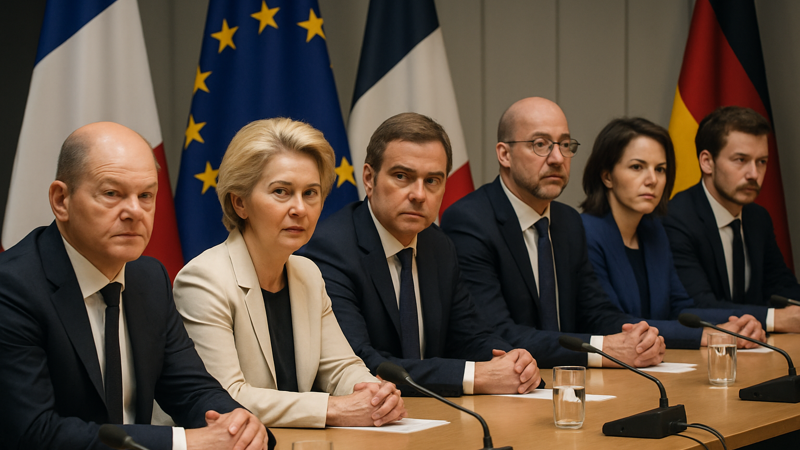
European defense cooperation has reached a watershed moment as nations accelerate strategic autonomy initiatives, with historic nuclear deterrence discussions and military partnerships emerging amid deepening transatlantic tensions and an unprecedented nuclear governance crisis.
The 62nd Munich Security Conference in February 2026 marked a pivotal turning point for European security architecture, with leaders embracing strategic autonomy over traditional American deference. For the first time since the Cold War's end, European capitals are seriously exploring nuclear deterrence arrangements that don't depend primarily on US security guarantees.
Historic Nuclear Deterrence Breakthrough
German Chancellor Friedrich Merz confirmed direct negotiations with French President Emmanuel Macron about expanding France's nuclear deterrent beyond national scope—an unprecedented shift in post-Cold War European security thinking. The discussions involve Germany, Poland, and Finland in preliminary conversations about extended deterrence arrangements, reflecting deep concerns about US security guarantee reliability under changing geopolitical circumstances.
French nuclear capabilities, currently numbering approximately 290 warheads, have historically been viewed as insufficient for extended European deterrence. Any expansion would require significant modifications to French nuclear doctrine, new legal frameworks, parliamentary approvals, and careful coordination with NATO obligations.
"Europe must become a geopolitical power providing its own security. Without Europeans, there will be no peace."
— Emmanuel Macron, French President
Nuclear Crisis Context
These discussions gain urgency from the New START Treaty's expiration on February 5, 2026—the first time in over 50 years without US-Russia nuclear constraints. UN Secretary-General António Guterres warned of a "grave turning point" with nuclear risks at their "highest level in decades." The treaty's expiration eliminated verification mechanisms and confidence-building measures between superpowers controlling 80% of global nuclear weapons.
The nuclear governance vacuum provides additional impetus for European alternative deterrence discussions, as bilateral US-Russia frameworks have collapsed amid broader strategic competition. Military communications restoration between Washington and Moscow represents the only remaining major diplomatic channel between the nuclear superpowers.
NATO Arctic Sentry Mission
European allies have demonstrated their enhanced capabilities through the NATO Arctic Sentry mission, officially launched during the February Brussels defense ministers meeting. The operation represents the alliance's most comprehensive Arctic security response, with European nations assuming unprecedented leadership roles.
The UK is doubling its Norway troop presence from 1,000 to 2,000 over three years, while Sweden deploys Gripen jets and specialized Arctic units to Greenland exercises. Finland contributes operational planning expertise, creating a template for enhanced European burden-sharing that addresses long-standing American concerns about alliance contributions.
Transatlantic Relations Under Strain
US Secretary of State Marco Rubio's diplomatic reset attempt at Munich, declaring America and Europe "made to be together," received mixed reactions from European leaders. Despite his standing ovation, Rubio's absence from a critical Ukraine supporters meeting with German, French, and Polish leaders was interpreted as declining American interest in European-led initiatives.
The Trump administration's bilateral approach with select European leaders—supporting Hungary's Viktor Orbán ahead of April elections and engaging Slovakia's Robert Fico—represents a departure from traditional broad EU institutional engagement. This selective diplomacy has raised concerns about American interference in European democratic processes and EU unity.
Enhanced European Defense Spending
The EU has approved a historic €90 billion loan package for Ukraine—the largest ever for a single nation—demonstrating unprecedented European financial commitment to continental security. Additional support includes Sweden-Denmark's €246 million air defense package and Germany's provision of 35 Patriot missiles, showcasing enhanced European defense industrial cooperation.
However, divisions persist within Europe, as Slovakia, Czech Republic, and Hungary refused participation in the Ukraine loan package, highlighting the challenges of achieving unanimous support for defense initiatives. This has accelerated discussions about "enhanced cooperation" mechanisms that allow subsets of EU members to advance policies without requiring unanimity.
Poland's Nuclear Considerations
President Karol Nawrocki's declaration that Poland must develop "nuclear potential" in response to Russian missile deployments in Belarus represents the most direct indication of European nuclear ambitions beyond France. The statement came amid concerns about Russian Oreshnik missiles positioned close to Polish borders, demonstrating how regional threat perceptions drive nuclear policy considerations.
Polish interest in nuclear options reflects broader Eastern European concerns about extended deterrence credibility, particularly as Russian territorial gains in Ukraine accelerate and systematic civilian infrastructure targeting continues.
Jordan-UK Defense Partnership
King Abdullah II's discussions with British Chief of Defense Staff General Sir Richard Knighton in London highlight expanding defense partnerships beyond traditional EU frameworks. These bilateral relationships strengthen regional security cooperation while demonstrating the global scope of contemporary defense challenges.
Such partnerships exemplify how European nations are diversifying security relationships to address multifaceted threats ranging from hybrid warfare to cyber attacks, terrorism, and state-level aggression.
Canadian-UK Strategic Cooperation
The handshake agreement between Canada and the United Kingdom to strengthen cooperation represents another dimension of evolving transatlantic partnerships. As traditional NATO structures adapt to new security challenges, bilateral relationships between like-minded democracies provide additional resilience to collective defense arrangements.
Challenges and Future Trajectory
European strategic autonomy faces significant implementation challenges, including technical obstacles to expanding nuclear deterrent capabilities, legal frameworks requiring international agreements, and massive financial investments estimated in the hundreds of billions of euros. Political coordination across 27 EU members while balancing autonomy with NATO obligations presents additional complexity.
The success of European strategic autonomy initiatives will determine whether the continent can develop operational independence while maintaining alliance relationships, or whether continued dependence on American security guarantees remains the only viable option.
Strategic Implications
The current developments represent the most fundamental shift in European security architecture since NATO's founding. Whether European strategic autonomy develops within existing alliance frameworks or requires complete transatlantic relationship restructuring will reshape global security architecture for 21st-century challenges.
These challenges include authoritarian resistance, technological disruption, climate security intersection, and great power competition. The stakes extend beyond Europe, potentially providing templates for other regions facing similar security dilemmas while affecting global governance mechanisms and territorial sovereignty enforcement.
As European leaders navigate between strategic autonomy and alliance solidarity, their choices will influence international security cooperation for decades. The success or failure of these unprecedented initiatives may determine whether Western institutions can adapt to contemporary challenges or require fundamental restructuring to remain relevant in an increasingly multipolar world.