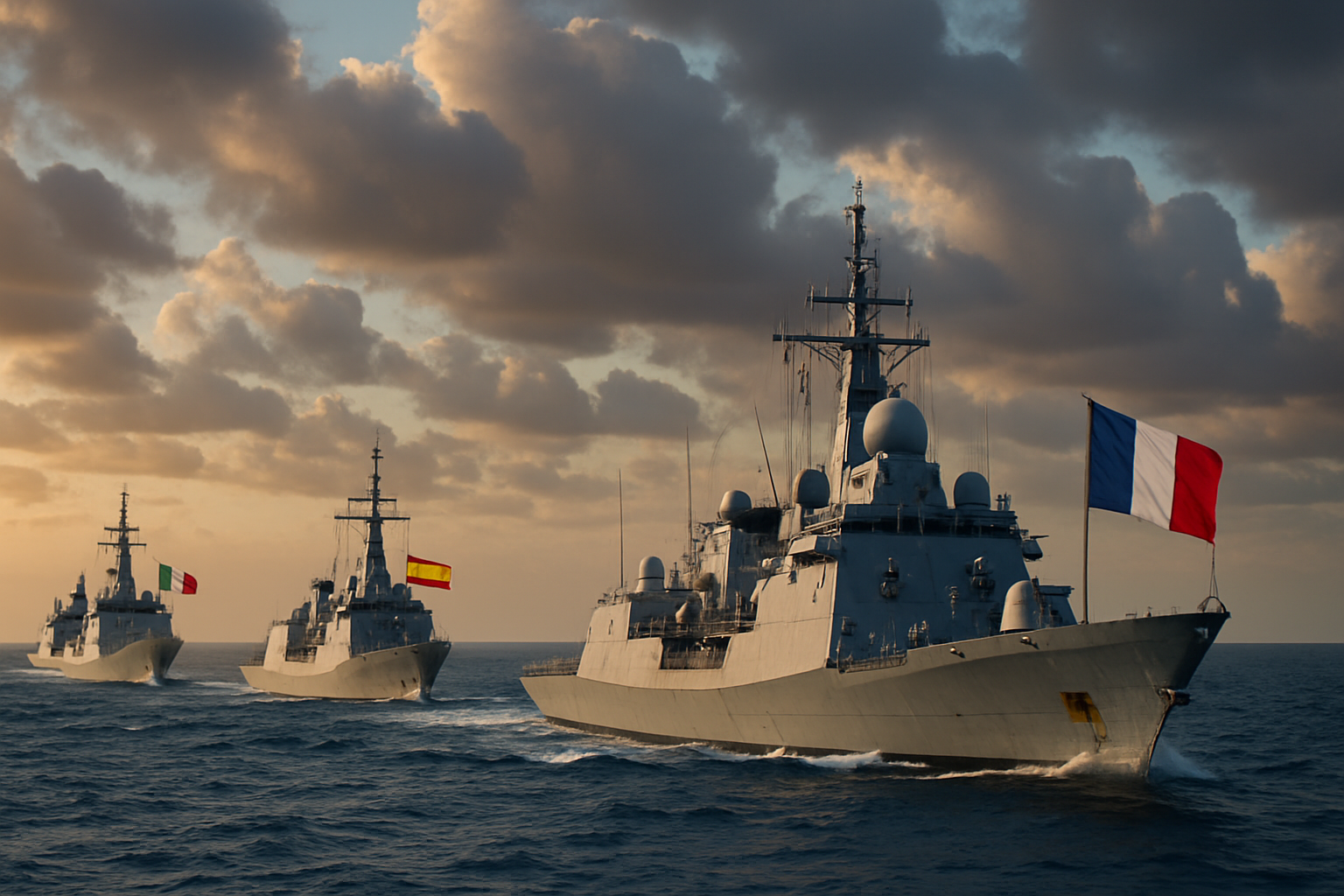
European nations are deploying an unprecedented naval armada to protect Cyprus, marking the most significant coordinated defense response in the Eastern Mediterranean since the 1974 Turkish invasion, as Italy confirms deployment of its missile frigate Federico Martinengo alongside vessels from Spain, France, and the Netherlands.
Italian officials announced Friday that the Federico Martinengo will carry at least 160 navy personnel as part of what Spain's Prime Minister Pedro Sánchez described as a coordinated European effort to defend "a victim of this war." The frigate, currently stationed southwest of Crete, is expected to reach Cypriot waters within 48 hours.
Multi-National Naval Response
The European response represents an extraordinary display of unity in the face of regional threats. Spain has ordered deployment of the naval air defense frigate Cristóbal Colón to the Levantine Basin, while French forces have already positioned the frigate Languedoc in Cypriot waters. The Netherlands is coordinating additional maritime assets as part of the four-nation coalition.
"With the same determination that we say 'no to war in Iran' we are in solidarity and will help Cyprus, a country of the European Union that is a victim of this war," Sánchez declared during a Friday press conference, drawing a clear distinction between European territorial defense and controversial military interventions.
"This war in Iran is, in my opinion, in Spain's opinion, a huge mistake. With the same determination that we say 'no to war in Iran' we are in solidarity and will help Cyprus."
— Pedro Sánchez, Spanish Prime Minister
The coordinated deployment follows Iranian drone strikes on British sovereign bases at RAF Akrotiri, representing the first attack on European territory by Middle Eastern forces since World War II. The escalation has transformed Cyprus from a strategic outpost into a frontline position requiring active protection.
Strategic Context and Timeline
The European mobilization comes amid broader regional escalation following the collapse of US-Iran nuclear negotiations and subsequent military operations. Greece has additionally deployed Patriot missile systems and F-16 fighter jets to protect neighboring Bulgaria, demonstrating how the crisis has spread beyond Cyprus to encompass broader European security concerns.
According to Cyprus government spokesman Konstantinos Letymbiotis, the country has activated its national ESTIA evacuation plan for the first time in its history, exposing critical gaps in civil defense infrastructure. The island's 2,200 registered shelters can protect only 30% of the population, with the number decreasing as owners declassify facilities for rental and storage purposes.
The immediate catalyst was Iran's "Operation True Promise 4" retaliation campaign, which the Islamic Revolutionary Guard Corps declared would recognize "no red lines" in targeting Western military assets. The expansion to European territory represents a significant escalation in the scope of Middle Eastern conflicts.
Military Capabilities and Coordination
The European naval response demonstrates sophisticated military coordination capabilities. Italy's Federico Martinengo last year completed participation in the EU's EUNAVFOR Aspides mission in the Red Sea, providing relevant experience in protecting assets from regional threats. The vessel carries advanced missile defense systems specifically designed to counter the drone and missile threats now targeting Cyprus.
Spain's deployment of the Cristóbal Colón brings additional air defense capabilities to the region, while French anti-missile technology and naval assets create a multi-layered protection system. The Netherlands' contribution, though not yet fully detailed, rounds out what officials describe as comprehensive maritime security coverage.
This represents the most concrete expression of European strategic autonomy in decades, with member states rapidly coordinating military responses based on shared threat assessments rather than waiting for broader NATO or US-led initiatives.
Broader Regional Implications
The European response occurs against a backdrop of massive global disruption. Over 18,000 flights have been cancelled worldwide as multiple Middle Eastern countries closed their airspace, representing the most extensive aviation crisis since the COVID-19 pandemic. Oil prices have surged past $80 per barrel as Iran effectively closed the Strait of Hormuz, affecting 40% of global oil transit.
The crisis has also strained traditional diplomatic alignments. Spain's refusal to allow US military bases on its territory to be used for operations against Iran created unprecedented tensions within NATO, with Prime Minister Sánchez defending Spanish sovereignty over alliance pressure while simultaneously committing to European territorial defense.
Regional coalition partners including Saudi Arabia, UAE, Qatar, and Egypt, who had supported diplomatic solutions, now face Iranian retaliation targeting their territories directly. This has created what Egyptian President Abdel Fattah al-Sisi described as potential for "comprehensive chaos" across the Middle East.
Historical Precedent and Strategic Autonomy
The European response represents a watershed moment for continental security cooperation. The last time European forces deployed in such coordination to defend Cyprus was during the 1974 Turkish invasion, making the current operation historically significant in demonstrating European capacity for independent action when territorial integrity is threatened.
Intelligence cooperation has intensified alongside military deployment. MI6 Chief Blaise Metreweli met with Cypriot President Nikos Christodoulides to coordinate threat assessments, while Belgian officials raised concerns about potential Western terrorist attacks emerging from the regional crisis.
The crisis has accelerated European discussions of strategic autonomy that have been developing since the Munich Security Conference assessment that "the post-war order no longer exists." The rapid military coordination proves European capability for independent defense responses, though it occurs amid broader alliance strains exemplified by the Spain-US base access dispute.
Nuclear Dimension and Future Implications
The European response occurs in a broader context of nuclear governance crisis. The New START treaty between the US and Russia expired February 5, creating the first period in over 50 years without nuclear constraints between the superpowers. This vacuum occurs as Iran continues uranium enrichment at 60% purity, approaching weapons-grade capability with over 400 kilograms of enriched material.
France has begun expanding its nuclear cooperation discussions, inviting Romania to join nuclear umbrella conversations and announcing the first French nuclear expansion in decades through "forward deterrence" policies. These developments represent the most significant European nuclear discussions since the Cold War's end.
The success or failure of European coordination in containing the Cyprus crisis will establish templates for future extra-regional threats. Geographic boundaries no longer contain regional conflicts, requiring new approaches to continental security that can respond rapidly to asymmetric threats extending beyond traditional alliance frameworks.
Challenges and Implementation
Despite the remarkable coordination, significant challenges remain. The European naval deployment must navigate complex diplomatic considerations while maintaining defensive rather than offensive postures. Cyprus's strategic location—100 miles from Lebanon and 200 miles from Syria—places it at the intersection of multiple conflict zones while hosting Western military assets and maintaining diplomatic independence.
The economic implications extend far beyond military costs. Energy markets have experienced severe volatility with natural gas prices increasing 24% in Europe as Qatar halted LNG production following infrastructure attacks. The interconnected nature of modern logistics means Persian Gulf disruptions affect consumer goods and industrial materials worldwide, not just energy supplies.
Implementation challenges include parliamentary approvals for extended operations, coordination of command structures among four nations, and managing relationships with non-European allies while maintaining European decision-making autonomy. The operations require sustained political will across multiple electoral cycles and changing governments.
Global Stakes and Future Scenarios
The European defense coordination represents the greatest test of multilateral cooperation in crisis management of the modern era. Success in containing the threat while providing effective protection could demonstrate European global security relevance and provide frameworks for future diplomatic engagement. Failure risks marginalizing European influence in future Middle Eastern developments while potentially encouraging further territorial violations.
The template-setting nature of this crisis extends beyond immediate military considerations. The rapid transition from promising diplomatic frameworks to military confrontation demonstrates the fragility of modern crisis management mechanisms in an increasingly multipolar world. Coming decisions will influence energy market evolution, nuclear proliferation approaches, and international law enforcement credibility for decades.
As the Federico Martinengo approaches Cypriot waters alongside its allied vessels, Europe faces a defining moment in post-Cold War security architecture. The success of this unprecedented coordination will determine whether European strategic autonomy remains an aspiration or becomes an operational reality capable of defending member state territory when continental security is threatened.