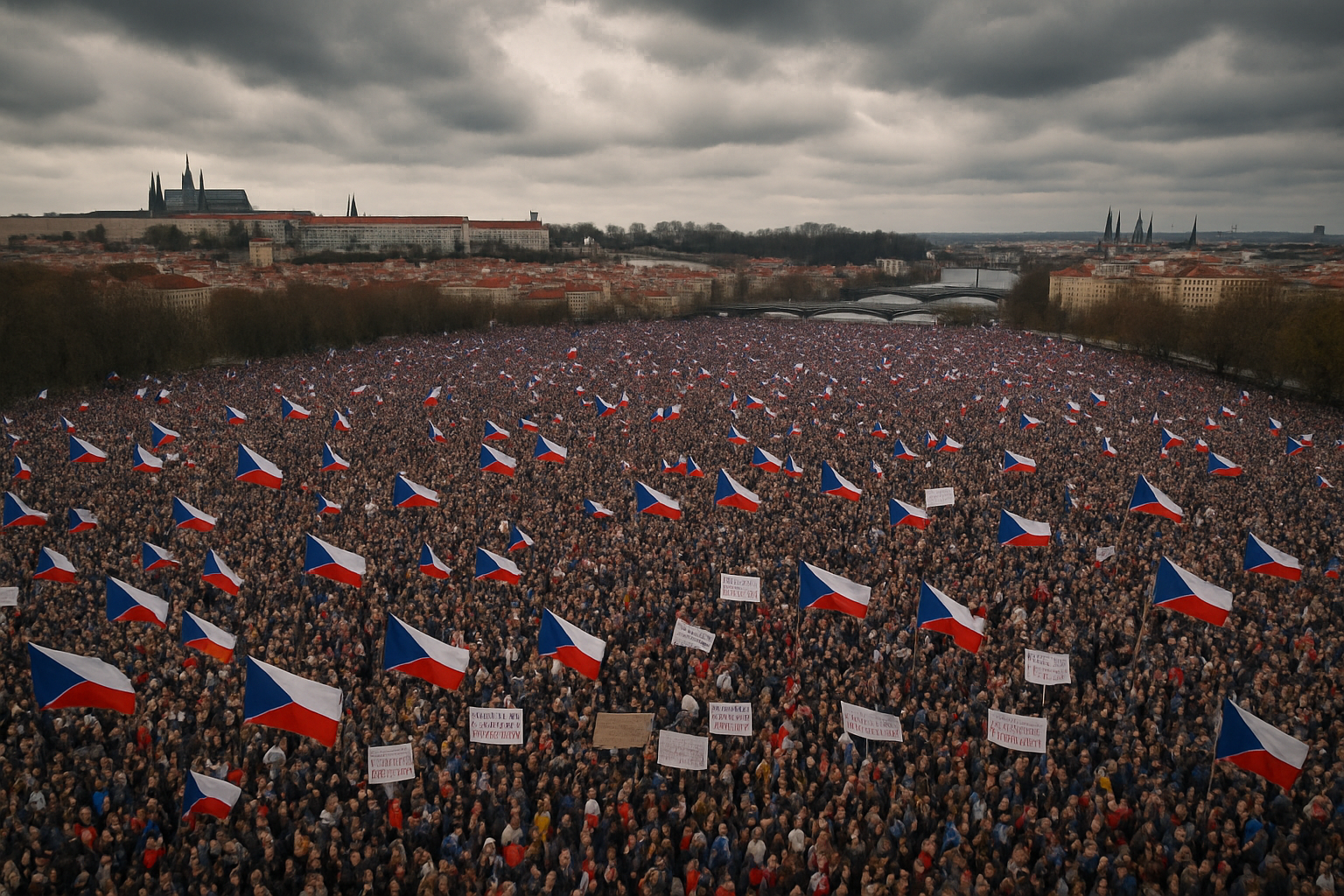
Over 250,000 protesters filled Prague's historic Letná Plain on March 21, 2026, in the largest demonstration against the Czech government since 2019, as political upheaval spreads across Europe in what observers are calling the continent's most severe democratic crisis since World War II.
The massive demonstration, organized under the slogan "Don't let them steal our future," reflects mounting public frustration with the government of Prime Minister Andrej Babiš, who has faced intensifying criticism over democratic regression, oligarchic influence, and potential adoption of Russian-style "foreign agent" laws.
Czech Republic: Democracy Under Siege
Demonstrators gathered at the same location where pivotal pro-democracy rallies occurred during the 1989 Velvet Revolution, creating powerful symbolism as protesters denounced what opposition leaders characterize as systematic erosion of democratic institutions. The crowd, estimated by various sources at between 200,000 and 250,000 people, represents one of the largest political gatherings in Czech history.
Opposition warnings have grown increasingly urgent, with political leaders cautioning that the Czech Republic risks following the authoritarian trajectory of Hungary and Slovakia if current governance trends continue unchecked. The protests specifically target concerns about media freedom restrictions, judicial independence threats, and economic policies perceived as benefiting oligarchic interests at the expense of ordinary citizens.
"We will not allow our future to be stolen," declared protest organizers, echoing language that has become central to opposition movements across Central and Eastern Europe.
— Prague Protest Organizers
Austria: Political Confrontations Intensify
Concurrent political developments in Austria have added to regional instability, with sharp confrontations emerging over government spending priorities and controversial budget allocations. The Freedom Party of Austria (FPÖ) has escalated its political rhetoric with personal attacks and criticism of what it characterizes as "patronage positions" within the Interior Ministry.
Austrian Finance Minister's repeated rejection of proposals for "fair contributions from super-rich" has triggered fierce political battles over wealth taxation and inheritance policies. The Green Party's response emphasized the need for systemic reform rather than continued protection of wealthy interests during a period of economic pressure on ordinary citizens.
Political expert analysis suggests Austrian coalition dynamics face unprecedented strain, with traditional cooperation mechanisms breaking down amid polarized debates over fiscal policy direction and European integration approaches.
France: Electoral Tensions and Administrative Controversies
French political dynamics have been fundamentally altered by the February death of Quentin Deranque during Lyon violence, creating lasting impacts on municipal election campaigns scheduled for March 15-22. The incident has intensified polarization while raising questions about political extremism's role in contemporary French democracy.
Adding to institutional tensions, the Interior Ministry's controversial reclassification of La France Insoumise from "left" to "extreme left" has triggered Council of State legal challenges over administrative neutrality. Opposition parties characterize the move as governmental manipulation of democratic processes for partisan advantage.
Jean-Luc Mélenchon denounced what he termed a "banana republic approach" to electoral administration, emphasizing concerns about institutional independence during critical democratic moments. The controversy highlights broader questions about administrative neutrality and democratic norms amid increasing political polarization.
Hungary: Electoral Vulnerability Amid International Pressure
Hungarian Prime Minister Viktor Orbán faces his most serious political challenge since returning to power in 2010, with opposition coalition polling leading for the first time in over a decade ahead of April 12, 2026 elections. The electoral vulnerability coincides with unprecedented international pressure over Hungary's blockade of EU support for Ukraine.
Péter Magyar's Tisza Party has organized massive demonstrations, including the "Greatest National March" that drew an estimated 500,000 participants to Budapest on Hungary's national holiday. The opposition campaign focuses on corruption allegations, economic stagnation, and democratic governance concerns that have resonated across traditional party lines.
International complications include confirmed Russian interference operations supporting Fidesz party electoral efforts, representing the first documented case of Kremlin operatives actively participating in European electoral campaigns. The interference combines with explicit American political backing through Trump administration endorsements, creating unprecedented dual foreign intervention in domestic Hungarian politics.
Regional Patterns and Democratic Resilience
Political analysts identify concerning patterns across multiple European member states, including traditional coalition mathematics breakdown, far-right "authoritarian innovation" within democratic systems, and increasing disconnect between public aspirations for European unity and actual political fragmentation.
Recent Eurobarometer polling shows 89% of Europeans demand greater EU unity, yet political reality demonstrates increasing sovereignty assertions and institutional friction. This disconnect between public preferences and political capacity represents a fundamental challenge to European governance effectiveness.
The convergence of electoral pressures, energy security concerns, and international conflicts has created what senior EU officials characterize as a "template-setting moment" for 21st-century crisis management, with outcomes likely influencing democratic governance approaches worldwide.
Stakes for European Integration
The Prague demonstrations and broader regional political upheaval occur within the context of unprecedented European challenges, including energy price volatility from Middle East conflicts, ongoing tensions over Ukraine support, and questions about institutional adaptation to contemporary pressures.
Lithuania's Foreign Minister Kestutis Budrys warned that "the EU cannot become Budapest's hostage," reflecting broader concerns about individual member states blocking collective action during critical periods. Enhanced cooperation mechanisms are being explored to bypass unanimity requirements that have proven vulnerable to disruption.
Success in managing current democratic tensions while maintaining institutional integrity could strengthen European resilience and provide templates for other regions facing similar challenges. Failure risks accelerating democratic backsliding across multiple member states simultaneously, undermining the European Union's global credibility as a democratic governance model.
Historical Significance
March 2026 represents a critical juncture in European political development, testing whether democratic institutions can effectively channel political extremism through electoral processes rather than extra-legal means. The protests in Prague, combined with political crises across Austria, France, and Hungary, demonstrate the breadth of institutional challenges facing contemporary European democracy.
International observers are monitoring these developments closely for precedent-setting implications regarding democratic governance under pressure. The window for effective institutional adaptation appears to be narrowing as demographic pressures, technological disruption, and geopolitical tensions require sophisticated responses that preserve democratic values while addressing legitimate citizen concerns.
"We are writing the template for 21st-century crisis management, with the world watching whether democratic institutions can adapt while preserving European values."
— Senior EU Official
The coming weeks will prove decisive as Prague's demonstration momentum continues, French municipal elections conclude, and Hungarian voters prepare for what may be the most consequential Central European election in decades. Success in navigating these challenges through democratic processes could reinforce institutional credibility, while failure might accelerate authoritarian tendencies that have been building across the region for years.