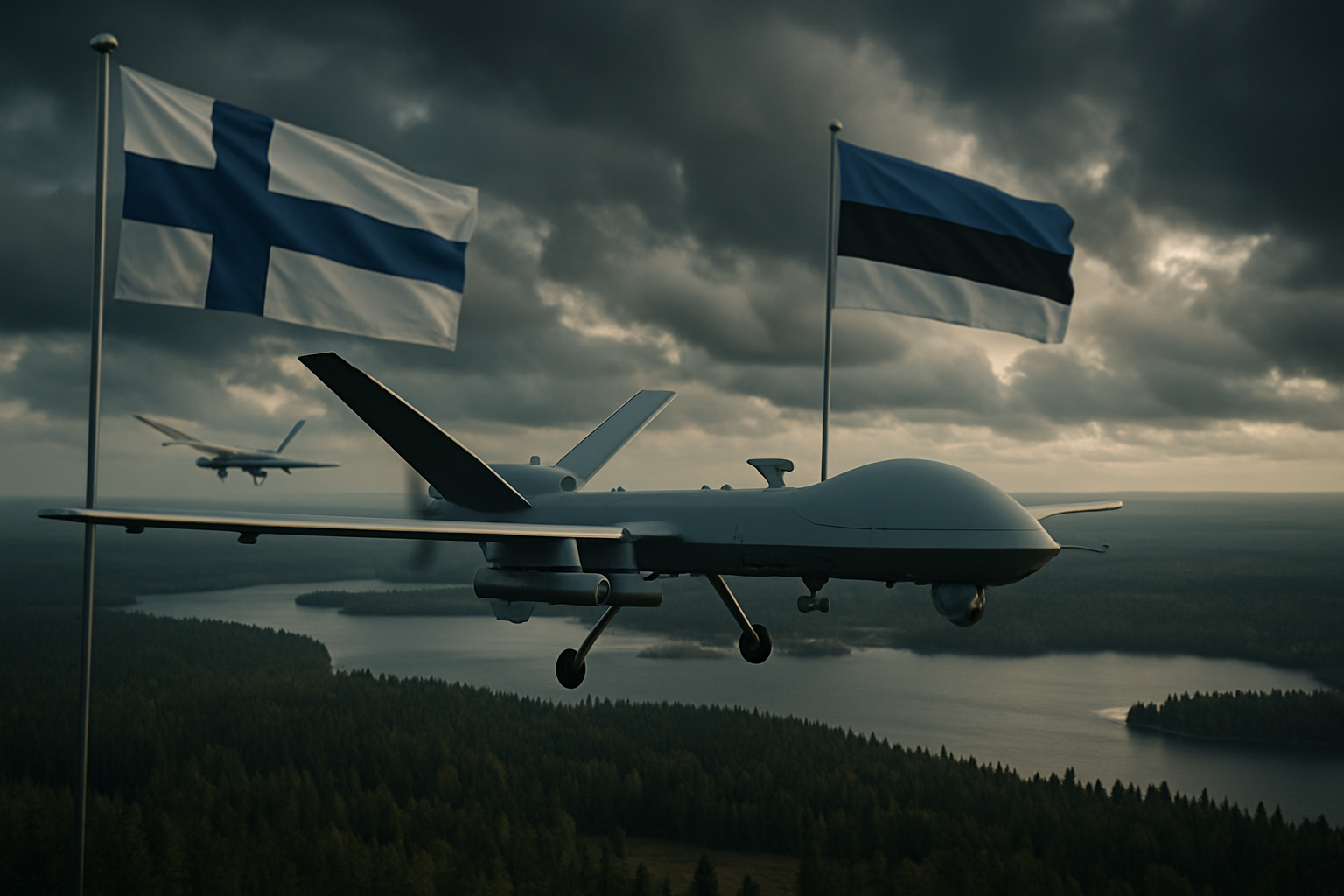
A series of drone incidents across Finland and Estonia over recent days has raised significant security concerns in the Nordic-Baltic region, coinciding with intense GPS jamming operations that have disrupted navigation systems and highlighted vulnerabilities in European airspace defense.
The latest incidents include multiple drone crashes in Finland's southeastern regions, with at least one confirmed Ukrainian military asset straying into Finnish airspace near Kouvola. Estonian authorities report that fewer than 10 foreign drones entered their airspace overnight, with investigators examining three potential crash sites across the country.
Finnish Authorities Confirm Ukrainian Drone Incidents
Finnish Defense Forces have confirmed that Ukrainian military drones conducted unauthorized flights over Finnish territory, with Defense Minister Antti Häkkänen treating the matter "very seriously." The incidents occurred simultaneously with powerful GPS interference affecting the broader region, raising questions about navigation system failures contributing to the airspace violations.
Local residents in the Kouvola area initially mistook fighter jet responses for routine training exercises before learning that drones had crashed in nearby forests. The Finnish Air Force scrambled aircraft to intercept the unauthorized aerial vehicles, marking the first confirmed Ukrainian military assets straying into Finnish airspace since the conflict began.
"The city's security chief Vesa Huuskonen hopes that municipalities will receive information about possible drones more quickly in the future,"
— Based on Finnish reports
The timeline of events shows the drones went astray during the same period when Finland experienced severe GPS jamming, suggesting navigation system disruption may have contributed to the incidents. This represents part of broader spillover effects from Ukraine's intensified energy infrastructure campaign targeting Russian facilities along the Baltic Sea coast.
Estonian Response and Regional Coordination
Estonian officials confirmed that multiple foreign drones entered their airspace during overnight operations, with the Police and Border Guard Department investigating three suspected crash locations. Colonel Uku Arold from Estonian Defense Forces stated that several Ukrainian drones "apparently went off course" during continued attacks on Russia's Baltic coastal facilities.
The incidents differ significantly from previous Russian drone provocations that struck Estonia's Auvere power station and crashed in Latvia's Krāslava region in late March. Current events appear to involve Ukrainian navigation errors during legitimate defensive operations rather than deliberate targeting of Baltic infrastructure.
This latest development occurs within the context of enhanced Baltic cooperation through NATO's Arctic Sentry mission, which includes expanded intelligence sharing, satellite surveillance, and maritime patrols. The initiative addresses a documented 23% increase in Russian military reconnaissance since Sweden and Finland joined NATO.
GPS Jamming Creates Navigation Crisis
The drone incidents coincide with widespread GPS interference across the Nordic region, creating significant challenges for both civilian and military navigation systems. Aviation authorities report disruptions affecting commercial flights, with pilots forced to rely on alternative navigation methods in affected areas.
The jamming operations appear coordinated with periods of heightened military activity, suggesting systematic efforts to disrupt regional navigation infrastructure. Finnish authorities are developing enhanced warning systems, including mobile phone applications and text message networks, to better alert civilians to aerial threats.
Estonia and Ukraine currently employ multiple methods for air threat warnings, while Finland's development of comprehensive alert systems remains in progress. The need for improved civilian notification protocols has become apparent following these incidents.
Broader Regional Security Implications
The recent incidents highlight the complex security challenges facing the Baltic region amid ongoing regional conflicts. Lithuanian intelligence assessments predict Russia could be ready for "limited military conflict" within 3-5 years if Ukraine ceasefire agreements permit force reconstitution.
This timeline has prompted enhanced regional defense preparations, including Finland's historic decision to lift its comprehensive nuclear weapons ban and Sweden's willingness to host nuclear weapons during wartime, breaking an 80-year Nordic taboo on nuclear alternatives to US guarantees.
The spillover effects demonstrate how regional conflicts can have far-reaching implications for neighboring countries. Ukrainian strikes on Russian energy facilities have stranded dozens of shadow fleet tankers in the Gulf of Finland, while navigation errors during these operations create airspace security challenges for Baltic nations.
NATO Arctic Sentry Mission Response
The enhanced security measures include NATO's most comprehensive Arctic defense initiative since the Cold War, featuring European leadership and unprecedented coordination. The UK has doubled its Norway troop presence from 1,000 to 2,000 personnel, while Sweden deploys Gripen jets for Greenland exercises and Finland contributes operational Arctic planning expertise.
Estonia has established a €10 million HIMARS maintenance center through partnership with Lockheed Martin, representing the first regional advanced rocket systems facility. These developments reflect broader efforts to strengthen territorial defense capabilities amid evolving security threats.
The current incidents also underscore challenges in distinguishing between hostile Russian provocations and friendly Ukrainian aircraft experiencing navigation difficulties. NATO is developing new protocols to address these complex identification challenges while maintaining collective support for Ukraine's defensive operations.
Technology and Defense Innovation
The Nordic region has emerged as a center for defense technology innovation, with Estonia achieving 88% renewable electricity generation and operating continental Europe's largest battery storage facility. The Tallinn Cyber Diplomacy Winter School now hosts representatives from 33 countries, addressing cyber incident response and AI security impacts.
Regional cooperation extends beyond traditional military measures to include unprecedented partnerships among Baltic national libraries, marking the first time cultural institutions have played a direct role in democratic resilience and regional security frameworks.
These technological advancements provide both opportunities and challenges, as enhanced surveillance capabilities enable better threat detection while GPS jamming operations demonstrate vulnerabilities in modern navigation-dependent systems.
International Response and Support
European allies continue providing substantial support despite the complex security environment. Sweden and Denmark have committed €246 million for air defense systems, while Germany provides 35 Patriot missiles as part of broader NATO coordination efforts.
The incidents occur within the broader context of the New START treaty expiration in February 2026, creating the first period in over 50 years without US-Russia nuclear constraints. This nuclear governance crisis adds urgency to regional security coordination efforts.
International observers note that the Baltic states' approach provides a template for small nation coordination in volatile international environments. Success in managing these challenges affects European security architecture for decades to come.
Looking Forward
As regional conflicts continue to create spillover effects, the frequency of such incidents may increase as Ukrainian long-range capabilities expand. The Baltic experience in managing these complex situations provides valuable lessons for other regions facing similar challenges.
Estonian authorities demonstrate measured responses that support Ukraine's legitimate defense while ensuring territorial sovereignty. NATO is developing enhanced protocols to distinguish between hostile and friendly aircraft during defensive operations, preventing escalation while maintaining collective security commitments.
The incidents underscore the need for continued investment in enhanced cooperation, early warning systems, and diplomatic coordination. Success in preventing casualties while supporting defensive operations demonstrates the effectiveness of multilateral approaches to contemporary security challenges.
The template established by Nordic-Baltic cooperation—combining enhanced air defense capabilities, diplomatic protocols, and technological innovation—offers a framework for addressing 21st-century security challenges that blur traditional boundaries between military and civilian domains.