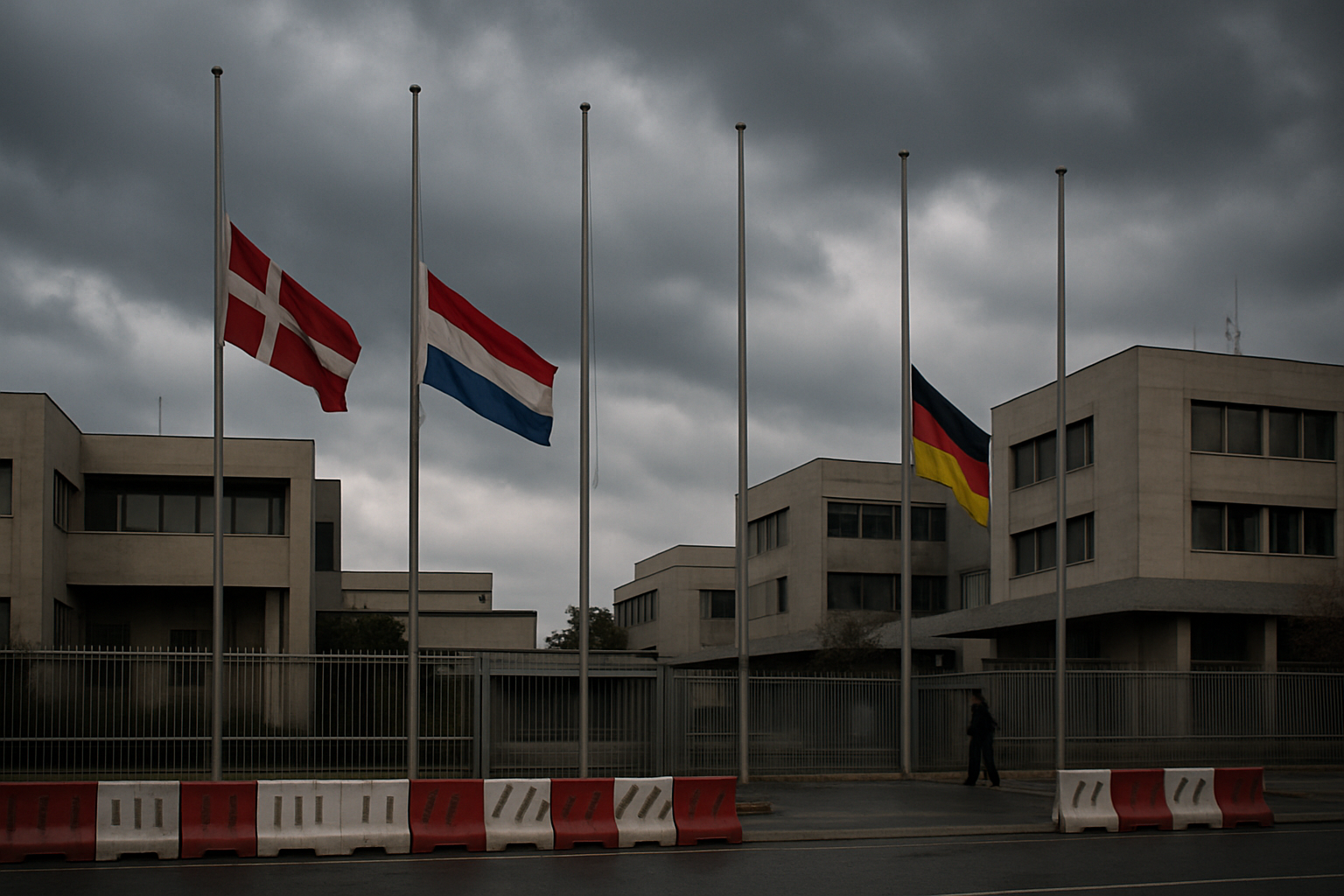
European nations are temporarily closing their embassies in Iran and evacuating diplomatic staff as the Middle East crisis enters its most dangerous phase since the Cold War, with Denmark and the Netherlands leading a coordinated European withdrawal from Tehran amid escalating security concerns.
The Danish Foreign Ministry announced Monday that Denmark is "temporarily closing its embassy in Iran" due to deteriorating security conditions, while Dutch embassy staff have been evacuated to Baku, Azerbaijan, according to multiple sources. The closures come as the region faces unprecedented instability following the death of Iran's Supreme Leader Ali Khamenei on March 1 and the largest U.S.-Israeli military operation since 2003.
Template-Setting European Response
The coordinated embassy closures represent the most significant European diplomatic withdrawal from Iran since 1979, reflecting the gravity of the current crisis. Cyprus has activated its national ESTIA evacuation plan for the first time in history, coordinating the evacuation of over 2,000 European nationals from the UAE and surrounding regions.
"This is an unprecedented moment for European crisis management capabilities," said a senior EU official familiar with the evacuation coordination. "The ESTIA plan was designed exactly for scenarios like this, but we never anticipated implementing it on such a scale."
Sweden and Serbia have ordered immediate evacuations of their citizens from Iran, citing "extremely uncertain" security conditions. Multiple other European nations have issued travel warnings for the entire Middle East region, with some governments chartering special flights to extract stranded nationals.
Regional Crisis Context
The embassy closures occur amid Operation Epic Fury, the largest coordinated U.S.-Israeli military campaign since the 2003 Iraq invasion. The operation has targeted over 2,000 Iranian sites using a dual-carrier deployment representing approximately one-third of the U.S. Navy fleet. First American casualties have been confirmed, with 3 service members killed and 5 wounded.
Iran's retaliation, dubbed "Operation True Promise 4" by the Revolutionary Guards, has declared that "no red lines remain," with systematic targeting of U.S. and Israeli assets across the region. The Iranian response has caused casualties across Gulf states, including the first European territory attack since World War II when Iranian drones struck RAF Akrotiri in Cyprus.
"The situation represents the most dangerous international crisis since the Cold War end"
— UN Secretary-General António Guterres
Unprecedented Global Implications
The crisis has triggered the most extensive aviation disruption since COVID-19, with over 18,000 flights cancelled worldwide. Eight Middle Eastern countries have simultaneously closed their airspace, while Dubai International Airport—the world's busiest with 86 million passengers annually—remains completely shut down from missile damage.
Energy markets have been equally devastated. Oil prices have surged 10% past $80 per barrel as Iran declared the Strait of Hormuz "unsafe," effectively closing the waterway that handles 40% of global seaborne oil transit. Natural gas prices have exploded 24% in Europe and 78% in the United States, with Qatar halting LNG production at facilities representing approximately 20% of global exports.
Nuclear Diplomacy Collapse
The current crisis stems from the complete breakdown of U.S.-Iran nuclear negotiations, despite achieving what diplomats described as "broad agreement on guiding principles"—the most significant progress since the 2018 JCPOA collapse. However, fundamental scope disagreements proved insurmountable, with Iran excluding ballistic missiles and regional proxies as "red lines" while the U.S. demanded a comprehensive approach including missiles, armed groups, and human rights concerns.
Iran continues enriching uranium at 60% purity with over 400 kilograms of material approaching weapons-grade levels. The breakdown occurs amid a broader nuclear governance crisis, as the New START treaty expired February 5, marking the first time in over 50 years without U.S.-Russia nuclear constraints.
Succession Crisis in Tehran
Following Khamenei's death, Iran faces an unprecedented constitutional succession crisis during wartime. A three-member transitional council consisting of President Pezeshkian, judiciary head Mohseni Ejei, and a Guardian Council representative is managing the country while the Assembly of Experts selects a permanent successor under active warfare conditions.
Intelligence assessments suggest a Revolutionary Guards member is likely to be chosen, marking a historic shift from clerical to military governance in the Islamic Republic's 47-year history. Mojtaba Khamenei, the deceased leader's son, has emerged as a favored candidate, which would represent the first hereditary succession in Iranian history.
European Unity Under Pressure
The embassy closures demonstrate remarkable European coordination in crisis management, with the EU activating shared evacuation resources and protocols. The unified response contrasts sharply with past Middle Eastern crises where European nations often responded individually.
"European strategic autonomy is being tested in real-time," observed a Brussels-based security analyst. "The coordinated diplomatic withdrawal and citizen evacuations show Europe can act decisively when territorial integrity and citizen safety are at stake."
The crisis has prompted an unprecedented European naval response, with HMS Dragon, Spanish frigates, and vessels from Italy, France, the Netherlands, and Greece deploying to protect Cyprus following the Iranian drone attacks. This represents the most significant Eastern Mediterranean military mobilization since the 1974 Turkish invasion of Cyprus.
Humanitarian and Economic Toll
The Iranian Red Crescent reports over 787 civilian casualties from U.S.-Israeli strikes, with international condemnation focusing on the attack on a girls' school in Minab that killed 53-85 students and staff. The images of children's backpacks scattered in rubble have become symbols of the diplomatic failure's human cost.
Stock markets have crashed globally, with Pakistan's KSE-100 recording its largest single-day decline in history at -8.97%. The Korean won has hit a 17-year low, while the Dow Jones futures dropped 400-570 points. Major shipping companies Maersk and MSC have suspended Persian Gulf operations, leaving over 150 oil and LNG tankers stranded, representing billions in cargo value.
Congressional and Public Pressure
In Washington, bipartisan lawmakers are demanding answers about strategy, costs, and the potential for ground troop deployment. Senator Richard Blumenthal expressed being "more concerned than ever" about boots on the ground, while the conflict's unpopularity is described as "almost unprecedented" for early-stage military operations, with only 25% American public support.
The Pentagon has reportedly prepared operations extending through September, far beyond the Trump administration's initial 4-6 week timeline, with costs already reaching $3.7 billion in the first week alone—$891.4 million daily.
Looking Ahead: Template-Setting Crisis
The European embassy closures represent more than a tactical diplomatic withdrawal; they signal the collapse of traditional conflict containment mechanisms in the multipolar era. The rapid transition from diplomatic breakthrough to military confrontation demonstrates the fragility of modern crisis management systems.
Success in containing this crisis could provide a framework for future nuclear dispute resolution and strengthen diplomatic precedents. However, failure may accelerate military solutions in international relations, encouraging nuclear proliferation globally and undermining diplomatic credibility for decades.
As European diplomats evacuate Tehran and citizens flee the broader region, the international community faces what UN Secretary-General Guterres has called "the greatest test of multilateral cooperation and crisis management of the modern era." The decisions made in the coming days and weeks will reverberate through international relations for decades, affecting approaches to conflict resolution, energy security architecture, and the fundamental principles of the post-World War II international order.
The embassy closures in Iran thus mark not just a diplomatic retreat, but a watershed moment in 21st-century international relations—one that will determine whether diplomatic solutions or military confrontation becomes the template for resolving future territorial and nuclear disputes worldwide.