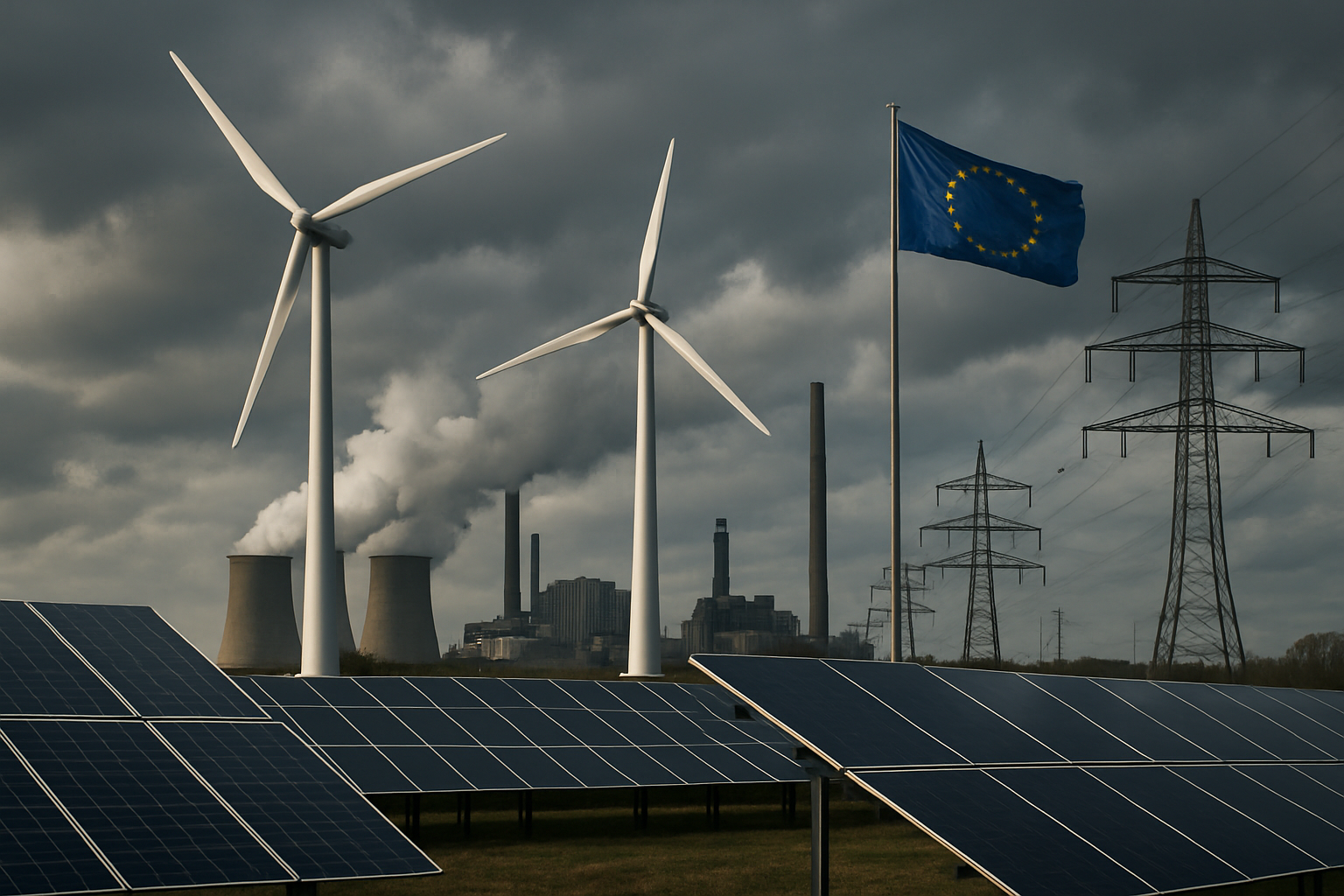
The European Union's ambitious green transition faces unprecedented challenges as persistently high electricity prices threaten to derail the bloc's central climate strategy, while multiple member states grapple with energy security crises and infrastructure vulnerabilities.
The European Central Bank (ECB) issued a stark warning Tuesday that elevated electricity costs are fundamentally undermining the EU's electrification strategy—the cornerstone of achieving net-zero emissions by 2050. Despite the launch of the Clean Industrial Deal in February 2025, electricity demand has remained stagnant over the past decade, directly contradicting the European Commission's ambitious targets.
The Commission aims to increase electricity's share of total energy consumption from 23 percent in 2024 to 32 percent by 2030. However, euro area electricity consumption actually declined by 6.3 percent between 2015 and 2023, highlighting the scale of the challenge facing European policymakers.
Aviation Sector Faces Emission Rights Shock
The energy transition costs are becoming increasingly visible across sectors. Airlines operating in European airspace now face tens of millions of euros in additional expenses as free emission rights lapse in 2026, forcing carriers to either invest heavily in sustainability measures or pay substantial penalties for carbon emissions.
This development represents a significant escalation in the EU's carbon pricing mechanism, putting pressure on an industry already struggling with post-pandemic recovery challenges. The aviation sector's predicament illustrates the broader tension between climate ambitions and economic competitiveness that characterizes Europe's current energy dilemma.
Critical Energy Security Vulnerabilities Exposed
The Netherlands faces a particularly acute energy security challenge as the Dutch research institute TNO warns that permanently sealing the Groningen gas field could leave the country vulnerable to sudden gas shortages. This warning comes as the nation seeks to balance its commitment to ending earthquake-inducing gas extraction with maintaining energy security amid volatile international markets.
The research agency's call to maintain Groningen as an emergency reserve underscores the complex trade-offs European nations face between environmental concerns, safety considerations, and energy independence. Natural gas prices have surged 24 percent in Europe this year, adding urgency to supply security discussions.
Meanwhile, Slovakia confronts its own energy vulnerabilities as disruptions to the Druzhba pipeline affect oil supplies, forcing both Hungary and Slovakia to draw from strategic reserves while seeking assistance from Croatia's previously overlooked pipeline infrastructure.
Climate Adaptation Urgency Intensifies
The European Scientific Advisory Board on Climate Change (ESABCC) delivered a sobering assessment Tuesday, warning that the EU is inadequately prepared for accelerating climate change impacts. The Copenhagen-based advisory body called for urgent investment increases to protect populations and infrastructure from mounting floods, wildfires, and severe heat waves.
This warning carries particular weight as January 2026 marked the 18th consecutive month of temperatures exceeding 1.5°C above pre-industrial levels, demonstrating that human-induced warming is now overriding natural climate variability. The persistent temperature increases occur despite La Niña conditions that typically provide cooling effects.
"Since electricity can be more readily generated from renewable sources compared with other forms of energy, increasing its share in final energy consumption is crucial for the green transition."
— European Central Bank Analysis
Infrastructure Investment and Innovation Progress
Despite these challenges, several European nations demonstrate progress in energy infrastructure development. Estonia operates continental Europe's largest battery storage facility, capable of serving 90,000 households, positioning the Baltic nation as a leader in grid stability solutions. Austria achieved 88 percent renewable electricity production in 2024, primarily through hydroelectric power.
Hungary has launched construction of the Paks II nuclear power plant, Europe's largest nuclear construction project, with Russian technology and IAEA backing. The €39.1 billion investment represents a century-long commitment to carbon-neutral baseload electricity, offering grid stability that complements weather-dependent renewables.
Romania is advancing a €1 billion Battery Energy Storage System project spanning 2,500 MW across multiple locations, designed to balance energy systems during peak demand periods while reducing dependence on fossil fuel backup power.
Supply Chain Dependencies Create Strategic Risks
European energy transformation faces critical material shortages, with EU auditors warning that climate goals are threatened by dangerous dependence on Chinese supply chains. China controls 60 percent of global production and 90 percent of refining capacity for lithium, cobalt, and rare earth elements essential for renewable energy infrastructure.
Memory chip prices have increased sixfold, affecting renewable control systems throughout Europe. These supply chain vulnerabilities highlight the intersection between climate policy and geopolitical security, prompting the US-EU-Japan Critical Minerals Partnership involving 55 countries to diversify supply sources.
The partnership includes seven African nations as alternative suppliers: Angola, Democratic Republic of Congo, Guinea, Kenya, Morocco, Sierra Leone, and Zambia. However, developing alternative supply chains requires billions in investment and years of infrastructure development.
Economic and Political Pressures Mount
The energy crisis occurs amid broader European economic challenges. Eurozone inflation declined to 1.7 percent in January 2026, providing some fiscal breathing room, but energy costs continue pressuring households and businesses across the continent.
Recent Eurobarometer polling shows 89 percent of Europeans demand greater EU unity, with 86 percent wanting a stronger global voice. However, energy policy coordination faces obstacles as member states balance national interests with collective climate commitments.
The crisis has exposed fundamental tensions in European energy policy: the need for immediate energy security versus long-term decarbonization goals, national sovereignty versus EU-wide coordination, and economic competitiveness versus environmental protection.
Path Forward Requires Coordinated Response
Successfully navigating Europe's energy and climate challenge requires addressing multiple simultaneous pressures: accelerating renewable deployment, ensuring grid stability through storage and backup systems, securing critical material supply chains, maintaining economic competitiveness, and protecting vulnerable populations from energy poverty.
The ECB's warning about electricity prices undermining electrification highlights a fundamental policy challenge: making clean energy affordable enough to drive widespread adoption while generating sufficient revenue to fund massive infrastructure transformation.
Climate adaptation infrastructure becomes increasingly urgent as extreme weather events threaten energy systems. Portugal's recent infrastructure failures during flooding demonstrate the vulnerability of current systems to climate impacts, requiring "build back better" approaches designed for future climate conditions rather than historical patterns.
The window for effective action continues narrowing as climate impacts accelerate faster than policy implementation. European leaders face critical decisions about balancing immediate energy security with long-term sustainability goals, national interests with continental coordination, and economic pressures with climate urgency.
Success will require unprecedented coordination across multiple dimensions: technological innovation, international cooperation, financial commitment, and adaptive management capable of responding to rapidly evolving conditions. The stakes extend beyond Europe, as the continent's experience provides crucial lessons for global energy transformation amid accelerating climate change.