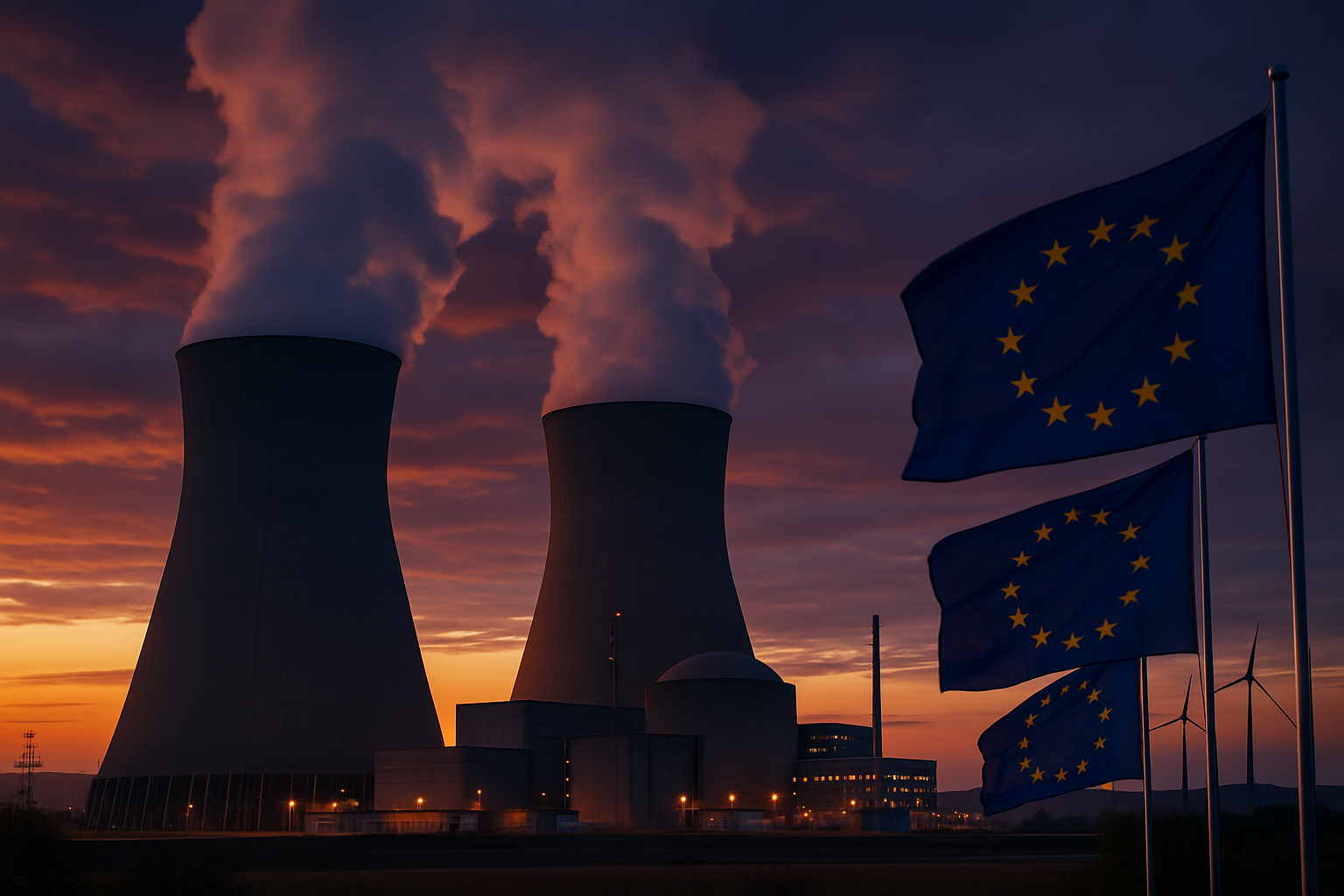
Surging energy prices and geopolitical instability are forcing European nations to dramatically reassess their energy policies, with nuclear power emerging from decades of decline as a potential solution to the continent's mounting energy security crisis.
The most striking example came this week when European Commission President Ursula von der Leyen declared the abandonment of nuclear power a "strategic error" during the World Nuclear Energy Summit in Paris, announcing new EU investment guarantees for nuclear projects. This marks a fundamental shift in European energy thinking, driven by oil prices surpassing $100 per barrel and natural gas costs jumping 24% across Europe.
The Perfect Storm of Energy Pressures
The current crisis stems from multiple converging factors. The Middle East conflict has disrupted critical energy supplies, with Iran's closure of the Strait of Hormuz affecting 40% of global oil transit. Meanwhile, Europe's ambitious renewable energy targets face harsh realities: despite massive investments, the continent remains vulnerable to price volatility and supply disruptions.
In Austria, households are experiencing a 55% surge in heating oil prices, creating potential savings of €2,387 annually for those switching to sustainable energy sources like pellets. German CSU leader Markus Söder has proposed establishing a pilot small modular reactor (SMR) project in Bavaria, despite significant opposition within the ruling coalition.
The energy squeeze is hitting consumers across Europe. In the UK, one of Britain's last major chemical plants faces closure if energy prices remain at current levels, with owner Peter Huntsman describing rising gas costs as "another nail in the coffin" for European heavy industry.
Nuclear Renaissance Gains Momentum
The nuclear revival isn't limited to policy declarations. Hungary is proceeding with the Paks II project, Europe's largest nuclear construction at €39.1 billion, backed by the International Atomic Energy Agency. Romania has emerged as a leader in small modular reactor technology at Deutschești, featuring advanced safety systems that address many historical concerns about nuclear power.
Perhaps most surprisingly, Greece—a nation historically skeptical of nuclear energy—has established a ministerial committee to explore small modular reactors under Prime Minister Mitsotakis's carbon neutrality framework. Slovakia is positioning nuclear power as central to achieving its climate goals, while even Estonia, which achieved 88% renewable electricity generation and operates Europe's largest battery storage system serving 90,000 households, is considering nuclear as a complement to address baseload power needs.
"Nuclear provides reliable electricity 24 hours daily, unlike weather-dependent alternatives. This represents a pathway to energy independence while reducing our dependence on geopolitically unstable regions."
— European Commission President Ursula von der Leyen
Technology Innovation Drives Revival
The new generation of nuclear technology addresses many of the concerns that led to the sector's decline. Small modular reactors feature digital monitoring systems, automated controls, and passive safety mechanisms that significantly reduce both costs and construction timelines compared to traditional large facilities.
Factory manufacturing of modular components allows for controlled assembly environments, dramatically reducing the complexity and cost overruns that plagued previous nuclear construction projects. These technological advances, combined with the urgent need for reliable baseload power, are reshaping the nuclear equation across Europe.
Geopolitical Vulnerabilities Exposed
The crisis has starkly illustrated Europe's dangerous dependence on volatile regions for energy supplies. China controls 60% of critical materials production and 90% of refining for lithium, cobalt, and rare earth elements essential for renewable energy infrastructure. The memory chip shortage has caused sixfold price increases for smart grid systems, further complicating the renewable transition.
In Slovakia, concerns about LNG supplies from the Middle East are mounting as the conflict disrupts traditional energy flows. The situation underscores how geopolitical tensions can instantly transform energy markets, regardless of long-term renewable energy plans.
Opposition Remains Strong
Despite the momentum, nuclear expansion faces significant resistance. Austria's environment commissioner has criticized the "dangerous path" of nuclear expansion, while Spain maintains reservations about international legality and environmental protection. Environmental groups like Greenpeace have denounced the nuclear renaissance as a "betrayal of the European Green Deal," arguing that renewable energy and efficiency should remain the focus.
The nuclear waste storage challenge remains unresolved, with radioactive materials remaining dangerous for thousands of years. Critics point to historical disasters at Chernobyl and Fukushima as evidence of catastrophic risks that no amount of technological advancement can fully eliminate.
Economic and Employment Benefits
Proponents argue that nuclear power offers significant economic advantages beyond energy security. Nuclear facilities create thousands of specialized, high-paying jobs and provide stable electricity pricing over operational lifetimes that can extend beyond a century. The economic multiplier effects include research and development, advanced manufacturing, and supporting services around nuclear facilities.
The employment potential is substantial, with nuclear projects typically creating thousands of jobs during construction and hundreds of permanent positions during operations. These positions often offer salaries well above regional averages and require specialized skills that can anchor technical expertise in local communities.
Climate Goals Integration
Nuclear power is increasingly viewed as essential for achieving climate objectives while maintaining grid stability. As weather-independent electricity generation, nuclear can provide reliable baseload power to complement intermittent renewable sources like wind and solar. This becomes particularly crucial as extreme weather events increase electricity demand and challenge grid reliability.
The integration challenge involves balancing nuclear's role as a bridge technology during the renewable transition versus a permanent fixture in a low-carbon energy mix. January 2026 marked the 18th consecutive month of global temperatures exceeding 1.5°C above pre-industrial levels, adding urgency to all decarbonization efforts.
Strategic Implementation Challenges
The shift toward nuclear faces practical hurdles beyond political opposition. Regulatory frameworks need updating, financing mechanisms require establishment, and public acceptance campaigns must address decades of skepticism. The timeline for nuclear deployment means that immediate energy security challenges will need alternative solutions while new plants come online.
International cooperation becomes essential, as nuclear technology, fuel supplies, and waste management cross national boundaries. The European approach must coordinate with global nuclear governance frameworks while maintaining strategic autonomy in energy decision-making.
Global Competition Context
Europe's nuclear renaissance occurs alongside major developments worldwide. The United States has approved TerraPower's small modular reactor project in Wyoming, while Japan is restarting the Kashiwazaki-Kariwa facility—the world's largest nuclear plant. This international competition adds urgency to European efforts, both for technological leadership and export potential.
The stakes extend beyond energy policy to encompass technological sovereignty and strategic influence in global energy markets. Success or failure in Europe's nuclear revival will influence international approaches to nuclear power for decades.
Looking Ahead
The coming months will test whether Europe's nuclear renaissance can translate from policy declarations to concrete implementation. The success or failure of these initiatives will determine not just Europe's energy architecture for decades, but also provide a template for how developed economies balance climate commitments with energy security in an increasingly volatile world.
As von der Leyen's acknowledgment of the "strategic mistake" reflects, European leaders are recognizing that energy independence and climate goals may require uncomfortable compromises with past ideological positions. The window for effective action is narrowing as climate change accelerates and geopolitical tensions reshape global energy flows.
The European experience will provide crucial lessons for the global energy transformation, determining whether nuclear power can successfully complement renewables in achieving rapid decarbonization while maintaining economic competitiveness and energy security in the 21st century.