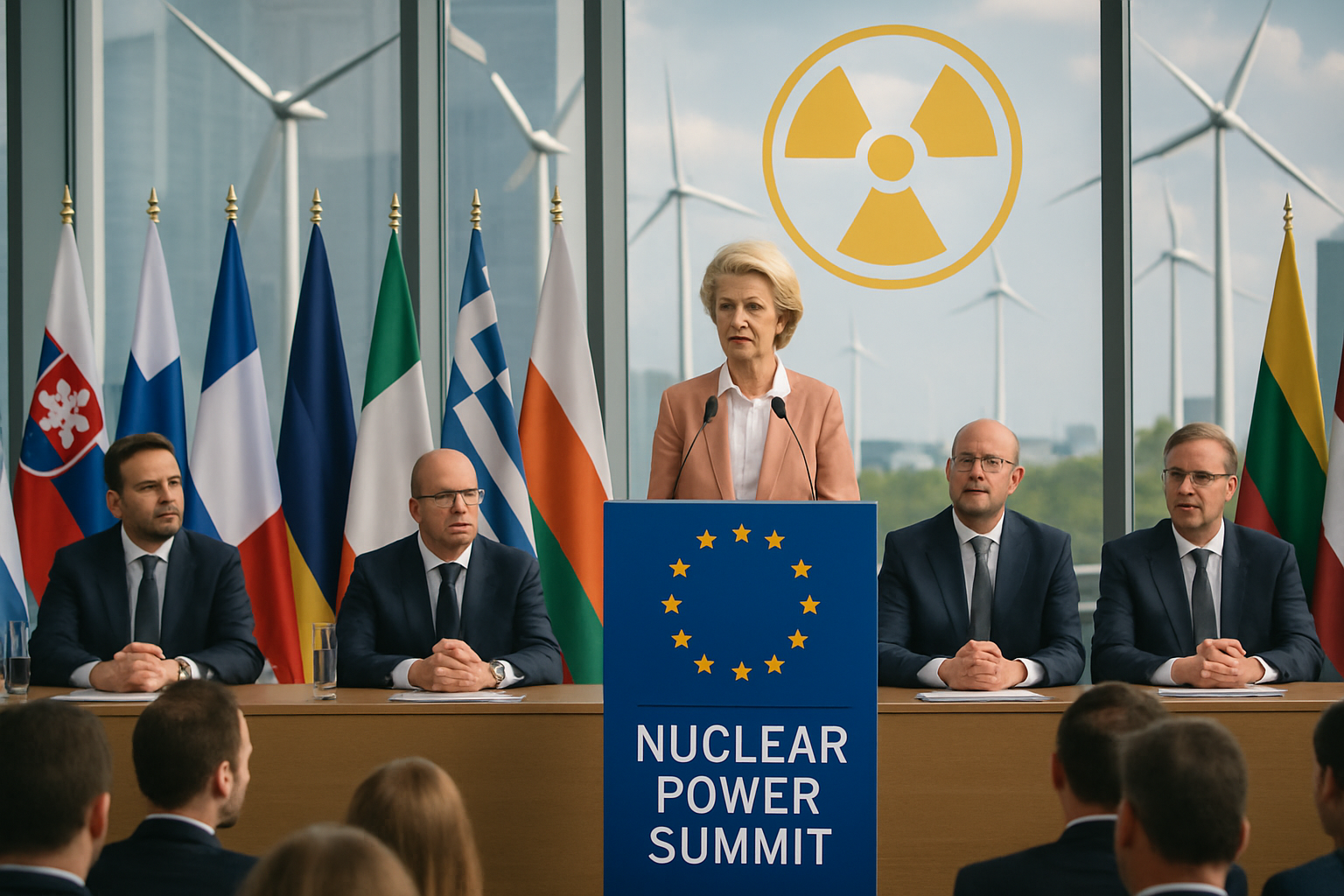
European Commission President Ursula von der Leyen declared Europe's turn away from nuclear power a "strategic error" at Tuesday's World Nuclear Energy Summit in Paris, announcing unprecedented EU investment guarantees for nuclear projects as the Middle East crisis drives oil prices above $100 per barrel and exposes critical energy vulnerabilities.
The declaration represents a dramatic policy reversal, driven by the current energy security crisis stemming from Iran's closure of the Strait of Hormuz, which handles 40% of global seaborne oil transit. Natural gas prices have surged 24% in Europe and 78% in the United States, while Qatar has halted LNG production at its Ras Laffan and Mesaid facilities, representing roughly 20% of global exports.
Nuclear Expansion Across Europe
Von der Leyen's endorsement of atomic energy comes as multiple European nations accelerate nuclear development plans. Hungary's Paks II construction project, valued at $39.1 billion with Russian investment, represents Europe's largest nuclear undertaking. The facility, utilizing Russia's latest VVER reactor technology with advanced safety systems, is designed to operate through the 22nd century.
Romania has emerged as a European leader in small modular reactor (SMR) technology through its Deutschești project, incorporating cutting-edge safety systems with digital monitoring and automated control mechanisms. Greek Prime Minister Kyriakos Mitsotakis announced the formation of a ministerial committee to explore SMR deployment, while Slovakia positions nuclear energy as central to its carbon neutrality pathway.
"Nuclear energy provides reliable electricity 24 hours daily, unlike weather-dependent alternatives,"
— Ursula von der Leyen, European Commission President
Estonia, despite achieving 88% renewable electricity production and operating continental Europe's largest battery storage facility serving 90,000 households, is exploring nuclear baseload options to complement its intermittent renewable sources. Latvia is addressing capacity warnings and high electricity prices through nuclear considerations.
Crisis-Driven Policy Transformation
The current energy crisis began with Iran Supreme Leader Ali Khamenei's death on March 1, followed by massive regional conflict escalation. The resulting aviation crisis has cancelled 18,000+ flights worldwide, while eight countries simultaneously closed airspace. Dubai International Airport, the world's busiest with 86 million passengers annually, remains completely shut down from missile damage.
European vulnerability has been starkly demonstrated by Chinese dominance in critical materials, controlling 60% of production and 90% of refining capacity for lithium, cobalt, and rare earth elements essential for renewable infrastructure. The US-EU-Japan Critical Minerals Partnership, involving 55 countries, addresses these strategic dependencies but requires years to establish alternative supply chains.
Technological Innovation and Safety
Small modular reactors represent the next generation of nuclear technology, featuring factory manufacturing, modular deployment, passive safety systems, and reduced construction costs. Unlike traditional large facilities, SMRs offer enhanced safety through digital monitoring, automated control, and atmospheric pressure operation that prevents explosive failures.
The technology addresses traditional nuclear concerns through modular design that reduces financial risks, phased construction and commissioning, and advanced fuel cycles that minimize waste production while maximizing efficiency. Nuclear power provides weather-independent baseload electricity, complementing intermittent renewables and addressing grid stability requirements.
Political Divisions and Opposition
Despite the energy security imperatives, nuclear expansion faces significant political opposition. Austria's environment commissioner criticized the "dangerous path" of nuclear expansion, while Spain maintains reservations emphasizing international legality and environmental protection concerns.
Environmental groups argue that enforcement mechanisms for safety and environmental protection remain insufficient. Greenpeace has characterized nuclear expansion as a "betrayal of the European Green Deal," reflecting broader concerns about the rapid policy shift driven by crisis conditions.
Global Competition Context
The European nuclear renaissance occurs within a broader international competition for nuclear technology leadership. The United States recently approved TerraPower's Wyoming SMR project, while Japan restarted the Kashiwazaki-Kariwa facility, the world's largest nuclear plant. This international nuclear technology competition adds urgency to European nuclear development efforts.
Economic benefits include thousands of specialized high-paying jobs, stable pricing over century-plus operational lifetimes, and long-term employment opportunities that provide economic resilience. Nuclear facilities offer stable electricity pricing that reduces dependence on volatile fossil fuel markets and weather-dependent renewable sources.
Energy Independence Pathway
Von der Leyen emphasized nuclear power as a pathway to energy independence, reducing supply chain vulnerabilities to geopolitical instability. The current crisis demonstrates how over-dependence on strategic chokepoints like the Strait of Hormuz creates fundamental vulnerabilities in energy security architecture.
EU Commissioner for Energy Dan Jorgensen has called on member states to help consumers and businesses by lowering taxes on energy where possible, as the war in the Middle East has caused oil and gas prices to surge dramatically. European governments are rapidly developing emergency options including state aid for energy-intensive industries.
Long-Term Strategic Implications
The success of European nuclear expansion will determine continental energy architecture for decades and influence global nuclear renaissance momentum. Von der Leyen's declaration represents a template for European energy policy transformation that balances climate commitments with security requirements in an era of modern geopolitical threats.
Nuclear power offers a carbon-free, reliable electricity source that operates regardless of weather conditions, providing the baseload power necessary for grid stability as renewable sources expand. The technology complements rather than competes with renewable energy, addressing intermittency and storage challenges while maintaining carbon neutrality goals.
Implementation Challenges
Despite policy support, nuclear expansion faces substantial implementation challenges including sustained political commitment across electoral cycles, technical capacity building for specialized nuclear expertise, and adaptive management for rapidly evolving environmental and security conditions.
The European approach emphasizes international cooperation, advanced reactor technology leadership, and integration with medical applications including isotope production. This comprehensive atomic science approach addresses both energy and healthcare solutions, marking a new chapter in peaceful nuclear technology applications.
As Europe confronts the most dangerous international crisis since the Cold War, with nuclear risks at their highest levels in decades according to UN Secretary-General António Guterres, the continent's embrace of nuclear power represents both a practical response to immediate energy needs and a strategic positioning for long-term energy independence in an increasingly multipolar world.