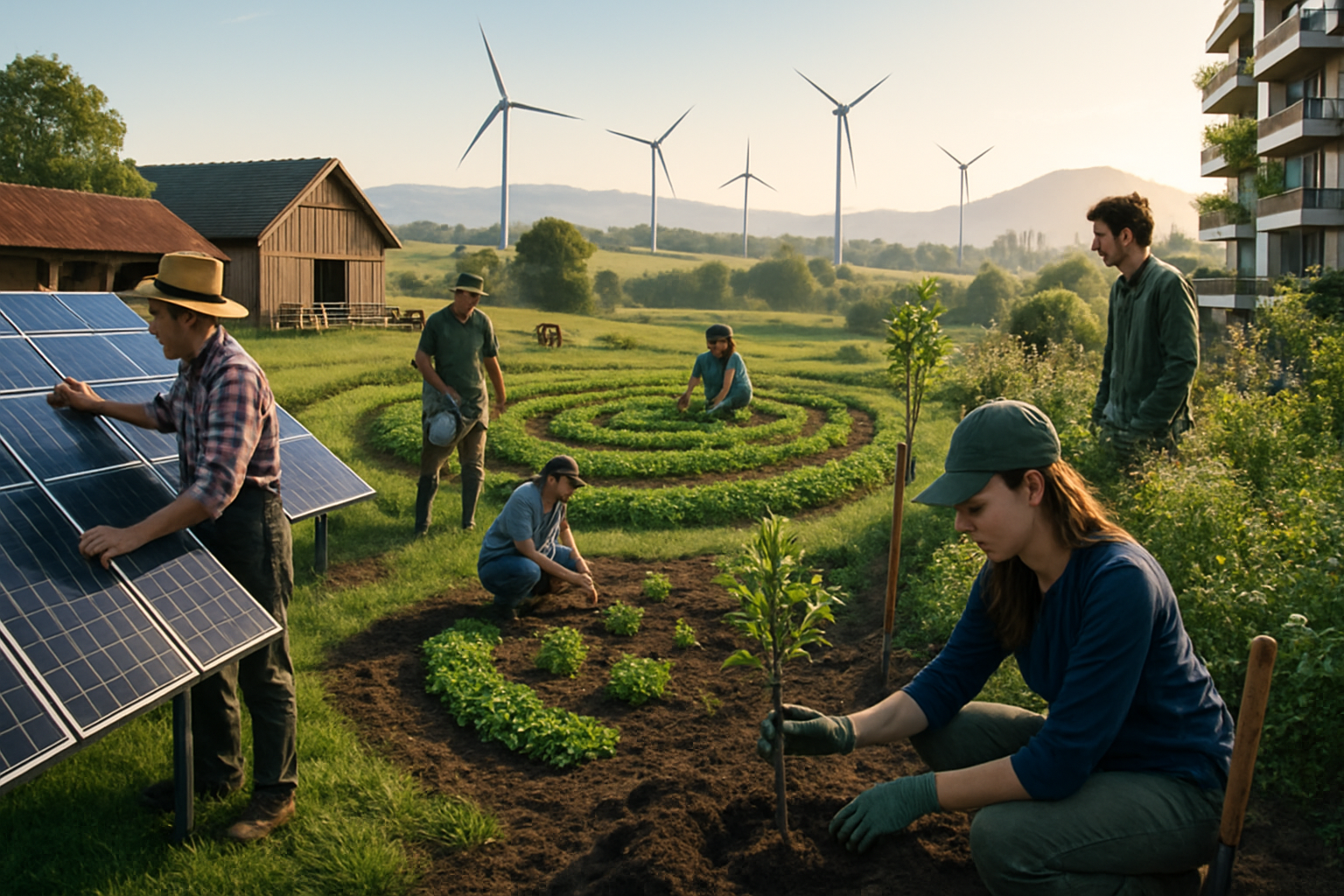
From an Estonian activist's year-long eco-challenge to Portugal's agricultural revolution and France's ambitious urban park transformation, Europe is experiencing an unprecedented surge in environmental initiatives that signal a fundamental shift from reactive crisis management to proactive ecosystem stewardship.
The convergence of grassroots activism, technological innovation, and policy reform across multiple European nations demonstrates how environmental protection is evolving from isolated efforts into coordinated continental action during Earth's most challenging climate period on record.
Estonia's Grassroots Revolution
In Tallinn, environmental activist Elliot Lään—known as "Rohekodanik" (Green Citizen)—has embarked on an ambitious year-long journey of monthly eco-challenges designed to dramatically reduce his carbon footprint. Each month follows a strict green rule, creating a personal laboratory for sustainable living that reflects Estonia's broader environmental leadership.
This individual commitment parallels Estonia's national energy strategy, where EU Auditor Keit Pentus-Rosimannus confirmed that returning to oil shale-based energy production would be "neither practical nor sensible." Instead, Estonia has embraced renewable energy, with electricity costs declining due to strategic wind energy investments that mirror Finland's successful model.
"Finland's investment in wind energy has created cheaper electricity through strategic renewable planning, demonstrating the economic advantages of environmental leadership."
— Keit Pentus-Rosimannus, European Court of Auditors
France's Urban Ecological Transformation
Forty years after François Mitterrand's inauguration of the Parc de La Villette in northeast Paris, the green space is undergoing a revolutionary metamorphosis. The park is being transformed into a living laboratory where animals, plants, and children coexist in an integrated ecosystem that addresses climate change adaptation head-on.
The transformation includes urban farming initiatives, biodiversity restoration programs, and climate adaptation infrastructure that positions the park as a model for urban environmental integration across Europe. This represents a fundamental shift from viewing parks as recreational spaces to recognizing them as essential climate infrastructure.
Portugal's Agricultural Innovation
Portuguese farmers in Évora, Elvas, and Castro Verde have received €1.5 million in funding to pioneer regenerative agricultural practices. These producers, who grow wheat grain used in infant foods, will implement sustainable farming methods through 2027, demonstrating how agricultural transformation can support both food security and environmental goals.
The investment reflects Portugal's broader commitment to sustainable agriculture, combining traditional farming wisdom with cutting-edge environmental science to create resilient food systems capable of withstanding climate pressures while maintaining productivity.
Slovakia's Climate Reality Check
In Slovakia, researchers have documented alarming ecosystem changes as the country's mountains experience significant plant species losses due to warming temperatures. Ecosystems are increasingly dominated by warm-adapted species, providing a stark illustration of how climate change is reshaping European biodiversity in real-time.
This ecological transformation highlights the urgent need for adaptive conservation strategies that can respond to rapidly changing environmental conditions while preserving essential ecosystem services.
United Kingdom's Circular Innovation
British scientists have achieved a remarkable breakthrough in circular economy innovation: transforming human waste into fertilizer for reforestation projects. The Bristol-based startup NPK Recovery has successfully converted waste from 700 Boomtown festival attendees into 540 liters of fertilizer that will support the growth of 4,500 trees at a national park.
This innovative approach to the Brecon Beacons restoration scheme demonstrates how creative resource cycling can address multiple environmental challenges simultaneously—waste management, reforestation, and ecosystem restoration—while creating sustainable funding mechanisms for conservation.
Corporate Environmental Leadership
The private sector's role in environmental transformation is exemplified by major energy partnerships emerging across European boundaries. TotalEnergies and Abu Dhabi's Masdar have agreed to pool their renewable energy assets across nine Asian countries, demonstrating how European energy companies are expanding green technology deployment globally while the Iran conflict increases costs for traditional oil and gas supplies.
This strategic partnership reflects a broader trend of energy companies pivoting toward renewable infrastructure as both an economic opportunity and a climate necessity, particularly as geopolitical tensions highlight the vulnerabilities of fossil fuel dependencies.
Technology Meets Traditional Knowledge
Across all these initiatives, a common thread emerges: the sophisticated integration of cutting-edge technology with traditional ecological knowledge and community-based management. Estonia's activism combines digital monitoring with traditional conservation practices, France's urban transformation leverages environmental science with historical park management, and Portugal's agriculture merges satellite monitoring with generations of farming wisdom.
This synthesis represents a fundamental evolution in environmental protection methodology, moving beyond purely technological or traditional approaches toward comprehensive frameworks that combine scientific rigor with cultural sensitivity and community ownership.
Economic Development Through Environmental Protection
Perhaps most significantly, these European initiatives demonstrate that environmental protection functions as an economic development strategy rather than a regulatory burden. Countries implementing comprehensive environmental protection consistently show greater economic resilience and attract sustainable investment across multiple sectors including eco-tourism, green technology manufacturing, and environmental services.
The economic multiplier effects extend beyond direct environmental sectors through improved public health, enhanced agricultural productivity via ecosystem services, reduced infrastructure costs from natural disaster prevention, and increased international competitiveness through environmental credentials.
Global Context and Urgency
These European environmental initiatives emerge during an unprecedented climate period. Recent months have marked consecutive temperature records exceeding critical 1.5°C thresholds above pre-industrial levels, with sustained warming demonstrating that human-induced climate change has fundamentally altered atmospheric systems beyond natural recovery mechanisms.
The compound environmental effects create additional ecosystem stress that traditional conservation approaches struggle to address: rising sea levels threaten coastal ecosystems, changing precipitation affects forest regeneration, and increased extreme weather frequency disrupts marine food chains and terrestrial habitats.
Looking Forward: The Decisive Decade
The convergence of environmental initiatives across Europe in 2026 represents a critical juncture between reactive crisis management and proactive ecosystem service management. The environmental action window is narrowing rapidly as ecological systems approach critical thresholds that could trigger potentially irreversible changes affecting global food security, climate stability, and human settlements.
However, the tools, knowledge, and cooperation frameworks exist for comprehensive environmental protection, as demonstrated by the diverse initiatives spanning from Estonian activism to Portuguese innovation. Success depends on sustained international cooperation, enhanced multi-sector coordination, and increased financial commitments that recognize environmental protection as essential infrastructure for human prosperity and planetary sustainability.
The European environmental renaissance emerging in 2026 offers both inspiration and practical templates for rapid scaling of environmental protection globally. The integration of cutting-edge technology with traditional ecological wisdom creates adaptable frameworks that respect cultural diversity while leveraging global technological capabilities, providing hope for maintaining planetary habitability during Earth's most challenging environmental period in recorded history.