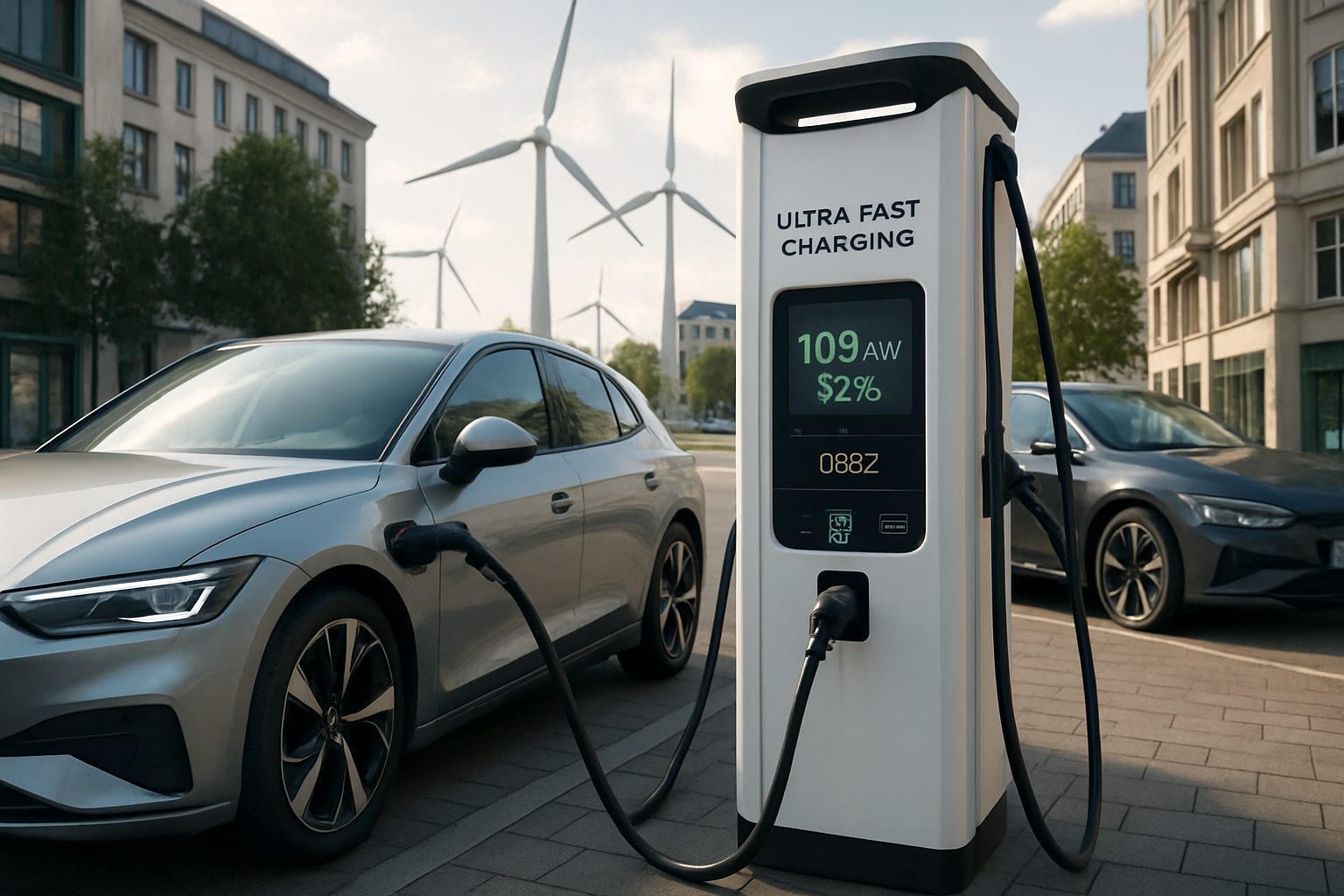
European electric vehicle sales have surged to unprecedented levels while Chinese battery manufacturer CATL unveiled revolutionary battery technology promising an extraordinary 1500-kilometer range on a single charge, potentially eliminating the final barriers to mass EV adoption across the continent.
The convergence of surging consumer demand, breakthrough battery technology, and critical infrastructure expansion is reshaping Europe's automotive landscape at an accelerated pace. German automotive data confirms European markets are experiencing what analysts describe as a "historic tipping point" in transportation economics, driven by both technological advancement and economic necessity.
CATL's Revolutionary Battery Breakthrough
Contemporary Amperex Technology Limited (CATL), the world's largest EV battery manufacturer with over 40% global market share, announced transformative battery technology developments that could triple current electric vehicle range capabilities. The Chinese company's latest innovations build upon their existing Megawatt Flash Charging system, which already delivers 1,360 kW power enabling vehicles to gain 400 kilometers of range in just five minutes.
"This technology addresses the final psychological barriers to mass EV adoption," explains automotive industry analyst Dr. Henrik Müller from the German Automotive Research Institute.
— Dr. Henrik Müller, German Automotive Research Institute
The breakthrough involves advanced lithium iron phosphate chemistry combined with sophisticated thermal management systems that function effectively at temperatures as low as -30°C, addressing northern Europe's climate adoption barriers. The technology leverages hydrofluorocarbon-based electrolytes achieving double the energy density of traditional systems while maintaining Arctic operational efficiency.
European Market Transformation
European electric vehicle adoption has accelerated dramatically, with multiple indicators pointing to fundamental market maturation. Swedish automotive data confirms that used electric vehicles are now "often cheaper than gasoline and diesel cars" for the first time, representing a watershed moment in transportation economics.
This price parity breakthrough comes amid a global energy crisis that has pushed oil prices above $119 per barrel, making electric vehicles an economic necessity rather than merely an environmental choice. European fuel prices approaching €3 per liter have created unprecedented incentives for consumers to consider electric alternatives.
Infrastructure Investment Surge
Supporting this demand surge, European nations have launched massive infrastructure expansion programs. Austria has doubled its charging capacity by adding 1,000 new stations, while Estonia maintains European leadership with 88% renewable electricity and continental Europe's largest battery storage system serving 90,000 households.
New Zealand announced a $50 million investment doubling its public charging network through ChargeNet and Meridian Energy partnerships, deploying 2,574 new charging points nationwide. This investment represents the most significant EV infrastructure expansion in the country's history.
Technology Maturation Exceeds Predictions
Battery longevity studies are revealing that electric vehicle batteries significantly exceed early industry predictions. Tesla Model S vehicles from 2012-2014 with over 200,000 miles show 85-92% battery capacity retention, while Nissan Leaf vehicles from 2011-2013 demonstrate 75-85% capacity retention after a decade of operation.
This data suggests practical EV battery lifespans may extend 15-20 years or 300,000+ miles, far beyond initial manufacturer warranties. These findings are fundamentally reshaping total cost of ownership calculations and supporting the emergence of robust used EV markets.
"The improved battery reliability is transforming our understanding of EV economics. What we're seeing is a technology that's not just environmentally superior, but economically advantageous over its entire lifecycle."
— Sarah Chen, European Battery Research Consortium
Supply Chain Challenges and Strategic Dependencies
Despite technological advances, the industry faces significant supply chain vulnerabilities. China maintains approximately 60% of global critical materials production and 90% of refining capacity for lithium, cobalt, and rare earth elements essential for EV batteries. Memory chip shortages have driven semiconductor prices to six times normal levels, affecting vehicle control systems until 2027.
The US-EU-Japan Critical Minerals Partnership, encompassing 55 countries and seven African suppliers, is coordinating diversification efforts. However, these initiatives require massive infrastructure investment and years of development time, leaving Chinese manufacturers with continued competitive advantages in the near term.
Regional Manufacturing Evolution
European automakers are responding through strategic partnerships and localized production strategies. BMW announced electric 3 Series production beginning August 2026 at its Munich facility, while Toyota plans electric Highlander production at its Princeton facility to compete in the three-row SUV segment against offerings from Kia and Hyundai.
Commercial Vehicle Electrification Accelerates
The transformation extends beyond passenger vehicles to commercial transportation. Tesla announced large-scale Semi truck production milestones after years of development, while fleet operators increasingly prioritize total cost of ownership calculations that favor electric alternatives.
Vehicle-to-grid technology is advancing rapidly, enabling electric vehicles to serve as mobile energy storage systems. This capability allows EVs to charge during off-peak renewable generation periods and discharge electricity during high-demand periods, supporting grid stability while providing additional economic benefits to vehicle owners.
Climate Urgency Drives Policy Acceleration
The automotive transformation occurs against a backdrop of unprecedented climate urgency. January 2026 marked the 18th consecutive month of global temperatures exceeding 1.5°C above pre-industrial levels, demonstrating human-induced climate change that overrides natural variability patterns.
European policymakers are responding with accelerated regulatory frameworks, including the European Parliament's 90% emissions reduction target for 2040. China has implemented a hidden door handle ban effective January 2027, affecting Tesla, BYD, NIO, and XPeng, demonstrating the country's emerging role as a global automotive standards-setter.
Urban-Rural Adoption Patterns
EV adoption patterns reveal persistent urban-rural disparities. Homeowners and rural residents maintain advantages through home charging capabilities, while urban apartment dwellers face infrastructure barriers despite proximity to public charging networks. Workplace charging initiatives are emerging as crucial solutions for urban EV adoption.
Economic and Environmental Convergence
The convergence of technological advancement, environmental urgency, economic incentives, and evolving consumer preferences is creating unprecedented conditions for accelerated transportation transformation. Caribbean markets demonstrate potential EV economics, with owners saving $75 per $100 compared to gasoline despite electricity rate increases.
Success in managing this transition depends on sustained international cooperation, strategic technology and infrastructure investments, and adaptive management responding to rapid market changes during what industry analysts describe as the most significant automotive transformation in modern history.
Strategic Implications for Global Markets
The European experience provides a template for emerging markets navigating similar transitions. The combination of crisis-driven demand, technological readiness, and coordinated policy responses creates conditions for fundamental shifts from fossil fuel dependence to electric mobility.
Industry experts emphasize that the window for effective climate action continues narrowing, but technological innovation, economic incentives, and international cooperation offer genuine transformation opportunities during this decisive climate action decade. The success of European EV market transformation will likely influence global automotive strategies and climate policy approaches worldwide.
"What we're witnessing in Europe represents a fundamental restructuring of personal mobility. This isn't simply about adding electric options to existing markets – it's about reimagining transportation systems for the 21st century."
— Prof. Maria Santos, Institute for Sustainable Transportation Policy
The automotive industry now faces unprecedented coordination requirements across energy systems, infrastructure development, materials supply chains, and regulatory frameworks. The success of this transformation will determine not only the industry's sustainability trajectory but also its role in addressing planetary climate stability during Earth's most environmentally challenging recorded period.