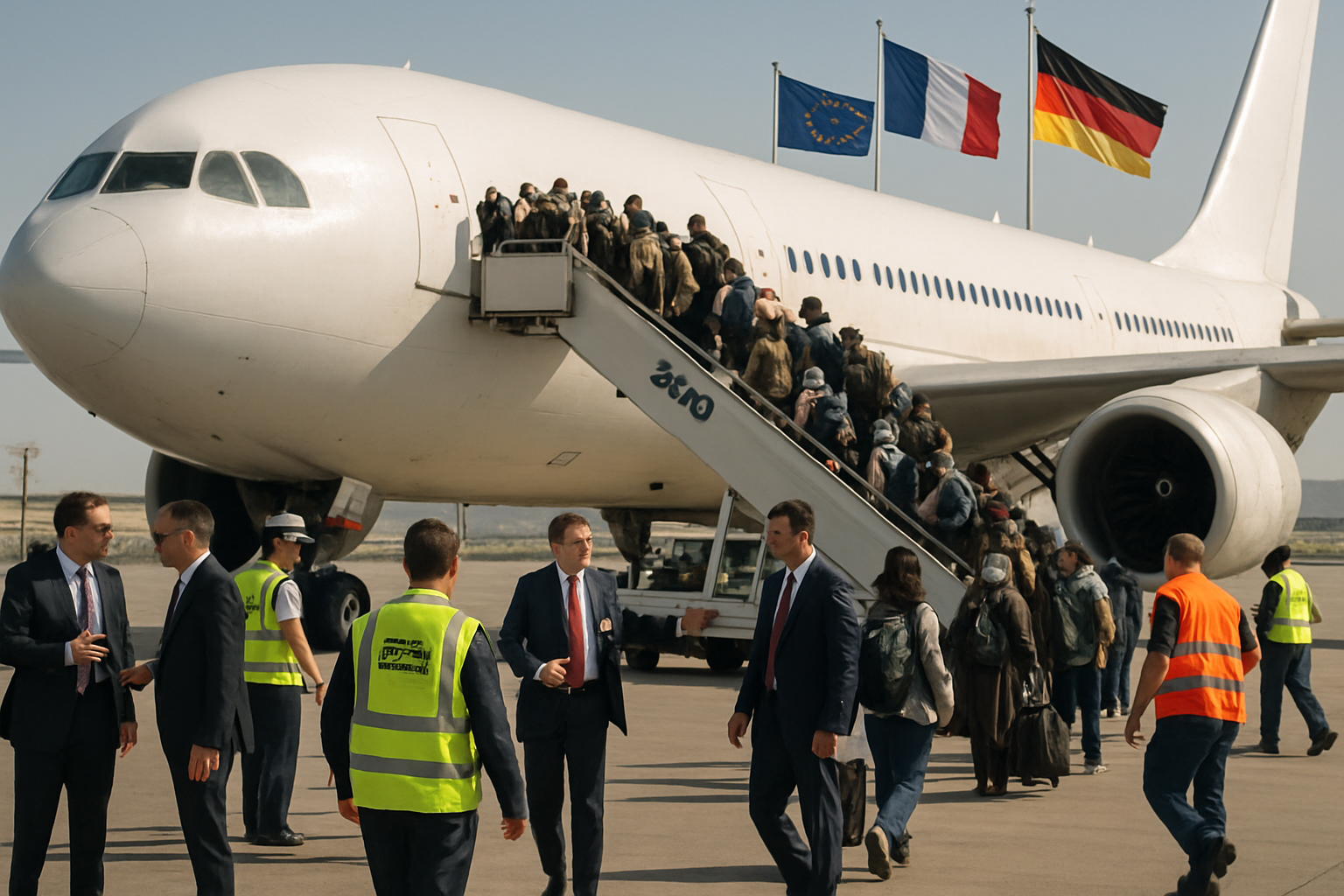
European nations have launched the largest coordinated evacuation operation since the Arab Spring of 2011, organizing charter flights and emergency protocols to extract over 200,000 citizens from Middle Eastern countries as the Iran conflict reaches unprecedented levels of escalation.
The massive evacuation effort comes as multiple European countries simultaneously activated emergency protocols following Iran's Supreme Leader Ali Khamenei's confirmed death on March 1, 2026, and subsequent Iranian retaliation strikes across the Gulf region during what has become the most dangerous international crisis since the Cold War ended.
Unprecedented Scale of Evacuations
According to diplomatic sources, European nations are coordinating evacuations affecting hundreds of thousands of citizens across more than 15 Middle Eastern countries. The scale rivals only the 2011 Arab Spring evacuations, with multiple governments activating contingency plans that had never been implemented at such magnitude.
Key evacuation numbers include:
- Germany: 30,000 tourists and residents stranded across the region
- France: Multiple charter flights bringing nationals home from Oman and UAE
- Netherlands: Over 1,000 citizens requiring assistance, with KLM operating special evacuation flights
- Estonia: 3,000 nationals advised to contact authorities immediately
- Sweden: Emergency evacuation orders issued for Iran, citing "extremely uncertain" security conditions
- Slovakia: Completed repatriation flights from Jordan with additional operations planned from Oman
- Bulgaria: Three specialized flights organized by airlines "Gulliver" and "Bulgaria Air" from Dubai, Abu Dhabi, and Oman
Cyprus Activates Historic ESTIA Plan
For the first time in its history, Cyprus activated its national "ESTIA" evacuation plan for European and third-country nationals. Foreign Minister Constantinos Kombos announced the activation during an emergency EU Foreign Affairs Council session, coordinating with British authorities for the evacuation of over 2,000 registered nationals from the UAE.
"This represents an unprecedented mobilization of European crisis response capabilities," said Kombos. "We are working around the clock to ensure the safety of all European citizens in the region."
The ESTIA activation marks a watershed moment for European Union crisis management, demonstrating coordinated response capabilities during the continent's most serious security challenge in decades.
Aviation Crisis Compounds Evacuation Challenges
The evacuation operations face unprecedented logistical challenges as eight Middle Eastern countries—Iran, Iraq, Israel, UAE, Qatar, Syria, Kuwait, and Bahrain—have simultaneously closed their airspace to civilian traffic. Over 18,000 flights have been cancelled worldwide, creating the most extensive aviation disruption since the COVID-19 pandemic.
Dubai International Airport, the world's busiest with over 86 million passengers annually, remains completely shut down after sustaining missile damage during Iranian retaliatory strikes. This closure has severed critical Europe-Asia flight connections, forcing complex rerouting for evacuation aircraft.
Major European carriers including Air France-KLM, Wizz Air, and Bulgaria Air have suspended all Middle Eastern operations, affecting hundreds of thousands of passengers globally. Airlines are implementing emergency protocols with enhanced fuel loading and alternative routing strategies to navigate multiple closed airspaces.
Energy Crisis Parallels Evacuation Efforts
The evacuation crisis unfolds alongside a severe global energy security threat. Iran has effectively closed the Strait of Hormuz, through which 40% of global seaborne oil transit passes, declaring the waterway "unsafe" for commercial shipping. Oil prices have surged 10% to over $80 per barrel, while natural gas prices have increased 24% in Europe and 78% in the United States.
Major shipping companies Maersk and MSC have suspended operations in the Persian Gulf, with over 150 oil and LNG tankers currently anchored, representing billions of dollars in stranded cargo. This energy crisis adds urgency to evacuation efforts as European economies face potential supply disruptions.
Diplomatic Breakdown Context
The current crisis stems from the complete collapse of U.S.-Iran nuclear diplomacy despite what had been the most promising breakthrough since the 2018 JCPOA collapse. Geneva talks had achieved "broad agreement on guiding principles," but fundamental disagreements over scope proved insurmountable. Iran excluded ballistic missiles and regional proxies as "red lines," while the U.S. demanded comprehensive agreements covering missiles, armed groups, and human rights.
This diplomatic breakdown led to "Operation Epic Fury," the largest coordinated U.S.-Israeli military operation since the 2003 Iraq invasion, using a dual-carrier deployment representing approximately one-third of the active U.S. Navy fleet positioned 800 kilometers from Iran's coast.
Regional Coalition Under Severe Strain
The unprecedented Saudi Arabia, UAE, Qatar, and Egypt consensus that had backed the diplomatic process is now severely threatened as Iranian retaliation "Operation True Promise 4" has directly targeted member territories. Egyptian President Sisi condemned attacks on "sisterly Arab countries," warning of "comprehensive chaos."
Casualties across Gulf states have included one civilian killed in Abu Dhabi from missile debris, 32 foreign nationals injured in drone strikes on Kuwait Airport, and eight people injured by fragments in Qatar despite successful Patriot missile interceptions of 65 missiles and 12 drones.
First-Time Emergency Protocols
Several European nations are implementing emergency evacuation protocols for the first time in their modern history. Sweden and Serbia issued immediate evacuation orders for citizens to leave Iran, citing "extremely uncertain" security conditions. Multiple European governments have issued comprehensive travel warnings covering the entire Middle East region.
"When the airspace reopens, we don't want any Swedish citizen to be stuck longer than necessary,"
— Svante Liljegren, Head of Swedish Foreign Ministry's Consular Unit
The Swedish government has deployed a specialized emergency team to Riyadh, Saudi Arabia's capital, to help coordinate evacuation efforts and provide on-ground assistance to stranded nationals.
Nuclear Governance Crisis Context
The evacuation crisis occurs against the backdrop of broader nuclear governance breakdown. The New START treaty expired on February 5, marking the first time in over 50 years without U.S.-Russia nuclear constraints. Combined with China's nuclear expansion and what UN Secretary-General António Guterres calls nuclear risks at their "highest level in decades," this crisis represents a template-setting moment for 21st-century diplomacy versus military confrontation.
International Coordination Challenges
The massive scale of simultaneous evacuations has revealed both strengths and limitations in international coordination frameworks. While individual nations have demonstrated rapid response capabilities, the crisis has exposed varying levels of preparedness and the lack of unified coordination mechanisms for mass crisis response affecting civilian populations worldwide.
European Union leaders, including Commission President Ursula von der Leyen and Council President António Costa, have issued joint statements demanding "maximum restraint" from all parties while coordinating evacuation efforts across member states.
Recovery Timeline Uncertain
Unlike natural disasters or weather disruptions with predictable recovery timelines, the current crisis depends entirely on military operations resolution and diplomatic tensions normalization. Aviation industry executives report conducting daily operational reviews but cannot make long-term scheduling decisions given the unprecedented geopolitical volatility.
Even when flights resume, clearing the backlog of stranded passengers and cancelled flights could take weeks. The aviation industry faces fundamental questions about route planning, risk assessment, and enhanced contingency planning for navigating geopolitical volatility in strategic regions.
Historical Significance
March 2026 marks a watershed moment for European crisis management capabilities and international aviation industry adaptation to geopolitical risks. The success or failure of these evacuation efforts could provide a framework for future European responses to global security crises while testing the continent's capacity for unified foreign policy action during the most dangerous international crisis since the Cold War ended.
The template-setting implications extend beyond immediate evacuation success, affecting international approaches to conflict resolution, nuclear governance, energy security architecture, and diplomatic versus military solutions precedent for the 21st century.
As the crisis continues to unfold, European nations face their greatest test of multilateral cooperation and crisis management in the modern era, with decisions made in the coming days and weeks likely to reverberate through international relations for decades to come.