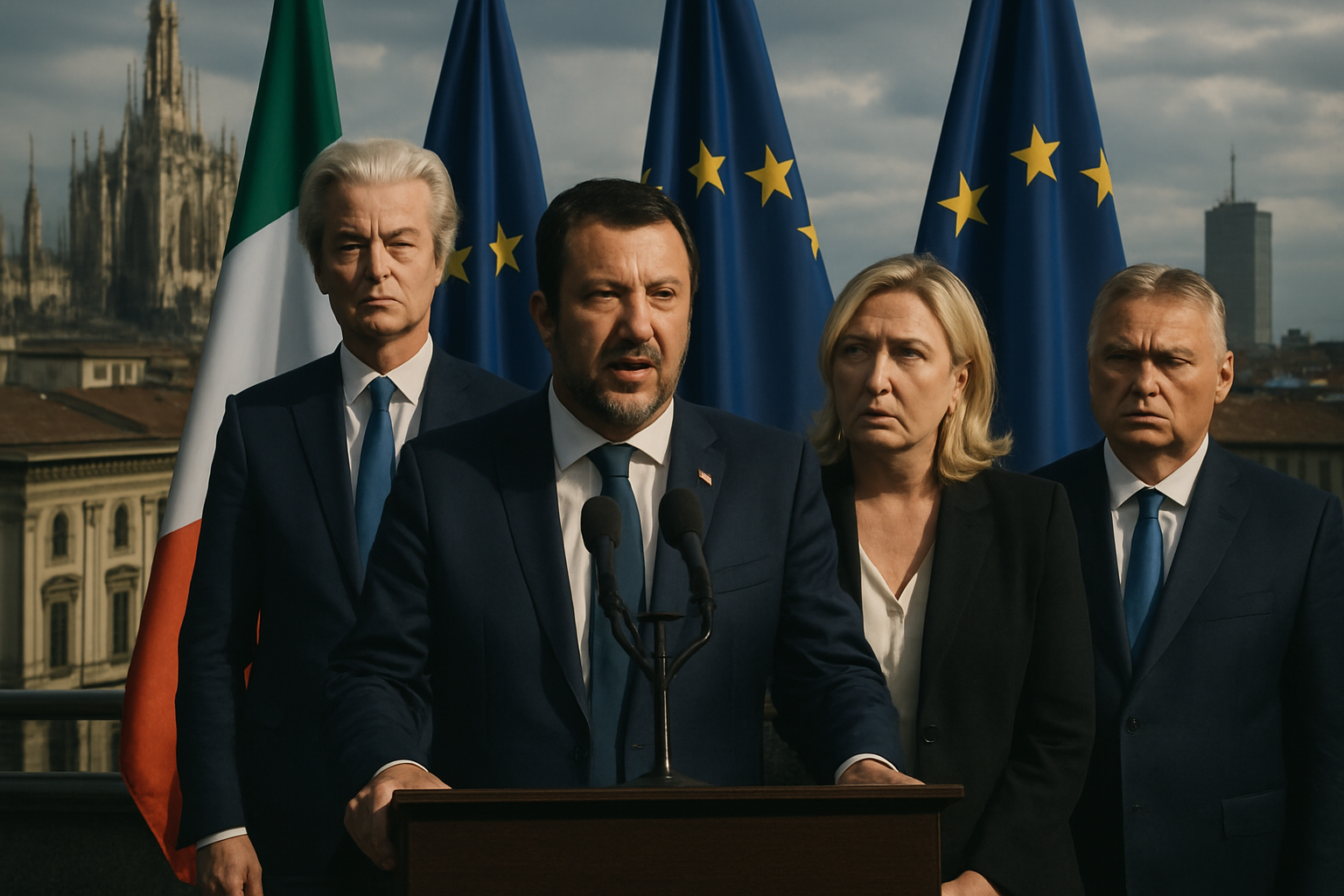
European far-right leaders convened in Milan on Saturday for their first major rally since Viktor Orbán's devastating electoral defeat in Hungary last weekend, seeking to regroup after losing one of their most successful political models while facing mounting opposition across the continent.
The gathering, dubbed "Fearless: Masters of Our Destiny in Europe," was organized by Matteo Salvini, Italy's Deputy Prime Minister and League leader, conspicuously without the presence of the defeated Hungarian strongman who had served as a template for authoritarian populism across Europe.
The Orbán Template Collapses
Viktor Orbán's stunning defeat on April 12, 2026, sent shockwaves through Europe's far-right movements. Péter Magyar's Tisza Party achieved an unprecedented constitutional supermajority with 141 seats out of 199 in the Hungarian Parliament, ending Orbán's 16-year authoritarian rule with a record 80% voter turnout—the highest since 1989's democratic transition.
The defeat was particularly striking among "Generation Orbán"—voters aged 18-30 who came of age under his rule. Despite growing up under nationalist messaging, over 70% supported Magyar's pro-European vision, demonstrating the failure of authoritarian indoctrination among youth. Digital resistance platforms like Márton Gulyás's "Partizán" proved crucial in breaking Orbán's information monopoly, reaching younger demographics despite extensive traditional media control.
"This is the Russian playbook in its most cynical form," wrote Magyar on social media, as allegations of electoral fraud emerged from defeated Fidesz supporters.
— Péter Magyar, Hungarian Prime Minister-elect
The Hungarian transformation was immediate and comprehensive. Hungary's €90 billion Ukraine aid blockade was lifted immediately, ending the deepest EU institutional crisis in history. The frozen €19 billion in EU funding is expected to be restored within days, while Magyar announced that constitutional reforms would begin immediately, including judicial independence restoration and media oligarchy dismantling.
Milan Rally: Regrouping Without Their Champion
Against this backdrop, European far-right figures gathered in northern Italy to build momentum for upcoming elections in several EU countries, including France. The rally focused heavily on anti-immigration rhetoric, with speakers denouncing what they called a migration "tsunami" and Brussels bureaucracy.
The absence of Orbán—who had been a keynote speaker at previous such gatherings—was palpable. For over a decade, his Hungary had provided a successful governmental model for far-right movements, demonstrating how democratic institutions could be systematically undermined while maintaining electoral legitimacy.
The timing proved particularly challenging as Spanish Prime Minister Pedro Sánchez simultaneously hosted left-wing leaders at rallies in Barcelona, promoting democracy and progressive unity. Sánchez, a vocal critic of both Donald Trump and the far-right surge, declared that far-right influence was waning—a claim that the parallel Milan gathering seemed to contradict even as it struggled with the loss of its most successful example.
Foreign Interference Backfires Spectacularly
One of the most significant aspects of Orbán's defeat was the complete failure of unprecedented foreign interference. For the first time in EU electoral history, documented evidence emerged of dual foreign intervention: Russian operatives supporting Fidesz (revealed by investigative journalist Szabolcs Panyi) combined with explicit Trump administration backing through JD Vance's Budapest visit just days before the election.
Vance had condemned EU "shameless interference" while declaring Orbán a "model for Europe," but this external support ultimately backfired spectacularly. Hungarian voters decisively rejected what they perceived as foreign manipulation of their democracy, providing a template for how democratic societies can resist external electoral interference.
The Broader European Context
The Milan rally took place amid what observers describe as the most challenging period for European democracy since World War II. Recent polling shows that 89% of Europeans demand greater EU unity, yet political reality demonstrates increasing fragmentation across member states.
Sweden has witnessed historic political realignment, with the Liberal Party abandoning decades of opposition to cooperate with the Sweden Democrats, a party with white nationalist roots. This represents the most significant Nordic political shift since Social Democratic establishment and breaks the last barrier preventing far-right formal government participation in Scandinavia.
In Germany, the Alternative for Deutschland (AfD) nearly doubled its support to 18% in Baden-Württemberg, becoming the third-largest party in this traditionally stable southwestern state. The breakthrough demonstrates sophisticated far-right expansion beyond eastern strongholds into areas previously considered immune to extremist appeals.
Spain continues to grapple with Vox's enhanced position in regional coalitions, while France's National Rally achieved historic urban breakthroughs in recent municipal elections, evolving from rural populism to sophisticated metropolitan campaigning—what experts term "authoritarian innovation."
Democratic Resilience Emerges
Despite these challenges, the Hungarian example has provided hope for democratic movements across Europe. Magyar's victory demonstrated that authoritarian drift can be reversed democratically through united opposition, credible leadership, and clear alternatives. The peaceful power transfer, with Orbán conceding defeat and promising a smooth transition, maintained constitutional continuity while enabling comprehensive reform.
The digital resistance that helped break Orbán's information monopoly offers a template for democratic movements worldwide facing similar challenges. Young Hungarians compared Orbán's defeat to the fall of communism in 1989, representing a generational rejection of authoritarianism that transcends national boundaries.
Geopolitical Implications
The loss of Hungary as a reliable ally represents a significant blow to Vladimir Putin's European strategy. For years, Orbán had served as Moscow's most dependable voice within EU institutions, blocking sanctions, maintaining economic relationships despite international pressure, and providing legitimacy for Russian positions.
European integration has accelerated with the removal of its most persistent internal critic. Enhanced cooperation discussions, which had gained momentum as a way to bypass Hungary's vetoes, are now unnecessary. The EU's global voice has been strengthened by the restoration of Hungarian alignment with mainstream European positions.
The Path Forward
As far-right leaders gathered in Milan, they faced the uncomfortable reality that their most successful governmental model had collapsed. The Hungarian template had shown how to systematically undermine democratic institutions while maintaining electoral legitimacy—a strategy that other movements across Europe had sought to replicate.
The challenge now is whether European far-right movements can adapt to this new reality or whether Orbán's defeat signals a broader turning point in European politics. With upcoming elections in France and other key member states, the stakes could not be higher.
For democratic forces, the Hungarian example provides both inspiration and a roadmap. Record participation, digital resistance, and unified opposition proved capable of defeating even well-entrenched authoritarian systems. As one senior EU official noted, Europe is "writing the template for 21st-century crisis management, with the world watching whether democratic institutions can adapt while preserving European values."
The Milan rally may have proceeded without Viktor Orbán, but his absence spoke louder than any speech could have. The age of authoritarian populism in Europe may not be over, but the Hungarian people have demonstrated that it is not inevitable.